
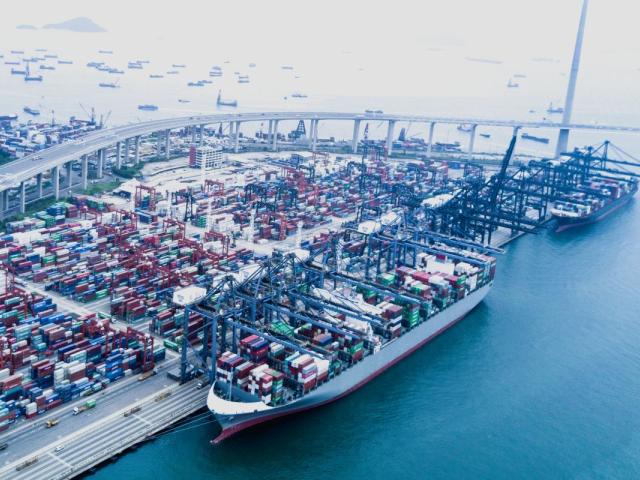
2026 marks the 29th anniversary of Hong Kong's return to the motherland, and more than seven years have passed since the release of the Outline Development Plan for the Guangdong-Hong Kong-Macao Greater Bay Area. Against the backdrop of the rapid rise of inland river ports such as Shenzhen Port and Guangzhou Port, Hong Kong's logistics industry has not been marginalized. Instead, it has found new room for growth through role transformation and upgrading. This article provides an in-depth analysis of the development status and future opportunities of Hong Kong's logistics hub from three dimensions: trade data, policy frameworks, and business models.
1. Data Perspective: The Fundamentals of Hong Kong's Logistics
In 2025, the Port of Hong Kong handled approximately 16.8 million TEU of container throughput, ranking eighth globally. Although the gap with Shenzhen Port (33.5 million TEU) and Guangzhou Port (26.8 million TEU) is widening, Hong Kong's Kwai Tsing Container Terminals still maintain unique advantages in the following dimensions:
- International route network: Approximately 270 international ocean liner calls per week, covering more than 460 ports worldwide, with the highest route density in South China
- Free port status: Except for a few categories such as tobacco and alcohol, import and export goods are exempt from customs duties, and customs clearance efficiency remains within 2 hours
- Financial services: The world's third-largest financial center, with mature trade finance, letters of credit, and foreign exchange settlement services
- Legal system: The common law system is aligned with international business rules, with well-established arbitration and dispute resolution mechanisms
2. Role Upgrading: From "Gateway" to "Hub Node"
The deepening construction of the Guangdong-Hong Kong-Macao Greater Bay Area is reshaping Hong Kong's position in the regional logistics network.
(1) Mature sea-air intermodal transport model
In 2025, the "Shekou, Shenzhen—Hong Kong Airport" sea-air intermodal corridor handled over 250,000 tonnes of cargo, a year-on-year increase of 18%. After arriving by sea at Shenzhen Port, goods are transferred by barge or road to Hong Kong Airport for air export, combining the scale cost of sea freight with the timeliness advantage of air freight. It is particularly suitable for categories such as electronics, pharmaceuticals and health products, and luxury goods, which have high time sensitivity and high value.
(2) Strong growth in cross-border cold chain logistics
Consumption upgrade in the Greater Bay Area has driven cross-border cold chain demand for high-end food, pharmaceuticals, and biological products. Hong Kong has over 300,000 cubic meters of cold storage facilities and a mature cold chain logistics network, making it an important transit node for mainland high-quality food exports to Southeast Asia, Europe, and the United States. In 2025, Hong Kong Port handled approximately 1.2 million tonnes of cold chain cargo, a year-on-year increase of 12%.
(3) Hong Kong consolidation model for cross-border e-commerce
More and more mainland cross-border e-commerce sellers are setting up consolidation warehouses in Hong Kong, leveraging Hong Kong's free port policy and multimodal transport advantages to ship goods from mainland factories to Hong Kong for consolidation and then distribute globally. Cainiao Network's eHub at Hong Kong International Airport was fully operational in 2025, with an annual processing capacity of 1 million tonnes.
III. Latest Progress in Guangdong-Hong Kong Customs Clearance Facilitation
Since 2026, Guangdong and Hong Kong have continued to roll out measures to facilitate customs clearance:
- Since the 24-hour cargo clearance at Shenzhen Bay Port was implemented at the end of 2025, the average clearance time for cross-border trucks has been reduced by about 40%.
- The "co-location" clearance model has been extended to more ports, with customs authorities of Guangdong and Hong Kong sharing inspection premises to avoid repeated unpacking.
- The electronic lock + GPS in-transit monitoring system now covers more than 70% of China-Hong Kong transport vehicles, significantly reducing port inspection rates.
4. Bofeng Logistics Hong Kong Dedicated Line Service System
Bofeng Logistics has been deeply engaged in the Hong Kong logistics dedicated line for more than 8 years and has built a transport network covering major cities in the Pearl River Delta to Hong Kong:
- Daily scheduled China-Hong Kong trailer services (Shenzhen/Guangzhou/Dongguan/Foshan ↔ Hong Kong), covering general trade and cross-border e-commerce goods.
- Self-owned warehousing facilities in Yuen Long and Kwai Chung, Hong Kong, with a storage area of 10,000 square feet, providing value-added services such as container stripping, sorting, and labeling.
- Long-term cooperation with multiple shipping companies and local Hong Kong logistics providers, allowing flexible deployment of capacity to handle peak-season warehouse overflow.
Welcome to obtain real-time quotes for the Hong Kong dedicated line through our online quotation system.