
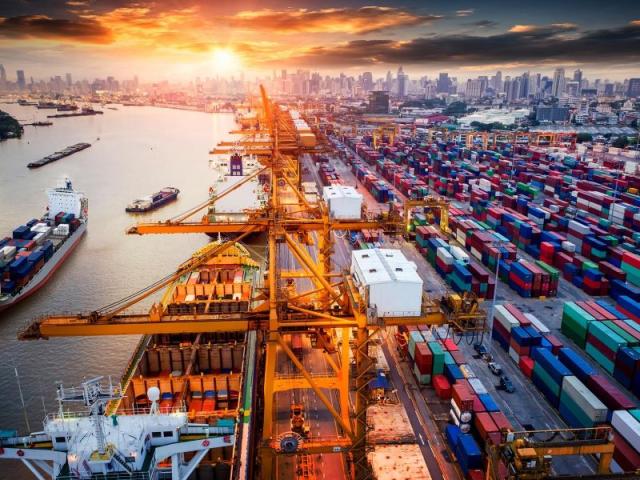
China's economy has achieved remarkable growth over the past few decades, significantly driving the development of the global shipping market. The Chinese economy is currently undergoing a transition, and the changes it triggers have a profound impact on the strategic decisions of the shipping market, shipowners, ship finance banks and leasing companies, and shipping industry investors. By sharing insights into the changes in China's shipping market over the past year and their effects, the Marsoft team aims to help the industry look ahead to the future.
Rebound in the Shipping Sector
Over the past year, the dry bulk market has experienced a renewed lease on life, while the container ship market has rebounded since the Hanjin Shipping bankruptcy crisis. This recent strong market performance stems from the rapid growth in Chinese import demand in the first half of 2017. We have analyzed the trade volume growth of the five major shipping sectors over the past two years to illustrate the scale and scope of the market recovery (see table below). From the first half of 2016 to the first half of 2017, China's import growth rate in the dry bulk, LNG, and container markets doubled compared to the same period two years earlier, while the growth rate in the crude oil and refined oil markets also maintained a considerable double-digit pace.
China's 2030 Development Roadmap
The World Bank and the Development Research Center of China's State Council released a reference report titled "China 2030" in 2012 on China's economic development path, forecasting China's gradual transition from an infrastructure and investment-focused economy to a consumption-focused one. We have felt the smooth progress of this transition over the past few years, and China's structural reform process has also undergone adjustments alongside the changing global economic landscape.
The World Bank and State Council report highlights the impact of China's drastic economic transformation on the economic growth model, predicting that the services sector and consumption will far surpass infrastructure and manufacturing as the main drivers of economic growth. In Figure 1, we have applied the report's forecast for China's economic growth rate through 2030, incorporating the expectation of a diminishing contribution of infrastructure and manufacturing to China's economic growth, resulting in corresponding service sector growth rate projections.
Steadfastly Promoting Green Development
The rapid development of China's economy poses corresponding challenges to environmental protection. In recent years, various regions and departments across China have been steadfastly implementing the new development concept and making solid progress in environmental protection. China's policies on air pollution prevention and control have also had a direct impact on the shipping industry. To promote green shipping development and energy saving and emission reduction in ships, thereby reducing emissions of air pollutants from ships in key areas, the Ministry of Transport released the "Implementation Plan for Ship Emission Control Areas in the Pearl River Delta, Yangtze River Delta, and Bohai Rim (Beijing-Tianjin-Hebei) Waters" in the first half of 2016. The plan requires that, starting from 2019, ships in emission control areas use fuel with a sulfur content of ≤ 0.5% m/m, and by the end of 2019, an assessment will be conducted to determine whether ships should be required to use fuel with a sulfur content of ≤ 0.1% m/m. After the implementation of this plan, it is expected that sulfur dioxide and particulate matter emissions in the emission control areas in 2020 will decrease by 65% and 30% respectively compared to 2015.
In 2016, President Xi Jinping pointed out that the people should genuinely feel the tangible environmental benefits brought about by economic development. Achieving the goal of bluer skies, greener mountains, and cleaner air across China will not be easy and will come with corresponding economic costs. The shipping industry will play a significant role in reducing environmental pollution, and we believe it can achieve pollution prevention and control goals at a lower cost.
Middle-Class Consumption Driving Trade Growth
According to estimates by the Brookings Institution, a U.S. think tank, urbanization and economic growth will add 350 million people to China's middle class between 2015 and 2022, with middle-class consumer spending increasing by over 2.1 trillion RMB during the same period. Figure 2 shows projections for middle-class population and consumer spending growth in China, other parts of Asia, and the rest of the world.
The purchasing power of the emerging middle class will become a major driver of global economic growth. We expect that China's "Belt and Road" initiative will boost economic growth and middle-class consumption in neighboring countries. For instance, demand for commodities in countries like Pakistan will steadily rise, importing more oil and gas to power urban lighting, and more iron ore for construction materials in housing and transportation networks, providing new growth momentum for the tanker, LNG carrier, and bulk carrier markets. China will also increasingly import finished goods: agricultural products from the U.S., medical devices from Europe, and clothing and electronics from neighboring Asian countries, which will appear more frequently in the lives of China's middle class and drive growth in China's container import trade.
New Growth Points in Economic Transformation
China's economic shift toward a slower-growth, energy-efficient development path will have profound impacts on the demand side of the shipping industry. Sectors such as steel face overcapacity and peaking demand, meaning further growth in the global bulk carrier market will increasingly rely on bright spots outside China. In the energy sector, growth in natural gas, LPG, and renewable energy will come at the expense of declining coal consumption. In the container ship market, the focus will gradually shift from Chinese exports to Chinese imports.
Surge in Natural Gas Imports
Natural gas imported via maritime routes and pipelines has played a key role in China's efforts to increase power generation while reducing pollution emissions. The share of natural gas in China's total power generation will reach 10% by 2020 and double its current share to 15% by 2030. LNG re-liquefaction capacity is expected to double from current levels by 2025. We project that from 2016 to 2021, China's natural gas imports will maintain an annual growth rate of 20%.
Cheap LNG from the U.S. Gulf region will be the largest source of growth in China's import demand. In 2016, China imported less than 250,000 tons of natural gas from the U.S., but by 2021, exports from the U.S. Gulf region via the Panama Canal to China are expected to exceed 19 million tons. The U.S.-to-China shipping route will become one of the highest-volume natural gas trade routes, rivaling exports from Australia to Japan and China.
LPG Imports Will Continue to Grow
Driven by a significant increase in demand for LPG as a raw material for plastics, China's LPG imports have seen substantial growth in recent years. The commissioning of key projects such as Hebei Haiwei Petrochemical in 2017 marked the end of China's large-scale investment in chemical raw material projects and the high-growth phase of LPG imports (e.g., up to 60% growth from 2015 to 2016). Residential and commercial demand for LPG will become a more important driver in the future market, helping China further advance its coal-to-gas transition and pollution control efforts. We forecast China's LPG import demand to grow at an annual rate of approximately 6% over the next five years.
Crude Oil and Refined Product Import Growth Slows
China's oil consumption has grown relatively slowly recently (at about half the rate of GDP growth). Taking into account improvements in energy efficiency, particularly advancements in energy-saving technologies in the automotive sector, we have lowered our expectations for China's oil consumption growth. Meanwhile, China's domestic oil production will gradually decline—the goal of significantly boosting domestic oil output through shale gas technology could be described as "successful, but still requiring time." Considering both supply and demand factors, we expect China's oil import growth to slightly exceed consumption growth.
China's oil reserves will be a key factor influencing the market. According to the International Energy Agency, the second phase of China's three-phase strategic petroleum reserve construction plan was completed in early 2017. The scale of the third phase remains uncertain but may exceed the total of the first two phases. Strategic petroleum reserve growth accounted for about half of China's oil import growth from 2016 to 2017, highlighting its importance to the tanker market.
The gap between China's oil consumption growth and domestic oil production decline is the best indicator for forecasting import demand. By this measure, we estimate China's oil import growth rate at approximately 4% per year over the next five years. However, if progress on the third phase of China's strategic petroleum reserve accelerates, our short-term forecast for China's oil import growth could double.
Dry Bulk Market Growth Prospects Level Off
Iron ore, coke, and thermal coal account for about 75% of China's dry bulk imports, with the growth of these three bulk commodities expected to flatten or turn negative. This trend is directly influenced by policies such as China's reduction of overcapacity, elimination of obsolete capacity, implementation of clean production technology upgrades, and optimization of the energy structure. We anticipate that over the next five years, China's steel output will peak (with electric arc furnace steelmaking using recycled scrap accounting for a larger share of total steel production), and coal's share of total energy consumption will decline in line with national plans. Based on these fundamentals, after experiencing 13% annual growth in dry bulk imports since 2000, we expect China's dry bulk imports to grow at just 1% per year over the next five years.
This low growth expectation stands in stark contrast to the 9% year-on-year growth in the dry bulk market so far in 2017, raising a question worth exploring: Are our analyses flawed regarding China’s fundamental economic transformation and changes in its energy structure, or are there other special reasons for the unusual market changes in recent times? Our analysis suggests that special reasons—particularly the substantial growth in China’s iron ore inventory in the first half of 2017—can provide a primary explanation for the recent above-expectation growth. As the growth in China’s iron ore inventory slows, or even turns negative in the second half of the year, the robust trade growth in the dry bulk market could disappear.
Container trade growth rate to surpass GDP growth rate
Between 1995 and 2015, China’s container trade import volume grew at an annual rate of 12%, which was 1.2 times the annual GDP growth rate during the same period. However, in the past two years, despite China’s economy still growing relatively strongly, the annual increase in container trade imports was only 4%, with a multiplier of 0.6 compared to the annual GDP growth rate.
Since 2017, China’s container trade imports have shown a rebound. Marsoft’s analysis indicates that as China’s economy becomes more driven by consumption, the growth momentum of container trade will outpace the GDP growth rate. China’s container export trade is currently the main driver of the liner market, but the key factor supporting future container market demand will shift to China’s container import trade. We believe this shift is crucial for the strategic decisions of liner companies and container ship owners. In the near future, the number of container ships carrying high-end consumer goods from Europe and the United States to China may far exceed those carrying toys and flat-screen TVs from China to Europe and the United States.
Economies of scale enhance corporate profitability
The Chinese government has continuously introduced policies in recent years to support the restructuring and integration of industries in the "old economy," while helping companies in the "new economy" sectors enter global market competition. COSCO Shipping is a model enterprise in implementing the national strategy of supporting the integration of central state-owned enterprises. It completed its integration in 2016, solidifying its world-leading position in the three major ship-type transport sectors. Our market analysis shows that the LNG and LPG markets will be highlights driving future growth in the shipping industry, and COSCO Shipping still has significant growth potential in these two markets.
According to COSCO Shipping Energy’s 2016 annual report, as of the end of 2016, the subsidiary had 25 LNG vessels under construction, with all newbuilds expected to be delivered by the end of 2020. COSCO Shipping is achieving organic growth in the LNG vessel market through newbuilding projects. In the LPG market, mergers and acquisitions may provide the company with a more cost-effective growth plan.
Shipping industry addresses global emissions reduction
According to data from the International Energy Agency, air pollution claims 6.5 million lives worldwide each year. The shipping industry accounts for 13% of global sulfur oxide emissions and 15% of nitrogen oxide emissions. As the shipping industry implements stricter sulfur oxide and nitrogen oxide emission standards, the safety of people’s lives around the world will be better safeguarded.
How will the shipping industry contribute to the green development of China's economy? To meet the pollution prevention targets set by the International Maritime Organization, Chinese shipping companies must choose between installing exhaust gas cleaning systems on vessels and using ultra-low sulfur fuel oil. Which of these two options offers greater cost advantages? Marsoft's analysis shows that for a vessel consuming 50 tons of fuel per day, the investment in an exhaust gas cleaning system can be recovered within two years, and it can achieve fuel cost savings of $4.7 million over five years. Our view aligns with the International Energy Agency's conclusion: the investment required to install exhaust gas cleaning systems on ships is more cost-effective than upgrading refineries to expand ultra-low sulfur fuel production capacity.
In recent years, the Chinese government has shifted its development focus from growth speed to growth quality. The upcoming 19th National Congress of the Communist Party of China will set the blueprint for China's development in the coming years and will also reshape the trajectory of global development over the next few years. We expect that the development philosophy centered on growth quality will receive further support and consolidation at the congress. Only by fully adapting to China's new growth strategy and proactively addressing the new risks and challenges posed by the Chinese market can shipowners, ship financing banks, and investors in the maritime industry seize the historical opportunity of China's gradual rise to a high-income country and become winners in economic, industry, and corporate development. China Ocean Shipping Monthly, Issue 8, 2017
Bofeng Logistics specializes in one-stop logistics services including domestic container shipping, international shipping (FCL/LCL), Hong Kong and Macao logistics routes, as well as trucking, customs clearance, and warehousing. Contact number: 130-7567-8958 (Manager Huang). Call now for a customized quote!