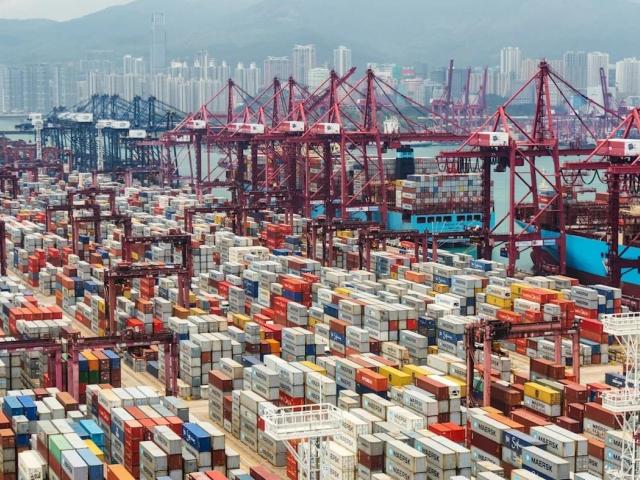
1. Hong Kong Port – the world’s 7th largest container port
In 2025, the container throughput of Hong Kong’s Kwai Tsing Container Terminals was approximately 12.9 million TEUs (Hong Kong Maritime and Port Board, 2025), ranking 7th globally. In the same period, Shenzhen Port’s throughput exceeded 30 million TEUs (Shenzhen Port Authority, 2025), and Guangzhou Port also surpassed 25 million TEUs. The rapid development of mainland ports may seem to overshadow Hong Kong Port, but this actually reveals the deep value of China-Hong Kong logistics – the fast growth of Shenzhen and Guangzhou ports has brought more international shipping line calls. These international liners call at both Hong Kong and South China ports simultaneously, increasing the demand for mainland cargo to be transported to Hong Kong via cross-border trucks for transshipment.
The irreplaceable advantages of Hong Kong Port are reflected in the following aspects:
Free port policy. Hong Kong is a free port, and no customs duties are levied on goods entering or leaving Hong Kong. This policy makes Hong Kong a global core hub for re-export trade – a large volume of goods transported from the mainland to Hong Kong via cross-border trucks can be directly transshipped by sea to destinations worldwide without paying any duties. In contrast, exports from mainland ports require a complete customs declaration and tax rebate process, giving Hong Kong a clear advantage in flexibility and timeliness.
Global shipping network. Hong Kong Port connects to approximately 600 ports worldwide, with particularly dense routes within Asia. For goods dispatched from mainland China to Southeast Asia, South Asia, the Middle East and other regions, there are far more shipping schedule options via Hong Kong transit than from mainland ports. For cargo owners, transshipment via Hong Kong means more sailing choices and more flexible shipment arrangements.
Efficient customs clearance system. Hong Kong Customs’ electronic declaration system supports online customs clearance, with general cargo usually cleared on the same day. Compared to the customs clearance procedures at mainland ports, Hong Kong’s clearance efficiency is higher, which is a significant advantage for time-sensitive goods.
Financial services system. The Hong Kong dollar is freely convertible, facilitating convenient settlement for international trade. Hong Kong’s banking system is mature, and letter of credit operations are standardized, providing ample trade finance support for enterprises.
Therefore, the relationship between Hong Kong Port and mainland ports is not a "zero-sum" competition, but rather complementary collaboration – mainland ports handle large-volume direct shipping, while Hong Kong Port leverages its advantages as a free port and transshipment hub, and China-Hong Kong logistics serves as the key link connecting these two systems.
2. Hong Kong International Airport – The world’s busiest cargo airport
Hong Kong International Airport has ranked first globally in cargo throughput for many consecutive years, with air cargo volume reaching 5.07 million tonnes in 2025 (Airport Authority Hong Kong, 2025). The airport has approximately 50 all-cargo freighter destinations, covering major global trading cities. Against the backdrop of rapid global cross-border e-commerce growth, the airport's cargo hub status has been further strengthened – a large number of cross-border e-commerce parcels are transported via cross-border trucks from the Pearl River Delta to Hong Kong Airport, and then shipped to Europe, America, and Southeast Asia by international flights.
The core advantage of Hong Kong Airport’s cargo operations lies in its 24-hour operation capability. Nighttime is the busiest period at Hong Kong Airport – a large volume of cargo is consolidated and palletized during the day, loaded onto freighters at night, and can arrive at major European and American cities by the following morning. For high-value, time-sensitive goods – such as electronic components, pharmaceutical and health products, precision instruments, etc. – shipping via Hong Kong Airport is the optimal choice for global distribution.
In addition, Hong Kong Airport is home to the largest air cargo cold chain facility in the Asia-Pacific region, with an annual handling capacity of over 1 million tonnes. Temperature-controlled goods such as food, pharmaceuticals, and perishables can be efficiently processed through the airport's cold chain facilities. This is a significant logistics advantage for perishable food and pharmaceutical exporters within the Greater Bay Area.
For China-Hong Kong logistics, the significance of Hong Kong Airport lies in: mainland goods are transported to the airport by cross-border trucks, connecting to international flights for export worldwide. Compared to transporting goods directly to mainland airports for export, shipping via Hong Kong Airport offers distinct advantages in terms of route choices, flight frequency, and freighter capacity.
3. China-Hong Kong Logistics – The land corridor connecting the mainland and Hong Kong
China-Hong Kong logistics refers to the land freight service that uses dual-plate vehicles (licensed for both Hong Kong and mainland) to transport goods from cities in mainland China to Hong Kong (export direction), or bring goods from Hong Kong back to the mainland (import direction). It is the most critical logistics corridor connecting the mainland and Hong Kong.
Port of Entry Options
The six major ports in Shenzhen are key nodes for China-Hong Kong logistics. Each port has different positioning and advantages:
| Port | Features | Recommended Scenario |
| Shenzhen Bay | One-stop customs clearance (co-location), clearance time approx. 20-40 minutes | First choice for general cargo, highest efficiency |
| Huanggang | Only 24-hour port of entry | Night shipments, urgent cargo |
| Man Kam To | Dedicated channel for live/fresh goods | Perishables/food items |
| Sha Tau Kok | Lower traffic volume | To avoid peak hours |
| Liantang/Heung Yuen Wai | Newly opened in 2023, designed daily clearance capacity of 17,000 vehicle trips | Goods from eastern areas (Huizhou/Heyuan) to Hong Kong |
| Hong Kong-Zhuhai-Macao Bridge | Connects Zhuhai to Hong Kong, interconnectivity between three regions | West Pearl River → Hong Kong/Macau |
Choosing the correct port can significantly improve clearance efficiency. For example, time-sensitive goods using the Shenzhen Bay co-location channel can be controlled within 4 hours from loading at the factory to arrival at a Hong Kong warehouse; night shipments can only go through Huanggang port.
Transportation Modes
Transportation modes for China-Hong Kong logistics are divided into four types based on cargo volume and time requirements:
Groupage (LCL) Transport. Suitable for small batches of cargo less than 5 CBM. Goods from multiple customers are consolidated onto one cross-border truck for transportation, and costs are shared based on actual cargo volume. Fixed daily departures; door-to-door pickup available in major Pearl River Delta cities; generally arrives in Hong Kong within 1-2 working days. This is the most frequently used mode in China-Hong Kong logistics, suitable for electronic components, hardware parts, garment accessories, and samples.
Full Truckload (FTL) Transport. Suitable for large batches of cargo exceeding 5 CBM or those with extremely high time sensitivity. A single cross-border truck carries goods from only one customer, traveling directly from the factory to Hong Kong without transshipment or consolidation. Loading and Arrival in Hong Kong on the same day; ideal for goods needing to meet shipping deadlines or urgently needed on production lines.
Courier/Express Transport. Suitable for samples, documents, small parcels. Processed via expedited channels, delivery from Shenzhen to Hong Kong in 4-8 hours. Simple operation, no formal customs declaration documents required (KJ1/KJ2 express method), suitable for cross-border e-commerce restocking or urgent samples.
Cold Chain Transport. Suitable for temperature-controlled food, pharmaceuticals, and biological products. Uses cross-border refrigerated trucks with cooling units; full temperature control adjustable throughout the journey. The cold chain center at Hong Kong Airport provides seamless connection with these refrigerated trucks, offering a complete temperature-controlled logistics chain for pharmaceutical and perishable exporters.
Cargo volume, time sensitivity, and cargo type are key factors in choosing the transportation mode – not all goods are suitable for groupage, nor do all urgent shipments require a full truckload. Proper matching is essential to achieve the optimal balance between cost and efficiency.
4. Bofeng Logistics’ China-Hong Kong Dedicated Line Services
Bofeng Logistics specializes in mainland-to-Hong Kong cross-border trucking dedicated line services, owning a fleet of vehicles with Yue Z and FV dual license plates, capable of handling transportation in both export (Mainland → Hong Kong) and import (Hong Kong → Mainland) directions.
Service Coverage: Door-to-door pickup arranged within Guangdong Province including Shenzhen, Dongguan, Guangzhou, Foshan, Zhongshan, Zhuhai, etc. Goods from other regions can be sent to the Zhuhai warehouse for transshipment. Customs clearance via Shenzhen Bay or Huanggang port for entry into Hong Kong; clearance via the Hong Kong-Zhuhai-Macao Bridge for entry into Macau. Delivery throughout Hong Kong territory and throughout Macau territory.
Service Modes: Groupage Transport (suitable for small batches less than 5 CBM, 1-2 days to Hong Kong), Full Truckload Transport (suitable for cargo over 5 CBM or urgent goods, delivered the same day), Courier Transport (suitable for samples and documents, 4-8 hours delivery), Cold Chain Transport (suitable for temperature-controlled food and pharmaceuticals).
> Data Notes: Port throughput figures cited from Hong Kong Maritime and Port Board 2025 statistics. Airport cargo volume cited from Airport Authority Hong Kong 2025 Annual Report. Data as of July 2026.
Related Logistics Services
Bofeng Logistics offers the following related services, feel free to inquire: