
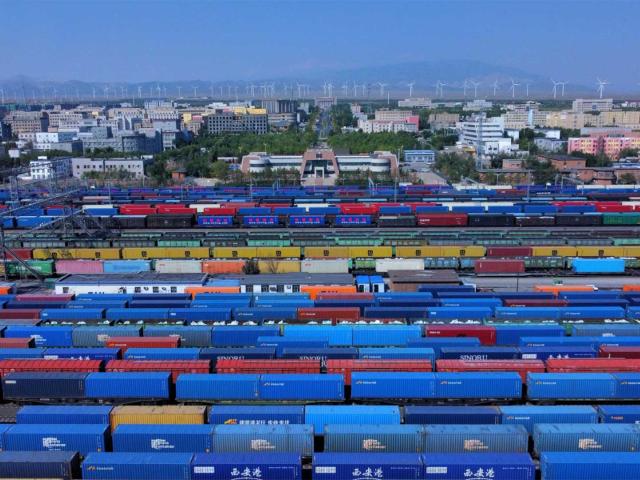
The China-Europe Railway Express uses containers as its transport units, and the choice of container type directly affects load utilization, freight rates, and cargo safety. Rail transport container standards are basically consistent with those for maritime shipping, but the requirements for payload and container body strength are more explicit—the China-Europe Railway Express undergoes multiple transshipments throughout its journey (due to different track gauges, transshipment is required at border crossings such as Alashankou, Khorgos, and Erenhot), so containers must withstand repeated lifting and long-distance vibration. Below are the container types commonly used on the China-Europe Railway Express and key points for container selection.
I. Comparison of Common Container Types for China-Europe Railway Express
| Container Type | Internal Dimensions (L×W×H) | Volume | Maximum Payload | Suitable Cargo |
|---|---|---|---|---|
| 20-ft 35-ton open-top container | 5.89×2.43×2.71 m | 39 m³ | 32 t | Bulk cargo and mineral bulk cargo; the open top facilitates hoisting, and the container body uses special corrosion-resistant paint |
| 20-ft general-purpose standard container | 5.89×2.35×2.39 m | 33 m³ | 28 t | All kinds of general cargo; the container body has high strength and rigidity and is suitable for sea, road, and sea-rail intermodal transport |
| 20-ft 35-ton general-purpose container | 5.89×2.43×2.69 m | 38 m³ | 32 t | About 30 cm taller than a 20-ft standard container, with greater loading space and payload |
| 40-ft general-purpose standard container | 12.03×2.35×2.69 m | 76.4 m³ | 26 t | Large-volume, lightweight, low-density cargo |
| 40-ft 35-ton general-purpose container | 12.03×2.46×2.69 m | 80 m³ | 31 t | Bulk general cargo with higher payload requirements |
| 45-ft 35-ton general-purpose container | 13.55×2.46×2.69 m | 90 m³ | 29.9 t | Low-density cargo; lower freight cost per unit volume |
The above are common container types for China-Europe Railway Express. Actual available container types are subject to the current container supply of the train platform.
II. Special Container Types: Refrigerated Containers, Tank Containers, and Flat Rack Containers
In addition to general-purpose container types, the China-Europe Railway Express can also apply for the following special container types to meet the transport needs of different types of cargo:
- Refrigerated containers: Used for temperature-controlled cargo such as fresh produce, pharmaceuticals, and precision instruments. It is necessary to confirm whether the train is equipped with a generator car or mounted refrigeration units.
- Flat rack (frame) containers: Have no roof or side walls, suitable for large mechanical equipment that is over-height or over-width.
- Tank containers: Bulk cement tank containers, petroleum asphalt tank containers, etc., used for liquid and powdery goods.
- Open-top containers: The top can be opened, suitable for cargo that needs to be lifted from above.
Special container types have limited availability. It is recommended to request them together at the booking stage and allow more time for container allocation.
III. Container Selection Recommendations for China-Europe Railway Express
Container type selection mainly depends on four dimensions:
- Nature of cargo: For bulk cargo, prioritize open-top containers; temperature-controlled cargo must use reefer containers; out-of-gauge equipment should use flat rack containers.
- Weight and volume: For heavy cargo (steel, ore, etc.), choose 35-ton high-capacity containers to avoid overweight; for light bulky cargo, choose 40-foot or 45-foot containers to reduce the cost per unit volume.
- Transshipment and intermodal transport: For cargo requiring sea-rail intermodal transport, it is recommended to use standard 20-foot/40-foot containers uniformly to avoid changing containers en route.
- Container availability: 35-ton and 45-foot containers are in tight supply at some border ports, and must be secured in advance during peak season.
IV. Frequently Asked Questions
Q: Does the China-Europe Railway Express use 20-foot or 40-foot containers?
A: It depends on cargo volume and weight. A 20-foot container has a volume of 33–39 cubic meters and a payload of 28–32 tons, making it suitable for heavy cargo and small batches; a 40-foot container has a volume of 76–80 cubic meters and a payload of 26–31 tons, making it suitable for large-volume, light-weight cargo. Railway charges are calculated per container, so for light, bulky cargo, using 40-foot or 45-foot containers is more cost-effective.
Q: Can the China-Europe Railway Express transport refrigerated cargo?
A: Yes. The China-Europe Railway Express provides refrigerated containers for temperature-controlled cargo such as fresh produce, pharmaceuticals, and precision instruments. Note that the supply of refrigerated containers is limited, and you need to confirm whether the train is equipped with a power car or refrigeration unit. It is advisable to book space well in advance.
Q: What is the maximum payload of a China-Europe Railway Express container?
A: Among common specifications, the maximum payload of a 20-foot 35-ton container is about 32 tons, a 40-foot standard container is about 26 tons, a 40-foot 35-ton container is about 31 tons, and a 45-foot container is about 29.9 tons. Railways in different countries have different axle load limits, so overweight cargo requires confirming the weight limits along the route in advance.
Q: Are containers for the China-Europe Railway Express and sea freight interchangeable?
A: Standard 20-foot and 40-foot containers are interchangeable, which is also the basis of sea-rail intermodal transport. Special specifications such as 35-ton containers and 45-foot containers are mostly used for rail, and some are not suitable for sea transport. When multimodal transport is required, it is recommended to use standard container types uniformly.
V. Further Reading
- China-Europe Railway Express Services: Routes, transit times, and booking methods
- What Is the China-Europe Railway Express? A Complete Guide to Rail Freight from China to Europe
- What Routes Does the China-Europe Railway Express Have?
- How to Book Space on the China-Europe Railway Express
- What Goods Can Be Shipped on the China-Europe Railway Express?
- Which Regions Can the China-Europe Railway Express Reach?
- Container Knowledge Center: Dimensions and specifications, container type selection, and loading standards
Bofeng Logistics professionally provides one-stop logistics services including domestic container shipping, international shipping (FCL/LCL), Hong Kong and Macau logistics routes, and trucking, customs declaration, and warehousing. Contact number: 130-7567-8958 (Manager Huang). Call now for a customized quote!
Related Logistics Services
Bofeng Logistics offers the following related services, feel free to inquire: