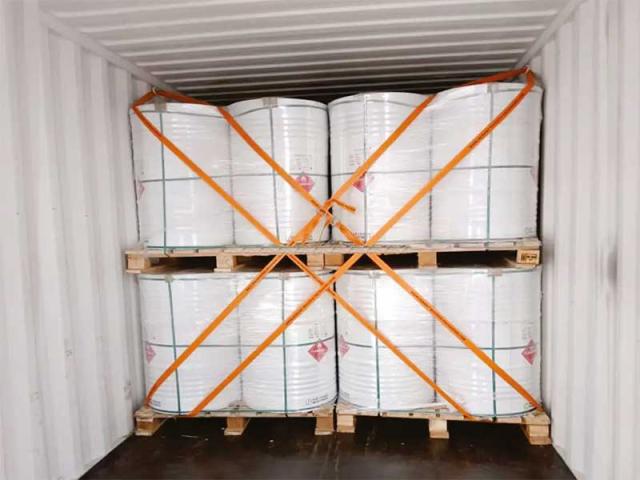
Typical Loading Methods for Domestic Container Shipping Cargo
Domestic container shipping typical cargo refers to representative bulk goods among container cargo. The types of container cargo have also been introduced in previous articles.
1. Domestic Container Shipping - Loading of Case Goods
When loading ordinary wooden cases, framed wooden cases, and wire-bound crates, if there are no other special requirements and the outer packaging is undamaged, they can be stacked from bottom to top. Smaller wooden cases can be loaded into enclosed containers, while larger wooden cases, due to the limitations of the loading surface, should be loaded into open-top containers. Except for cargo with special loading requirements or fragile wooden packaging, there is generally no need to insert padding between the goods. Taking the loading of wooden case goods as an example, the loading methods are briefly described as follows:
(1) For heavier small wooden cases, the interlocking stacking method can be used so that the upper wooden cases press onto the gaps of the two lower cases, using the weight of the upper layer to restrict the movement of the lower layer. However, the topmost layer of wooden cases must be securely fastened.
(2) After loading is complete, if there is a large gap near the container door, wooden planks and battens must be used to brace the entire stack of cases firmly, preventing them from impacting the container door during transportation.
(3) For wooden case goods with greater weight and smaller volume, if there are gaps on all sides after loading, support and fixation must be provided from all sides.
(4) For wooden cases with a high center of gravity, besides securing the bottom, wooden battens should be used to brace gaps above.
2. Domestic Container Shipping - Loading of Carton Goods
Carton goods are a relatively common packaging type in container cargo, generally used for packaging finer goods. The sizes of case goods vary. If the case goods loaded in the container are small in size and uniform in specification, then gap-free stacking can be carried out. This loading method has high container space utilization and does not require securing, making it the most economical and ideal loading form. If large cartons of the same size are loaded into the container, gaps often occur inside. If the transverse gap is around 10 cm, securing the cargo is generally not necessary, as this size of gap can be artificially dispersed during actual loading. However, if the gap is larger, the cargo needs to be secured according to the specific situation. When mixing cartons of different sizes, stacking can be arranged by utilizing the variations in size to eliminate gaps. Before loading, if it can be determined that the quantity of cargo loaded will leave large gaps in the container, the container floor should be filled first before stacking upwards. The loading methods for carton goods are as follows.
(1) The loading sequence is either from the inside of the container outward, or from both sides toward the middle.
(2) For loading gaps smaller than 300mm, special treatment is generally not required during loading, as the weight of the upper layer cargo can press down on each other, but the topmost layer needs to have gaps eliminated using filling materials.
(3) To prevent the lower layer of cartons from deforming under pressure, padding needs to be inserted between the layers of the container. The best material for padding is corrugated cardboard, which offers the advantages of light weight, low cost, high friction, and significant effectiveness in preventing cargo slippage.
When loading small carton goods, cross-stacking or interlocking stacking methods can be used to prevent collapse. There are generally three stacking methods. Since most of the pressure on corrugated cardboard boxes is borne by the box edges, the box corners should be aligned when stacking. During stacking, the cartons should generally be arranged like brickwork or in an interlocking manner to enhance the mutual pulling force between the goods. Corrugated cardboard boxes have greater strength when load is applied to the entire surface, so loading should be done correctly so that the load is borne across the full surface. To be continued... To learn more about cargo loading methods, please continue to follow us!
Domestic Container Shipping Door-to-Door Inquiry & Booking Hotline: 13075678958 Manager Huang
Bofeng Logistics specializes in providing one-stop logistics services including domestic container shipping, international shipping (FCL/LCL), Hong Kong & Macao logistics dedicated lines, as well as trucking, customs clearance, and warehousing. Contact number: 130-7567-8958 (Manager Huang), call now for an exclusive quote!
Related Logistics Services
Bofeng Logistics offers the following related services, feel free to inquire: