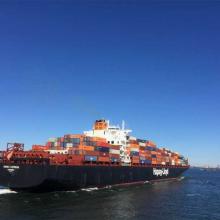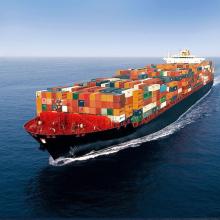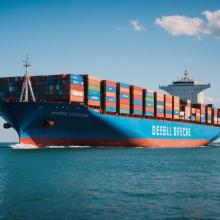
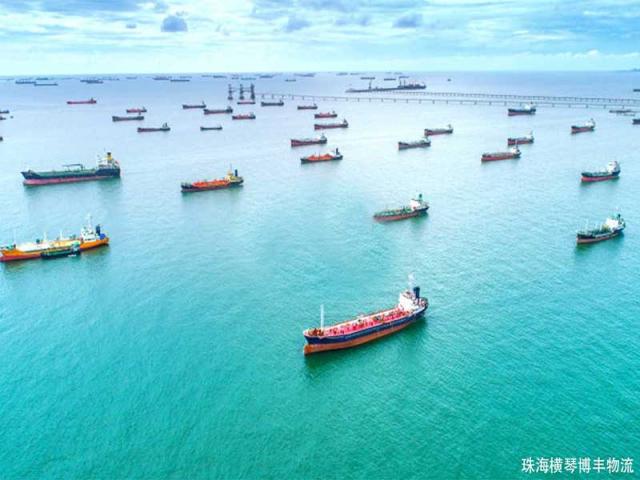
Container ships are a specific type of vessel that emerged with the development of container maritime transportation. Due to changes in cargo supply on container shipping routes, the growth of intermodal container transport, and the needs of ship operation, container loading methods have evolved, giving rise to many different types of container vessels. Currently, ships capable of carrying containers can be broadly classified into the following four types.
- General Cargo Ship In an ordinary break-bulk cargo vessel loaded with containers, the containers are mixed with general break-bulk cargo in the same hold; hence, such a vessel is also called a mixed-load ship. Typically, when using a general cargo ship, containers are chosen for stowage at the hatch opening area and on the upper deck.
- Convertible Container Ship Also known as an adaptable container ship, this type of vessel has simple, removable fittings inside the holds. When carrying general cargo or other bulk cargo instead of containers, these fittings can be removed. Bulk/container dual-purpose ships or multi-purpose vessels belong to this category.
- Semi-Container Ship In this type of vessel, some holds are designed exclusively for carrying containers, while other holds are used for general break-bulk cargo. The dedicated container holds are typically located in the central part of the hull; such a vessel is also called a partial-load-type ship.
- Full Container Ship All holds of the vessel are specially designed for carrying containers and cannot transport other types of cargo. This type of ship is also referred to as a dedicated container vessel.
In addition to the common lift-on/lift-off-type vessels mentioned above, roll-on/roll-off ships and barge carriers can also be used for transport.
Roll-on/roll-off ships, also called Ro-Ro (Roll On/Roll Off) vessels, do not require port handling equipment for loading and unloading containers at the dock. Instead, they use ramps at the side, bow, or stern to tow containers along with their chassis in and out of the ship.
The advantages of roll-on/roll-off container ships over lift-on/lift-off container ships include greater versatility: they can load not only containers and various vehicles but also other oversized cargo; cargo handling allows continuous, streamlined operations with high efficiency and is not limited by port lifting equipment. The main disadvantages are lower space utilization rates in the cargo holds and higher shipbuilding costs. Ro-Ro ships are often used for short-distance routes in coastal or near-sea shipping, especially where combined land-sea transport yields good economic returns.
A barge carrier, also known as a LASH (Lighter Aboard Ship) vessel, involves placing barges inside the mother ship, with containers loaded on the barges themselves. Maritime transport is completed by the mother ship. The barge carrier method can speed up the turnover of the mother ship and simplify requirements for port facilities. Barge carriers are well-suited for combined river-sea transport.
Port Transport Co., Ltd. specializes in providing one-stop logistics services, including domestic container shipping, international shipping (FCL/LCL), dedicated logistics routes to Hong Kong and Macau, as well as trucking, customs declaration, and warehousing. Contact number: 130-7567-8958 (Manager Huang), call now to get a personalized quote!
Related Logistics Services
Bofeng Logistics offers the following related services, feel free to inquire: