Client Background
A plastic injection molding machinery manufacturer in Foshan, primarily engaged in injection molding machines, extruders, and auxiliary equipment, exports products to markets including Southeast Asia, Europe, and the Middle East. This type of equipment is known as "oversized cargo": complete injection molding machines are often over-length, over-height, and over-width, with weights ranging from over ten tons to dozens of tons, making them impossible to load into standard containers. They must be transported on flatbed trailers. The customer's export route is to transport the equipment from the Foshan factory to Hong Kong's Kwai Chung Terminal, load it onto ships in Hong Kong, and then send it via ocean routes to overseas destination ports.
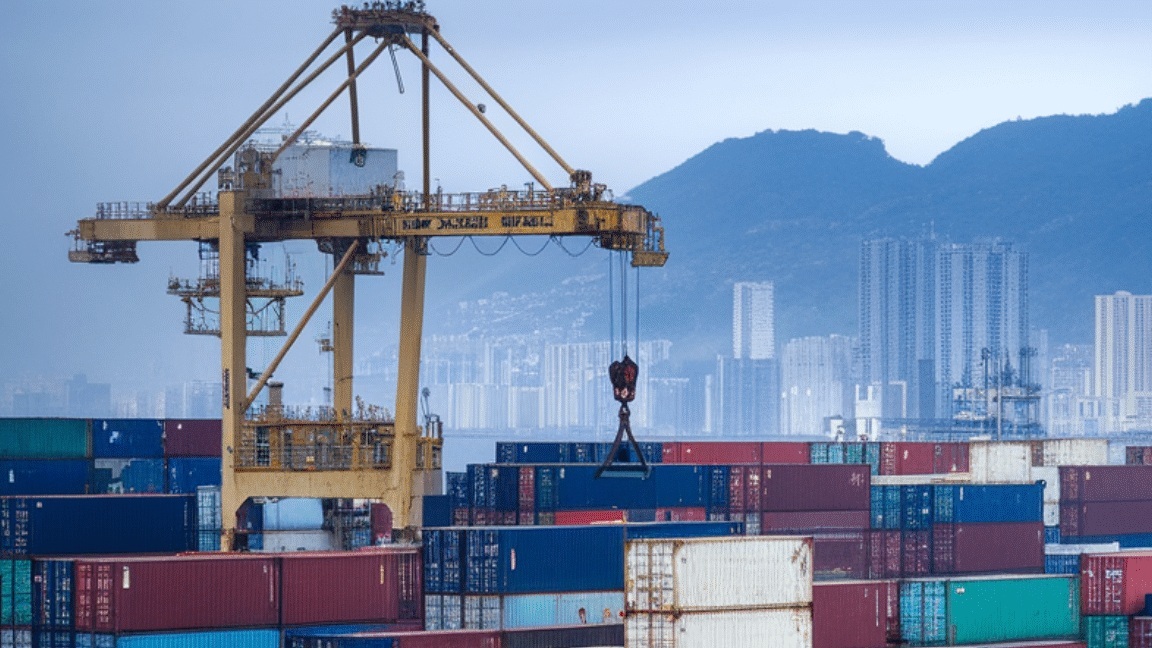
Hong Kong's Kwai Chung Terminal, with its dense shipping routes and many sailing schedule options, is an important hub for mechanical equipment exports from the Pearl River Delta. The customer ships a batch of equipment every week or every two weeks, with a relatively fixed export rhythm, and places high demands on "punctual arrival at the terminal"—ocean shipping schedules are booked in advance; if the equipment arrives at the terminal one day late, it may miss the scheduled sailing, and rebooking the next vessel often requires waiting several days, causing the overseas customer's receiving plan to be postponed accordingly.
The China-Hong Kong transport of oversized cargo is fundamentally different from ordinary cargo: ordinary goods can "be loaded onto a truck and go", while oversized cargo requires first preparing a loading plan, confirming dimensions and weight, arranging a suitable trailer bed, handling passage and declaration procedures, and then coordinating terminal lifting and loading windows. Waiting time at every step can be magnified into shipment delays. The customer previously assigned this type of transportation to multiple logistics providers for fragmented operations, requiring re-connection and re-familiarization with the equipment every time, causing recurring problems. Management decided to have a single service provider handle it uniformly, turning oversized transportation into a replicable standard process.
In oversized cargo transportation, the most testing part for service providers is the "preliminary work": before loading, it is necessary to conduct a loading feasibility assessment based on the equipment's three-dimensional dimensions, confirm the vehicle tonnage and trailer bed length; for over-width and over-height parts, determine in advance whether disassembly is needed, and handle relevant declarations according to regulations at the port. Only by doing this work in advance can the vehicle pass through the port smoothly. Otherwise, if the equipment arrives at the port and is found to be non-compliant in size, the cost of returning and reloading is extremely high. The mature practice in the industry is to first issue a loading plan diagram, then allocate vehicles, load, and declare according to the diagram. Every shipment is advanced in this order, digesting uncertainty before departure.
Key Challenges
- Large variations in size and weight: Equipment of different models varies significantly in size and weight. Some units need to be disassembled and shipped in parts, so the loading plan has to be re-evaluated every time and never becomes standardized, resulting in repeated rework and waiting;
- Uncertainty in customs clearance: Oversized cargo requires many declaration items when crossing the border, the inspection rate is relatively high, customs clearance time fluctuates greatly, and shipping schedule connections are often disrupted at the last minute;
- Ship loading coordination depends on luck: After equipment arrives at the dock, lifting and loading need to be coordinated. Under the old model, coordination with the terminal and the shipping company was loose, and the waiting time for loading after arrival varied. In one shipment, pages were found missing from the loading documents only after the equipment reached the dock, causing the scheduled sailing to be missed. The booking was changed to the next voyage, adding several days of waiting (the specific shipping schedule has been redacted), forcing the overseas customer's receiving plan to be postponed. Overall transit time was hard to predict;
- Data gaps make review difficult: In the past, there was no systematic record of how many hours each shipment took from leaving the factory to loading, or where it got stuck. When problems occurred, people could only rely on memory, making it hard to identify where to improve;
- Escort and compliance risks: Oversized cargo transport involves escort arrangements, permitted travel windows, and traffic restriction rules. Under the old model, operations relied on drivers' experience, and compliance details were not fully mastered, creating risks of inspection, requests for supplemental documents, and delays.
These challenges share a common point: every shipment is treated as a new problem. For export enterprises whose lifeline is the shipping schedule, unpredictable transit time is more deadly than the transit itself.
These challenges are not unique to the Foshan machinery industry; they are common problems encountered in the export of oversized cargo. A common practice in the industry is to find a truck only when loading is imminent and to handle formalities only after arriving at the port, leaving uncertainty to the last moment. The solution, by contrast, is to address uncertainty in advance. Customers choose to partner with Bofeng because they want to hand over the "uncertainty" of transportation to a service provider with experience in handling oversized cargo, so the export team can focus on orders and production schedules.
Transport Requirements
- Route: Foshan factory → Hong Kong Kwai Chung Terminal, container delivery and loading onto vessel;
- Volume: 1–2 shipments per week, each shipment consisting of either one complete machine or multiple components after disassembly, with dimensions and weight varying by model;
- Lead time: Scheduled in reverse from the booking vessel departure; delivery from the factory to the terminal for container handover must be completed before the customs clearance deadline;
- Transport equipment: Dual-plate flatbed trailer (cross-border Guangdong-Hong Kong); oversized cargo is assigned vehicles according to the plan; escort arranged when necessary;
- Declaration and compliance: Oversized cargo declaration, traffic arrangement, and avoidance of restricted travel periods;
- Coordination requirements: Coordinate terminal lifting and vessel loading windows; ensure complete delivery documents and clear acceptance procedures;
- Data requirements: Record the time points of departure from factory, customs clearance, arrival at terminal, and container handover for each shipment to form continuous data.
The client's core need is "predictable transit time and data for every shipment": when the equipment leaves the factory and when it arrives at the terminal should be provided to the shipping company and overseas consignee in advance, rather than being figured out step by step along the way.
Solution
Bofeng establishes a complete process for customers—"oversized-load plan + flatbed trailer + terminal container handover coordination + periodic data review"—to standardize every step of each equipment shipment:
- Oversized loading plan prepared up front: Before shipment, a loading plan is prepared based on equipment drawings and actual measured dimensions—confirming whether to use a long-bed or low-bed trailer, whether disassembly and separate transport is needed, and the loading center of gravity and lashing/securing plan. Detachable components (such as hoppers and robotic arms) are disassembled and transported separately on the same vehicle as the main unit, which both reduces the degree of oversized load and facilitates terminal lifting. The plans are consolidated into standard operation cards for different models, and repeat models directly apply them.
- Dual-plate flatbed trailer + escort: Dual-plate flatbed trailers are dispatched according to the plan, and over-length/over-width equipment is escorted by escort vehicles along the route. The escort vehicle helps observe rear traffic when turning or changing lanes, verifies height and width limit signs before passing bridges and tunnels, and, when necessary, cooperates with traffic control units to guide passage. After loading, multi-point lashing and securing is completed—anti-slip pads are placed between the base and the trailer bed, the four corners are locked with dedicated straps, and fragile electrical cabinets and control panels are additionally wrapped with protective boards. After lashing is completed, a designated person re-inspects and takes photos for records, and checks are made against them when unloading at port. The route avoids restricted driving periods, and traffic arrangements are filed in advance, absorbing as much as possible, before departure, the fluctuations that port inspection might cause.
- Terminal container handover coordination: The sailing schedule, customs cut-off time, and lifting window are confirmed with the shipping company and terminal in advance. After equipment arrives at port, lifting and container handover are arranged by appointment, and documents (packing list, customs declaration materials, authorization letter) are prepared all at once to reduce waiting for supplementary documents. If the sailing schedule changes, a new loading window is coordinated with the terminal immediately.
- Continuous periodic data management: Each shipment records four checkpoints—factory departure time, customs clearance duration, arrival time at terminal, and container handover completion time—forming a continuous data ledger. A review is conducted once a month to identify recurring bottlenecks (such as inspection at a certain port or lifting of a certain model), and targeted adjustments are made the following month.
- Single-window interface: A dedicated customer service representative is assigned to interface with the customer's export team, coordinating bookings, loading, customs clearance, and container handover in a unified manner. Monthly data reports are provided together with statements, giving the customer a clear view of "where it is and how long it waited" for each shipment.
The core of this solution is to transform oversized transport from "starting from scratch for every shipment" to "standardized processes + data-driven operations": loading plan reuse, customs arrangements in advance, terminal coordination by appointment, and periodic data review—all interlinked. For customers, the biggest change is that transit time has gone from "left to luck" to "predictable", and sailing schedule planning finally has a reliable basis.
Results
| Metric | First 6 shipments (old mode) | Last 6 shipments (new mode) | Improvement |
|---|---|---|---|
| Average transit time per shipment | Baseline | Reduced by 28% | Process standardization |
| Average customs clearance time | Baseline | Reduced by 35% | Advance filing |
| Waiting time at terminal before loading | Baseline | Reduced by 45% | Appointment coordination |
| Proportion of abnormal shipments | Baseline | Down by 70% | Single window |
| Shipping schedule connection accuracy | Baseline | Up by 22% | Data review |
Monthly transit data for 12 consecutive shipments (same scope as the previous table; shipment counts anonymized):
| Batch | Factory departure → customs clearance | Customs clearance → arrival at terminal | Arrival at terminal → container handover | Total time per shipment |
|---|---|---|---|---|
| Shipments 1-3 | Highly variable | Relatively long | Unstable | Baseline |
| Shipments 4-6 | Stable | Shortened | Variable | Reduced by 15% |
| Shipments 7-9 | Shortened | Stable | Appointment coordination | Reduced by 25% |
| Shipments 10-12 | Stable | Stable | Handover upon arrival | Reduced by 28% |
Data Disclaimer: The above is the data for this case (as of July 2026), reflecting the client's performance during the cooperation period, and does not constitute a service commitment.
The value of the continuous data ledger is that it makes improvements "visible": the first few shipments focused on resolving customs clearance fluctuations, the middle shipments optimized terminal coordination, and the later shipments stabilized the overall transit time. The client's export team can now provide an estimated time of arrival at the terminal in advance, and the shipping company's cooperation with the loading window has also improved accordingly. The proportion of abnormal shipments decreased by 70%, and supplementary documentation and urgent coordination caused by waiting have been significantly reduced. The client has made the cycle data report a fixed input for internal operation review meetings.
This set of continuous data has an additional benefit: the communication cost between the client's export team and the overseas consignee has dropped significantly. Previously, the estimated time of arrival reported to the shipping company often had to be changed, making it difficult for the other party's production scheduling to align. Now, with stable transit times, the estimated time is basically accurate on the first report, and the overseas end's evaluation of the client's supply chain has also improved. In the review, the client's management listed "predictable transit time" as the most important gain of this project—it not only reduced internal coordination costs, but also enhanced the credibility of the entire export chain.
For enterprises also exporting equipment, the takeaway from this case is that improvement in out-of-gauge transport is not a "one-time experience" but "continuously accumulated data." By recording the time nodes of each shipment, bottlenecks will surface on their own, and solutions can be iterated continuously. The value of data-drivenness is more enduring here than any "reliable luck."
The two parties' cooperation has entered its second year. The above data reflects case-by-case performance recorded continuously by batch during the cooperation period.
Client Testimonial
"Previously, when equipment was delivered to the Hong Kong dock, whether containers could be handed over on time depended entirely on the situation that day, and shipping schedules were always up in the air. Now every shipment has a time record from factory departure to container handover, transit times have stabilized, and we have confidence when reporting timeframes to shipping companies and overseas clients."
— Bofeng Logistics · Hong Kong Logistics Route Customer Feedback (published with authorization and anonymized)
Need a similar logistics solution? Contact us — a plan within 30 minutes.
Phone:13075678958 | WhatsApp:+86 13075678958 | Email:info@zhbfwl.com
Get a Quote