Client Background
A food and fresh produce supplier in Zhuhai (client information anonymized), operating in the processing and distribution of frozen food, aquatic products, and fresh fruits and vegetables, mainly supplying Hong Kong supermarket chains, food wholesalers, and catering businesses. The fresh food industry is extremely sensitive to temperature control: from leaving the cold storage to entering the receiving party's cold storage in Hong Kong, the temperature throughout the entire journey must be maintained within a specified range. Any rise in temperature at any point can cause quality deterioration or even spoilage, leading to returns and customer complaints.
The client ships with high frequency and small batch sizes, delivering to Hong Kong multiple times a week. In the past, they used the traditional route "via Shenzhen or Gongbei Port": goods from Zhuhai first queued through the port customs, then were transferred within Hong Kong to various delivery points. The most prominent problem with this route was the "queuing": during peak hours at the port, traffic was congested, and while vehicles waited in line, doors were opened and closed multiple times, and the ambient temperature continuously affected the cargo—a real quality risk for fresh goods. On one occasion, a batch of frozen food experienced a temperature rise while queuing at the port. After arriving in Hong Kong, some of the goods had thawed and softened, and the Hong Kong receiving party rejected a portion on the spot. The client not only lost the goods but also damaged their credibility with that party.
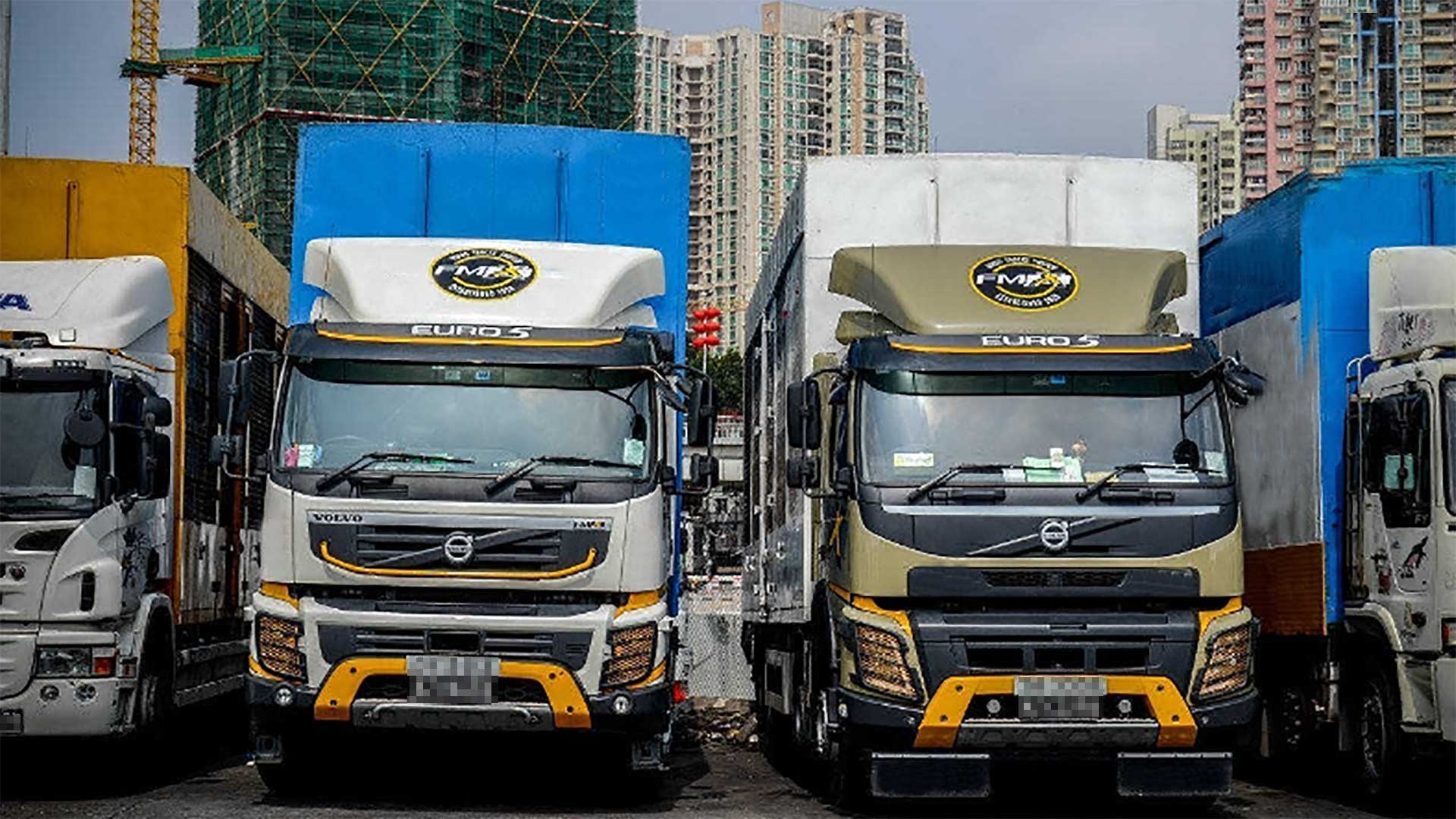
This incident prompted the client to seek a solution from "transport conditions." After research, the client found that the Hong Kong-Zhuhai-Macao Bridge offers 24-hour customs clearance, and the drive from Zhuhai to Hong Kong takes about 40 minutes—making it a route built almost entirely for time efficiency. Combined with cold chain trucks equipped with temperature recorders, this significantly reduces the main source of temperature drift—"waiting for customs clearance"—and the temperature throughout the entire journey can be recorded and traced. For fresh food companies, temperature data itself is proof of delivery: being able to present temperature records resolves half of quality disputes.
As a result, the client gradually switched their cold chain transport to Hong Kong over to the "cold chain truck + Hong Kong-Zhuhai-Macao Bridge" solution—using shorter crossing time for more stable temperatures, and traceable temperature records for fewer customer complaints.
Key Challenges
Customers face challenges in five main areas in cold-chain transport of fresh produce from Zhuhai to Hong Kong:
- Customs clearance queues cause temperature rise: At traditional checkpoints, waiting times during peak hours are unpredictable. While vehicles wait in line, the ambient temperature continuously affects the container, and fresh goods are damaged before they even arrive in Hong Kong;
- Inconsistent temperature control conditions: Previously, different logistics providers used reefer vehicles with varying temperature control standards. Some vehicles lacked sufficient cooling capacity, making it difficult to maintain the required temperature in hot weather—problems were only discovered after arrival;
- No temperature records make disputes difficult to resolve: Without temperature records for the entire journey, when quality issues arise upon arrival, the parties cannot use data to determine responsibility and can only negotiate by convention, often leaving customers in a passive position;
- Fresh produce loss and returns: Unstable temperature control directly translates into losses and returns. Frozen food thaws and softens, while fruits and vegetables discolor and shrivel—this not only reduces the value of the goods but also affects Hong Kong customers' confidence in placing orders;
- Hard to maintain continuous temperature when delivering to multiple receiving points: After arriving in Hong Kong, goods must be delivered to multiple supermarket receiving docks and restaurant kitchens. Maintaining temperature control across multiple transfer segments is also a challenge, and a temperature failure in the last leg can still affect delivery.
The common thread among these challenges is that temperature is uncontrollable and unverifiable. The success of fresh produce transport depends not only on whether the goods arrive quickly, but also on whether the temperature is stable and whether there are records. What customers need is a route into Hong Kong that significantly reduces temperature drift, paired with a transport method that turns temperature into data and data into proof—this is exactly what the combination of the Hong Kong-Zhuhai-Macao Bridge and cold-chain vehicles can provide.
Transport Requirements
- Route: Zhuhai cold storage → Hong Kong-Zhuhai-Macao Bridge → Hong Kong chain supermarket receiving dock / restaurant kitchen, cold chain door-to-door;
- Cargo volume: Multiple times per week, ranging from dozens to hundreds of boxes per shipment; quick-frozen items, aquatic products, fruits, and vegetables are loaded in separate temperature zones;
- Timeliness: Refrigerated and frozen items have separately set temperature ranges; departures from Zhuhai are scheduled in reverse based on Hong Kong receiving time slots; the Hong Kong-Zhuhai-Macao Bridge crossing takes about 40 minutes by drive plus 24-hour customs clearance, with time reserved for receiving and handover;
- Special requirements: Full-journey temperature control records, with temperature records provided upon delivery; loading in separate temperature zones (frozen approx. -18°C, refrigerated approx. 0-4°C); on arrival in Hong Kong, temperature is checked batch by batch and photos are sent back;
- Declaration and documentation: Export declaration documents for food products are centrally processed on the Zhuhai side; packing lists, certificates of origin, and quarantine-related documents are checked batch by batch;
- Insurance and billing: In-transit insurance coverage; invoices list cold chain transport and temperature control service fees by batch, with a clear cost structure.
The client's core requirement is "temperature control meets standards, with full traceability": the temperature must always remain within the specified range, temperature records must be available at delivery, and quality disputes can be verified with evidence.
Solution
Bofeng provides customers with a customized door-to-door cold chain solution combining "cold chain vehicle temperature control + fast customs clearance via the Hong Kong-Zhuhai-Macao Bridge + direct delivery in Hong Kong":
- Pickup and pre-cooling at Zhuhai cold storage: Goods are picked up from the Zhuhai cold storage according to customer orders and pre-cooled before dispatch to ensure they are already within the specified temperature range when loaded — frozen goods at approximately -18°C, chilled goods at approximately 0-4°C — with separate temperature-zone loading to avoid mixing and temperature crossover;
- Full-journey temperature control in cold chain vehicles: Refrigerated vehicles with independent refrigeration units and temperature recorders are used. Refrigeration performance is checked before departure, carriage temperature is continuously recorded during transit, and full-journey temperature data is archived; in hot weather, a refrigeration contingency plan is prepared in advance to ensure transport capacity matches refrigeration capability;
- Fast customs clearance via the Hong Kong-Zhuhai-Macao Bridge: Dual-plate cold chain vehicles travel directly to Hong Kong via the Hong Kong-Zhuhai-Macao Bridge, with 24-hour customs clearance and a drive time of approximately 40 minutes, greatly reducing border-crossing time and minimizing temperature drift from queuing at the source; departure times avoid Hong Kong receiving peaks, with buffer time reserved for handover;
- Direct delivery with temperature verification in Hong Kong: Upon arrival, goods are assigned by receiving point and delivered directly to chain supermarket receiving docks and restaurant kitchens. Temperature is measured batch by batch at delivery and cross-checked against temperature records; the receiver confirms the temperature meets requirements before signing. Photos of signed receipts are sent back and visible to the shipper in real time;
- Traceable temperature records: Full-journey temperature records are provided for each shipment as proof of quality delivery; in the event of temperature anomalies, system records can be traced back to specific time periods and process stages, providing a clear basis for determining responsibility;
- Temperature control coordination across multiple receiving points: When distributing to multiple receiving points in Hong Kong, deliveries are arranged by separate vehicles and time slots according to cold chain requirements to avoid repeated temperature fluctuations from multiple loading operations;
- Peak season and emergency plans: During the pre-holiday supermarket stockpiling period, cold chain vehicle capacity is locked in advance; contingency vehicle plans are in place for vehicle breakdowns, port emergencies, and other situations, ensuring fresh goods do not spend the night in transit due to capacity issues.
Taking a regular scheduled run as an example: goods are picked up and pre-cooled at the Zhuhai cold storage at 10:00 AM, loaded and dispatched at 2:00 PM, arrive in Hong Kong after approximately 40 minutes via the Hong Kong-Zhuhai-Macao Bridge, and temperature-verified deliveries to supermarket receiving docks and restaurant kitchens are completed before 4:00 PM. Full-journey temperature records are delivered with the goods and signed off batch by batch.
The core of the solution is to drastically compress "customs waiting" — the main source of temperature drift — by leveraging the time advantage of the Hong Kong-Zhuhai-Macao Bridge, and to turn "temperature" into data that can be recorded, traced, and delivered. For fresh food companies, this is not just a change in transportation mode, but a reconstruction of the delivery model — shifting from "inspecting goods by feel" to "accepting goods by reviewing temperature records", significantly reducing quality disputes and strengthening Hong Kong customers' trust in arrival quality.
From a cost perspective, the one-way freight rate for cold chain transport is higher than ordinary freight, but the customer's total cost actually decreases: reduced spoilage and returns offset the freight rate gap; temperature records substantially reduce quality disputes, saving manpower on negotiation and replenishment. For fresh food companies, cold chain is not about "the cheaper the better", but rather "the more stable the arrival quality, the better" — the repeat purchases and trust brought by stable quality are the true return on cold chain costs.
Results
| Indicator | Before Cooperation | After Cooperation | Improvement |
|---|---|---|---|
| Full-process temperature control compliance rate | Approx. 88% | Approx. 98% | Significantly improved |
| Loss rate of fresh products upon arrival | Baseline | Decreased by approx. 60% | Temperature drift compressed |
| Zhuhai → Hong Kong door-to-door transit time | Port queuing, high fluctuation | Approx. 40-minute drive, stable | Fluctuation narrowed |
| Temperature record delivery | No records, relied on negotiation | Temperature records traceable for each shipment | Evidence-based and verifiable |
| Quality disputes / customer complaints | Baseline | Decreased by approx. 45% | Clear responsibility determination |
| Rejection / returns | Occasional | Significantly reduced | Stable temperature control |
Data Statement: The above is data from this case (as of July 2026), reflecting the performance of this particular case during the cooperation period with this customer, and does not constitute a service commitment. The full-process temperature control compliance rate is based on the statistical scope during the cooperation period; batches that did not meet the standard were handled according to contingency plans and did not affect quality delivery.
The quantified improvements after cooperation are concentrated in five points: first, the full-process temperature control compliance rate increased from approximately 88% to approximately 98%, with temperatures maintained within the specified range for the vast majority of the time; second, the loss rate of fresh products upon arrival decreased by approximately 60%, and cases of thawed quick-frozen food and spoiled fruits and vegetables were greatly reduced; third, the door-to-door transit time from Zhuhai to Hong Kong changed from "port queuing, high fluctuation" to "approximately 40-minute drive, stable", and the 24-hour customs clearance at the Hong Kong-Zhuhai-Macao Bridge greatly shortened the in-transit time for fresh products; fourth, temperature records for each shipment are traceable, and at delivery the temperature data serve as quality proof, with quality disputes falling by approximately 45%; fifth, rejections and returns have significantly decreased, Hong Kong customers' trust in delivery quality has increased, and they are more confident in placing orders. Behind the data is the logic of "exchanging time for temperature": a large part of the loss in the fresh cold chain comes from temperature fluctuations during waiting time at the border, and the Hong Kong-Zhuhai-Macao Bridge precisely compresses this waiting period; combined with temperature recorders, temperature has shifted from "by feel" to "by data", and responsibility determination no longer relies on negotiation. This case also shows that for fresh food enterprises, cold storage and refrigerated trucks are "internal strength", while the timeliness of the entry channel is "external strength"—only when the entry step is fast and controllable enough can full-process temperature control truly translate into arrival quality. The Hong Kong-Zhuhai-Macao Bridge has given Zhuhai cold chain enterprises an efficient temperature-controlled channel to Hong Kong's dining tables.
The two parties have entered the second year of cooperation. The above data are case records from multiple weekly cold-chain shipments during the cooperation period.
Client Testimonial
"We used to dread queuing at the border. Once the truck stopped, it could be half a day, and we worried about frozen goods thawing. We couldn't even produce temperature records, so if anything went wrong upon arrival, we just had to accept the loss. Now cold-chain trucks come with temperature records. It takes 40 minutes to cross the bridge to Hong Kong. At delivery, the temperature is checked and the record is provided. Supermarkets and restaurants in Hong Kong all trust this approach. Since we started working together, there have basically been no rejections, and quality complaints have dropped significantly."
— Feedback from a client of Bofeng Logistics' Hong Kong logistics line (published with authorization and anonymized)
Need a similar logistics solution? Contact us — a plan within 30 minutes.
Phone:13075678958 | WhatsApp:+86 13075678958 | Email:info@zhbfwl.com
Get a Quote