Client Background
A precision instrument supplier in Shenzhen has long supplied lithography parts, optical lenses, precision measuring instruments, and semiconductor equipment spare parts to Hong Kong's scientific research laboratories, semiconductor R&D institutions, medical device enterprises, and third-party testing organizations. The precision instrument industry shares a common characteristic: the value of the equipment itself is concentrated, but the requirements for transportation conditions far exceed those of ordinary cargo. Lithography parts are optical and mechanical components with micron-level precision, whose surfaces undergo precision grinding and coating. Any improper vibration may cause optical axis deviation, scratches on the lens coating, or loosening of internal structures; optical lenses are sensitive to temperature, humidity, and dust; and complete precision instruments require stable support during transportation to avoid structural deformation caused by stress. Suppliers of such cargo usually attach great importance to whether the logistics service provider has operational experience in handling precision cargo—from receiving and inspecting goods, packaging and reinforcement, to loading, unloading, and collision avoidance. Every detail affects the condition of the instrument when the box is opened.
The customer's Hong Kong clients are mostly scientific research and testing institutions, and unpacking acceptance is the most critical step in the transaction process. Laboratory equipment schedules are often booked in advance, and instruments must be installed and debugged promptly after arrival. If any abnormality is found upon unpacking, not only does the goods have to be returned to Shenzhen for repair, but a new testing time slot must also be rebooked, affecting both research progress and customer trust. Previously, the customer relied on ordinary freight plus self-packaging and experienced several lessons of "failed acceptance": on one occasion, after lithography parts arrived at a Hong Kong laboratory, testing found optical axis deviation. It was confirmed to have been caused by vibration in transit, so the parts had to be repaired and reshipped, causing a delay of more than a week. The laboratory was quite dissatisfied at the time (specific cargo value and customer information have been desensitized). These experiences made the customer realize that cross-border transportation of precision instruments between Mainland China and Hong Kong should not only consider "whether it can be delivered," but also "whether the delivered condition is acceptable."
For cargo such as precision instruments, which are "high-value and low-tolerance," transportation cost is a secondary factor compared with cargo value and research scheduling: the opportunity cost of one repair and reshipment far exceeds the reasonable investment in professional transportation. This is precisely the fundamental reason why the customer is willing to pay a reasonable cost for exclusive packaging and dedicated escort. The customer ultimately decided to find a China-Hong Kong logistics service provider capable of dedicated transportation for precision instruments, requiring shockproof packaging design, vibration protection assessment, dedicated escort, and acceptance assistance, making "qualified upon unpacking" a predictable outcome.
Key Challenges
- Vibration damage is difficult to quantify: Ordinary trucks mostly use leaf spring suspension, and impacts from rough roads, hard braking, and speed bumps are transmitted directly to the cargo. Optical components are especially sensitive; the accumulation of tiny vibrations invisible to the naked eye can cause optical axis deviation, and the damage often only becomes apparent during unboxing inspection;
- Unprofessional packaging protection: DIY packaging often uses foam filling, which only provides basic cushioning. The instrument still has room to move inside the box, causing repeated collisions during transport. Moisture-proof, dust-proof, and anti-static measures are also inadequate. Once precision instruments become damp or accumulate dust, accuracy is directly affected;
- Multiple transfers increase risk: In LTL logistics, goods go through multiple stages such as pickup, transfer, and loading/unloading. Every handling step carries risks of collision and tipping. Precision instruments are especially vulnerable to negligence in the “last meter”;
- No environmental records: During laboratory acceptance, there is no data to verify the vibration, temperature, and humidity conditions the shipment experienced. If any abnormality occurs, responsibility is difficult to determine, and communication costs for repair are high;
- Strict acceptance standards: Hong Kong laboratories inspect immediately upon unboxing. Any nonconforming item must be repaired and reshipped, which is time-consuming and costly, directly affecting the long-term cooperation between clients and the laboratory;
- Difficulty in defining responsibility: LTL logistics involves many links and many handlers. Once a precision part is damaged, responsibility is often passed between parties, making it time-consuming and laborious for customers to assert their rights.
The core of these challenges is that transport safety for precision instruments does not depend on “luck,” but on control over every link: packaging, vehicles, loading/unloading, and monitoring. If any link fails, all prior protection may be in vain. For customers, the hardest part is not a single shipment, but ensuring every shipment consistently meets standards—which is precisely what LTL logistics cannot deliver.
Transport Requirements
- Route: Shenzhen → Hong Kong laboratory / research institution, door-to-door delivery;
- Cargo types: lithography accessories, optical lenses, precision measuring instruments, semiconductor equipment spare parts, mostly mid-to-high-value precision items;
- Special requirements: dedicated shockproof packaging + air cushion suspension damping + full-time escort by dedicated personnel throughout transport;
- Environmental requirements: shockproof, moisture-proof, and dust-proof throughout transport; temperature, humidity, and vibration recorders placed with the shipment;
- Timeframe: pickup on the same day, arrival at the port the next day, coordinated with the laboratory's scheduled unboxing and inspection time;
- Inspection support: assistance with unboxing and positioning after arrival at the port, with a rapid response plan for abnormal situations;
- Documentation and insurance: packing list and packing photo/video records prepared with the shipment; valuable precision items insured per shipment, providing clear evidence for claims in case of abnormalities.
The client's core requirement is "qualified upon unboxing": not only must the shipment arrive on time, but it must also arrive in the condition required by the laboratory, leaving no hidden risks during the inspection process.
Solution
Bofeng offers an integrated solution for precision instruments: "custom packaging + shock-proof dedicated vehicles + dedicated escort + full-process recording":
- Custom shock-proof packaging: A three-layer protection system of "outer wooden case + inner EPE foam + air cushion suspension" is custom-designed based on the instrument's shape, center of gravity, and fragile parts. The instrument is secured inside the case with flexible straps and a suspension structure, leaving buffer space in all six directions to prevent external forces on the case from being transmitted directly to the instrument body. Optical lenses are individually packed in anti-static bags with moisture-absorbing desiccant, and the case is marked with "This Side Up," "Fragile," and "Precision Instrument" warning labels;
- Pre-shipment shock testing: After packaging is completed, simulated vibration and tilt tests are conducted. An accelerometer measures vibration data at key points, and the shipment is released only after the cushioning effect is confirmed to meet standards. The instrument's center of gravity is also recorded for proper positioning during loading;
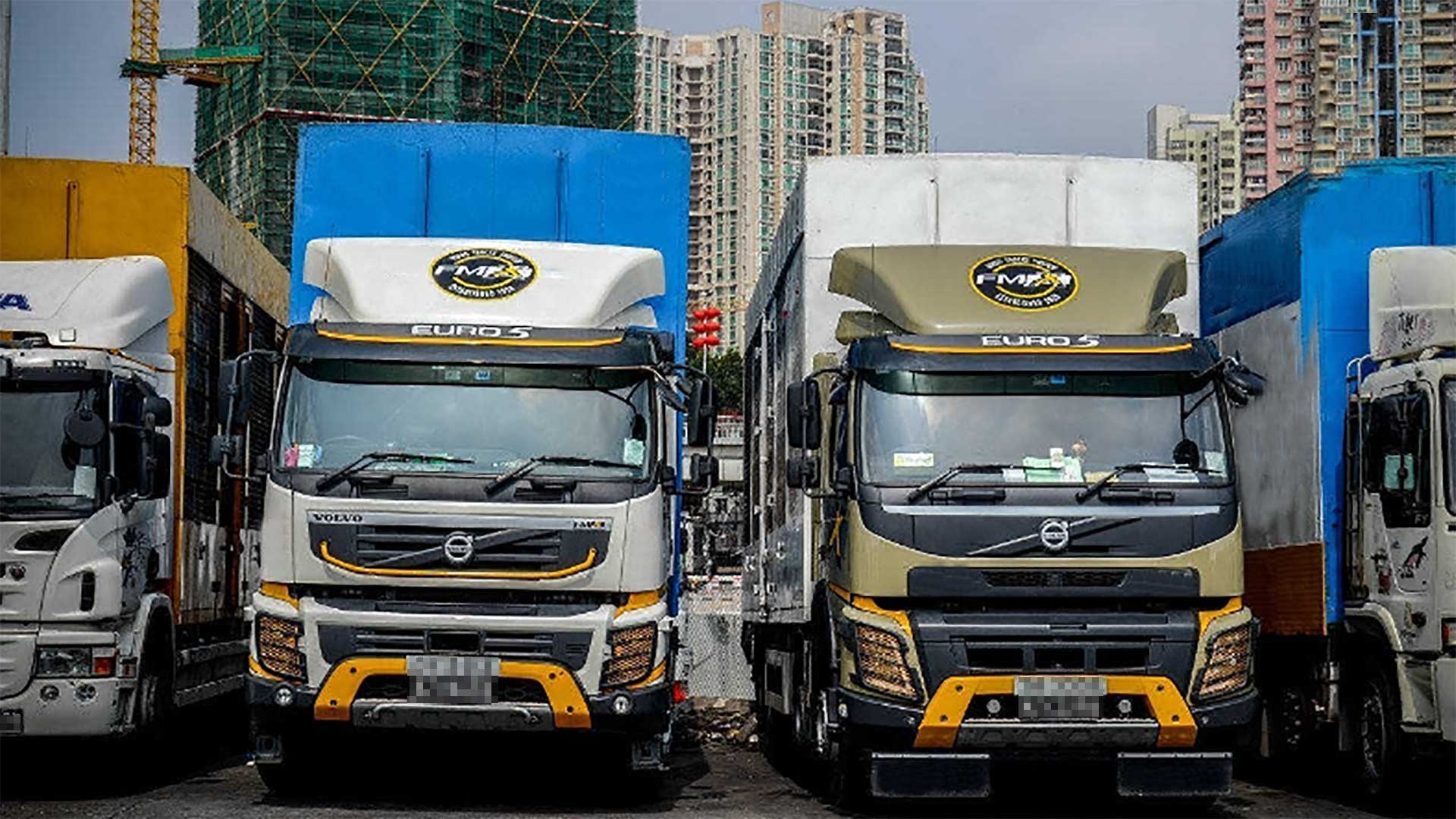
- Air-suspension dedicated vehicle: A China-Hong Kong truck equipped with air suspension (airbag damping) is used for transport. The air suspension effectively filters high-frequency vibration and road impact, and together with the shock-absorbing mat laid on the truck bed, keeps transport vibration within the acceptable range for precision instruments;
- Dedicated escort: An escort familiar with precision cargo handling accompanies the vehicle throughout the journey, responsible for supervising loading placement, checking during stops, coordinating customs clearance at the port, and directing unloading upon arrival to prevent rough handling during loading and unloading;
- Port and route optimization: Shenzhen Bay Port is selected for its mature clearance procedures and relatively manageable queuing. Departure times are carefully planned to avoid peak hours, reducing frequent stop-and-go during customs waiting and lowering the risk of vibration accumulation;
- Full-process environmental recording: Calibrated vibration recorders and temperature/humidity recorders are placed with the cargo. The data can be exported throughout the journey and is provided upon delivery for laboratory acceptance and archiving;
- Unpacking and acceptance assistance: After arrival, dedicated personnel assist with unpacking and moving the instrument to the designated work station, and cooperate with the laboratory's initial inspection. If any abnormality is found, the rapid response procedure is promptly activated to coordinate repair or replacement arrangements.
Taking a typical order as an example, the operational timeline is roughly as follows: on the shipment date, after order confirmation, shock-proof packaging and vibration testing are completed; that afternoon, an escort departs with the cargo from the Shenzhen warehouse, clears customs at Shenzhen Bay Port, and arrives at the Hong Kong warehouse that evening; the next day, delivery is made according to the laboratory's scheduled appointment, with accompanying unpacking and acceptance. The entire process from pickup to acceptance takes approximately 24 hours, with fixed checkpoints and clearly assigned responsible persons at every stage, allowing customers to track cargo progress at any time.
The core of the solution is shifting from the mindset of "shipping ordinary goods" to "shipping precision components": every shipment is executed under the same set of protection standards, with reproducible quality and traceable anomalies, no longer relying on the experience and luck of individual operations.
Results
| Indicator | Before Cooperation | After Cooperation | Improvement |
|---|---|---|---|
| Out-of-box acceptance first-pass rate | About 78% | Around 95% | Significantly improved |
| Transportation repair / replacement rate | About 5% | Below 0.3% | Significantly decreased |
| Delivery timeliness | 2-3 days | T+1 next-day arrival at port | Shortened by about 50% |
| Batches exceeding temperature/humidity limits | About 12% | Significantly decreased | Fully controllable throughout |
| Dedicated escort coverage | None | Full coverage | Clear accountability |
Data Statement: The above are case-specific data (as of July 2026), reflecting this client's performance during the cooperation period and do not constitute a service commitment.
After cooperation, the client's Hong Kong laboratory orders saw a significant improvement in out-of-box acceptance first-pass rate, a substantial reduction in repair and reshipment cases, and delivery timeliness stabilized at next-day arrival at port, greatly increasing flexibility in coordinating laboratory appointment scheduling. The standardization of the packaging solution brought two direct benefits: first, transport quality is replicable — different batches use the same set of protection standards and no longer rely on the packer's personal experience; second, anomalies are traceable — the in-transit data recorder and dedicated escort make every step documented and verifiable, with clear accountability, greatly reducing communication costs between the client and the laboratory. From a cost perspective, the client invests a predictable professional transport fee, saving the hidden costs of repairs, reshipments, rescheduling, and the risk of losing research clients. This combined solution of "shockproof packaging + shock-absorbing dedicated vehicle + full-journey monitoring" is equally applicable to China-Hong Kong transport of high-value, high-precision goods such as semiconductor equipment, precision measuring instruments, and medical devices. For precision instrument suppliers preparing to expand into the Hong Kong research market, stable and reliable China-Hong Kong transport is itself the confidence for external service: only when clients can comfortably use the equipment right out of the box will they trust you with their key equipment.
Over the past 12 months, the two parties have maintained a cooperation rhythm of dedicated escort for every shipment. The above data are case-specific records from the cooperation period.
Client Testimonial
"Previously, when precision components arrived in Hong Kong, the biggest fear was problems upon unboxing. Now Bofeng provides a one-stop service from packaging to escort, and upon arrival there are dedicated personnel assisting with acceptance inspection. In recent dozens of shipments, unboxing has basically passed on the first try, and the laboratory is also very satisfied with the quality of the goods received."
— Customer feedback for Bofeng Logistics · Hong Kong Logistics Dedicated Line (published with authorization and anonymized)
Need a similar logistics solution? Contact us — a plan within 30 minutes.
Phone:13075678958 | WhatsApp:+86 13075678958 | Email:info@zhbfwl.com
Get a Quote