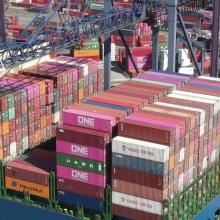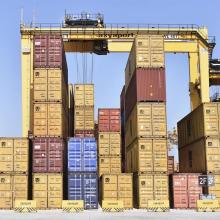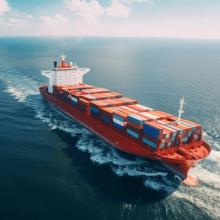
Shipping containers come in many types — each designed for specific cargo requirements. Based on our daily operations arranging container shipments from all major Chinese ports, we have seen how choosing the right container type directly impacts both cargo safety and shipping cost.
This guide covers all common shipping container types with detailed specifications, cargo recommendations, and selection guidance.
Quick Reference: 8 Container Types at a Glance
| Type | Sizes Available | Best For | Cost vs Dry Van |
| Dry Van (General Purpose) | 20GP, 40GP, 40HQ | General cargo, packaged goods, electronics | Baseline |
| Reefer (Refrigerated) | 20GP, 40GP, 40HQ | Food, pharmaceuticals, flowers | 2–3× higher |
| Open Top | 20GP, 40GP | Over-height cargo, machinery | 30–50% higher |
| Flat Rack | 20GP, 40GP | Heavy machinery, vehicles, oversized cargo | 50–100% higher |
| ISO Tank | 20GP tank | Bulk liquids, chemicals, food-grade liquids | 3–5× higher |
| Ventilated | 20GP, 40GP | Coffee, cocoa, grains, organic cargo | 20–30% higher |
| Open Side | 20GP, 40GP | Wide cargo, cargo requiring side loading | 30–40% higher |
| Collapsible | Varies | Empty repositioning, specialized logistics | Varies |
1. Dry Van Container (General Purpose)
The most common container type, accounting for approximately 90% of all containers in service. Fully enclosed and weatherproof, designed for general cargo.
| Specification | 20GP | 40GP | 40HQ |
| Internal Length | 5.90 m | 12.03 m | 12.03 m |
| Internal Width | 2.35 m | 2.35 m | 2.35 m |
| Internal Height | 2.39 m | 2.39 m | 2.70 m |
| Door Opening Width | 2.34 m | 2.34 m | 2.34 m |
| Door Opening Height | 2.28 m | 2.28 m | 2.58 m |
| Max Payload | ~28,200 kg | ~27,600 kg | ~27,000 kg |
| Cubic Capacity | ~33 CBM | ~67 CBM | ~76 CBM |
Ideal cargo: Boxed goods, electronics, furniture, machinery parts, textiles, toys, household goods, general merchandise.
Container structural specifications (ISO 668:2020)
Every dry van container must meet minimum structural strength standards:
| Component | 20GP Standard | 40GP Standard | Certification Test |
| Floor loading (forklift) | 4.5 tonnes per axle | 4.5 tonnes per axle | 7,200 kg per axle for 5 min |
| Roof loading | 300 kg (any 600×300mm area) | 300 kg | Distributed load test per ISO 1496-1 |
| End wall strength | 40% of max payload | 40% of max payload | Uniform load test |
| Side wall strength | 60% of max payload | 60% of max payload | Uniform load test |
| Lashing ring capacity | 1,000 kg (×8-12 positions) | 1,000 kg (×16-24 positions) | Pull test per CSC |
| Watertightness | No leakage at 100mm water head | No leakage at 100mm water head | 10-min spray test |
Container stack weight limits
When containers are stacked on vessels, lower containers must bear the weight of those stacked above:
| Stack Configuration | 20GP Max per Bottom Unit | 40GP Max per Bottom Unit |
| On deck (typical max) | 6-high (~152,000 kg total) | 5-high (~126,000 kg total) |
| Below deck (typical max) | 9-high (~228,000 kg) | 7-high (~140,000 kg) |
| Stacking weight per corner post | 84,000 kg (max structural) | 76,000 kg (max structural, wider post spacing) |
2. Reefer Container (Refrigerated)
Temperature-controlled containers with built-in refrigeration units. Essential for perishable goods and pharmaceutical products.
| Specification | 20GP Reefer | 40GP Reefer | 40HQ Reefer |
| Temperature Range | -25°C to +25°C | -25°C to +25°C | -25°C to +25°C |
| Internal Length | 5.45 m | 11.56 m | 11.56 m |
| Internal Width | 2.29 m | 2.29 m | 2.29 m |
| Internal Height | 2.27 m | 2.27 m | 2.27 m |
| Max Payload | ~26,500 kg | ~26,000 kg | ~26,000 kg |
Ideal cargo: Fresh and frozen food (meat, seafood, fruit, vegetables, dairy), pharmaceuticals, flowers, chemicals requiring temperature control.
Note: Reefer containers require a power source (ship's generator) during transit. When stored at a terminal, they require a shore power connection (reefer plug).
3. Open Top Container
A dry container with a removable soft or hard top cover instead of a solid roof. The end doors open fully, and the top can be uncovered for loading from above.
| Specification | 20GP Open Top | 40GP Open Top |
| Internal Length | 5.90 m | 12.03 m |
| Internal Width | 2.35 m | 2.35 m |
| Internal Height | 2.39 m | 2.39 m |
| Max Payload | ~27,000 kg | ~26,500 kg |
Ideal cargo: Machinery, equipment, granite and stone slabs, timber, steel pipes, any cargo that exceeds standard door height.
4. Flat Rack Container
A container with collapsible sides and no roof — essentially a platform with end walls. Designed for cargo that does not fit within a standard container's dimensions.
| Specification | 20GP Flat Rack | 40GP Flat Rack |
| Internal Length | 5.90 m | 12.03 m |
| Internal Width | 2.35 m | 2.35 m |
| Max Payload | ~30,000 kg | ~35,000 kg |
Ideal cargo: Construction machinery (excavators, bulldozers), vehicles, heavy industrial equipment, boats, oversized pipes.
5. ISO Tank Container
A stainless steel tank encased within a 20-foot container frame. Designed for bulk liquid transportation.
| Specification | 20GP ISO Tank |
| Capacity | 14,000–26,000 liters |
| Max Payload | ~26,000 kg |
| Pressure Rating | 4–22 bar (depending on design) |
Ideal cargo: Liquid chemicals, food-grade liquids (vegetable oil, wine, juice), fuel and petroleum products, gases (liquefied).
6. Ventilated Container
Similar to a dry van but with ventilation openings (louvres) that allow air circulation. Some models have electric fans.
| Specification | 20GP Ventilated | 40GP Ventilated |
| Internal Dimensions | Similar to dry van | Similar to dry van |
| Ventilation | Passive louvres or active fans | Passive louvres or active fans |
Ideal cargo: Coffee beans, cocoa beans, grains, nuts, seeds, onions, garlic, and other organic cargo requiring airflow.
7. Open Side Container
A container with one or both side walls that open fully, in addition to the standard end doors. Allows side loading for wider cargo.
Ideal cargo: Wide machinery, large pipes, lumber, construction materials, and any cargo that is easier to load from the side.
8. Special Containers
Less common but available for specific needs:
- Garment-on-hanger (GOH) containers: With rails for hanging garments — eliminates folding and pressing
- Car carriers: Designed for automobile transport, with internal ramps
- Bulk containers: With roof hatches for loading bulk commodities
- Half-height containers: 50% height for dense bulk cargo
Industry-Specific Container Recommendations
| Industry / Cargo Type | Recommended Container | Alternative | Why |
| Electronics (screens, monitors) | 40HQ (dry van) | 40GP | Extra height allows more stable stacking; HQ cost premium is minimal vs GP |
| Furniture (knocked-down) | 40HQ | 40GP | The 30 cm extra height can increase capacity by 15-25% for boxed furniture |
| Heavy machinery (1-5 tons) | 20GP (flat rack if over-height) | 20GP open top | 20GP offers highest payload (28,280 kg); flat rack for over-width cargo |
| Food ingredients (bulk bags) | 20GP ventilated | 20GP dry van | Ventilation prevents condensation damage; dry van works if condensation is managed |
| Textiles / garments on hangers | 40GP (GOH containers) | 40HQ with hanging rails | GOH containers with integrated rails require no modification |
| Wine / beverages (palletized) | 20GP reefer | 20GP dry van | Temperature stability is critical; reefer costs 2-3× but prevents spoilage |
| Vehicle parts (steel / heavy) | 20GP (standard) | 40GP | Weight-limited cargo — 20GP maximizes payload per container |
| Plastic products (light / bulky) | 40HQ | 40GP | Volume-limited cargo — maximize cubic capacity |
| Machinery (over-height) | Open top or flat rack | — | Open top for moderate over-height; flat rack for extreme dimensions |
Pro tip: For mixed cargo (both heavy and light items in one shipment), calculate the stowage factor (CBM per ton) and choose the container that matches your cargo's density profile.
How to Choose the Right Container Type
| Your Cargo Characteristics | Recommended Container Type |
| General packaged goods, standard size | Dry Van (20GP/40GP/40HQ) |
| Perishable, needs temperature control | Reefer |
| Over-height (above 2.3m door height) | Open Top or Flat Rack |
| Heavy machinery, oversized | Flat Rack |
| Bulk liquids | ISO Tank |
| Organic goods needing ventilation | Ventilated |
| Wide items, side loading preferred | Open Side |
| Goods on hangers | Garment-on-hanger |
FAQ
Q: What is the most common shipping container size?
A: The 40GP (40-foot general purpose) is the most widely used, followed by the 20GP and 40HQ.
Q: How much weight can a 40GP container hold?
A: A 40GP container has a maximum payload of approximately 27,600 kg (60,800 lbs), including packaging and dunnage.
Q: What is the difference between 40GP and 40HQ?
A: The 40HQ (High Cube) is 30 cm (1 ft) taller than the 40GP, providing approximately 76 CBM of volume vs 67 CBM for a standard 40GP.
Q: Can I ship a car in a shipping container?
A: Yes. Cars can be shipped in a 20GP container (1 car), 40GP container (2-3 cars), on a flat rack, or in a dedicated car carrier.
Q: Are reefer containers more expensive?
A: Yes — reefer containers cost approximately 2–3× more than dry van containers due to the refrigeration equipment, power consumption, and monitoring requirements.
Need help choosing the right container for your cargo? Bofeng Logistics provides container type recommendations as part of our freight forwarding service. Contact us for advice.
Bofeng Logistics
Phone/WhatsApp: 13075678958
Email: info@zhbfwl.com
Contact us for a personalized shipping solution.
Related Logistics Services
Bofeng Logistics offers the following related services, feel free to inquire: