
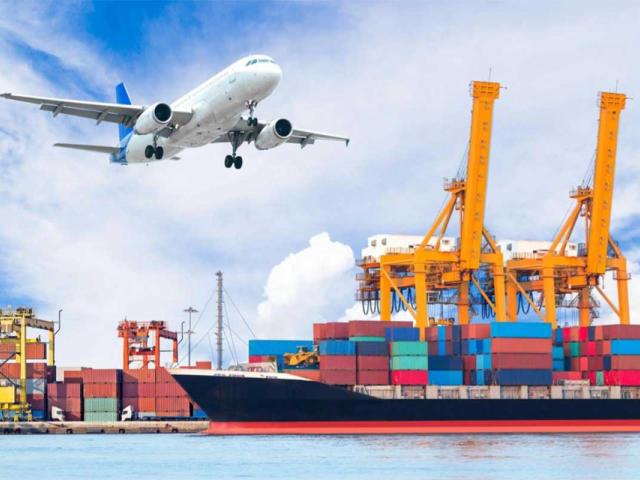
International air freight is the transportation of goods across national borders by aircraft. Although it accounts for less than 1% of global trade by tonnage, it carries approximately 35% of global trade value by value. For time-sensitive, high-value goods (electronics, pharmaceuticals, e-commerce parcels, etc.), air freight is an essential transport option. The Pearl River Delta (Hong Kong HKG, Shenzhen SZX, Guangzhou CAN) is a world-leading air freight hub cluster, with the three airports handling over 8.2 million metric tons of cargo annually.
1. What Is International Air Freight?
International air freight (air cargo) refers to the transportation of goods between different countries by aircraft. Compared to sea freight, air freight accounts for a relatively small share of cargo volume (less than 1% by tonnage), but it carries about 35% of global trade value by value — meaning air freight handles high-value, time-critical goods.
For time-sensitive, high-unit-value goods, air freight is an irreplaceable transport mode. Electronic products, semiconductors, pharmaceuticals, fresh food, aviation parts, emergency repair equipment — these goods rely on air freight for rapid transit from factory to market.
Core Advantages of Air Freight
| Dimension | International Air Freight | International Sea Freight | Notes |
|---|---|---|---|
| Transit Time | 1-5 days | 15-40 days | Air freight is 10-20 times faster |
| Cargo Security | Relatively high | Medium | Air freight involves fewer handlings and stronger control |
| Network Coverage | Hub-based | Port-based | Air freight reaches landlocked countries |
| Document Complexity | Medium | Relatively complex | Air waybill is non-negotiable |
| Price Volatility | High | Medium | Heavily affected by fuel and seasonality |
2. History of International Air Freight
🛩️ Infancy (1910s-1940s)
The beginnings of air cargo trace back to 1911 — the world's first air freight shipment (a barrel of light bulbs) was transported by plane in the UK. During the two world wars, military aviation technology developed rapidly, laying the foundation for post-war commercial air cargo.
📦 Growth Period (1950s-1980s)
The commercial operation of jet aircraft revolutionized air freight. In the 1950s, freighter aircraft such as the Douglas DC-4 and DC-6 began regular transoceanic cargo flights. In the 1970s, the introduction of wide-body aircraft (Boeing 747) greatly expanded air cargo capacity — the belly hold of passenger aircraft became a key component of air freight capacity.
It was also during this period that express giants began to rise — FedEx (1971), UPS Airlines (1988), and DHL (started air cargo in 1969) successively established global air express networks.
🚀 Globalization Period (1990s-2010s)
The 1990s through the 2010s were the golden thirty years for global air cargo. Three major drivers fueled rapid growth in the air freight market:
- Global supply chain restructuring — Electronics manufacturing, automotive parts, and pharmaceuticals adopted "zero-inventory" models, demanding extremely high timeliness
- E-commerce explosion — The globalization of platforms like Amazon and eBay led to exponential growth in small-package air freight demand
- Freighter capacity expansion — Dedicated freighters such as the Boeing 777F (2009) and 747-8F (2011) came into service, greatly increasing range and payload
🤖 Digital Era (2020s onward)
In the 2020s, air cargo entered a new phase driven by digitalization and e-commerce:
- Sustained e-commerce growth: The rise of Chinese cross-border e-commerce platforms like SHEIN, Temu, and TikTok Shop has fueled an explosion in air freight demand from the Pearl River Delta to the world
- Capacity model innovations: Preighters and charter flights became normalized during the pandemic, reshaping traditional capacity structures
- Accelerated digitalization: The adoption rate of electronic air waybills (e-AWB) continues to rise, and IATA has introduced the ONE Record data-sharing standard
- Sustainable Aviation Fuel (SAF): The global aviation industry has committed to net-zero emissions by 2050, with SAF usage increasing year by year
3. Global Air Cargo Market Overview
3.1 Key Data
| Indicator | Data (2025) | Notes |
|---|---|---|
| Global air cargo volume | ~72 million tonnes | About 1% of global trade volume |
| Global air cargo value | ~$8.5 trillion | About 35% of global trade value |
| Global cargo flights | ~250,000 per day | Includes freighters and passenger belly holds |
| China's air cargo volume | ~16 million tonnes | About 22% of global total |
| China's top 3 airports by cargo throughput | Shanghai Pudong / Shenzhen Bao'an / Guangzhou Baiyun | 2025 data |
3.2 Top 10 Global Cargo Airports (2025)
| Rank | Airport | IATA Code | Annual Cargo Throughput (10,000 tonnes) | Key Features |
|---|---|---|---|---|
| 1 | Hong Kong International Airport | HKG | ~470 | World's busiest cargo airport, free trade port |
| 2 | Shanghai Pudong International Airport | PVG | ~390 | China's largest air cargo gateway |
| 3 | Shenzhen Bao'an International Airport | SZX | ~180 | E-commerce parcel hub, fastest growth |
| 4 | Guangzhou Baiyun International Airport | CAN | ~170 | China Southern hub, wide-body freighter base |
| 5 | Incheon International Airport | ICN | ~160 | Northeast Asia transshipment hub |
| 6 | Ted Stevens Anchorage International Airport | ANC | ~150 | Transpacific transit node |
| 7 | Louisville Muhammad Ali International Airport | SDF | ~140 | UPS global superhub |
| 8 | Dubai International Airport | DXB | ~130 | Middle East/Africa cargo transit hub |
| 9 | Narita International Airport | NRT | ~120 | Japan's largest air cargo gateway |
| 10 | Frankfurt Airport | FRA | ~110 | One of Europe's largest air cargo hubs |
3.3 The Position of the Pearl River Delta in Air Freight
The Pearl River Delta is a world-class air freight hub cluster — the three airports (HKG #1 globally, SZX #3 globally, CAN #4 globally) together handle over 8.2 million tonnes of cargo annually, far exceeding traditional air cargo gateways such as New York (JFK+EWR ~1.8 million tonnes) and London (LHR+STN ~1.7 million tonnes).
This pattern is underpinned by the Pearl River Delta's strong manufacturing base and foreign trade vitality:
| City | City Positioning | Air Freight Advantage Industries |
|---|---|---|
| Shenzhen | Global electronics manufacturing center, e-commerce capital | Consumer electronics, IoT devices, e-commerce parcels |
| Guangzhou | Southern China manufacturing center, automotive/garment industry belt | Auto parts, garments, machinery equipment |
| Hong Kong | International trade center, free port | High-value goods, transshipment cargo, pharmaceuticals |
| Macau | Gateway to Portuguese-speaking countries | Special cargo, luxury goods |
4. Which Goods Are Suitable for Air Freight?
4.1 Types of Goods Best Suited for Air Freight
| Cargo Type | Typical Items | Reason for Choosing Air Freight |
|---|---|---|
| Electronics and Semiconductors | Chips, phones, computers, servers | High value, rapid product cycles |
| Pharmaceuticals and Medical Devices | Vaccines, biologics, test kits | Cold chain requirement, time sensitivity |
| Fresh and Temperature-Controlled Cargo | Seafood, fruit, flowers, meat | Short shelf life, need quick delivery |
| AOG (Aircraft on Ground) Parts | Aviation components, industrial equipment spares | Downtime loss far exceeds air freight cost |
| Samples and Documents | Foreign trade samples, contracts, design drafts | Arrive before bulk shipment, seize market opportunity |
| Cross-Border E-Commerce Parcels | Apparel, accessories, home goods, toys | Consumers expect 7-10 day delivery |
| High-Value Consumer Goods | Luxury items, jewelry, artworks | High security requirements, need controlled transport |
4.2 Cost Factors to Consider for Air Freight
Air freight costs are typically 8-15 times higher than sea freight (by unit weight), but in the following scenarios, the "hidden value" of air freight far exceeds the freight cost difference:
- Cash flow: Goods arrive in 10 days vs. 35 days — capital recovery is 3-4 weeks faster
- Inventory costs: Air freight supports small-batch, frequent replenishment, reducing inventory carrying costs
- Market opportunities: Capture peak season windows, new product launches, trade show deadlines
- Supply chain resilience: When sea freight is delayed or disrupted, air freight is a reliable alternative
For a detailed breakdown of air freight cost calculation, see Handbook Section 09: Air Freight Billing: Understanding Volumetric Weight.
5. Air Freight vs. Other Transport Modes
| Dimension | Air Freight | Sea Freight | Rail Freight | Express |
|---|---|---|---|---|
| Transit Time (China to Europe/US) | 1-5 days | 15-40 days | 10-18 days | 2-5 days |
| Cost (Reference) | High | Low | Medium | Highest |
| Suitable Shipment Size | 5 tonnes/shipment | >1 tonne/shipment | >1 tonne/shipment | 50 kg/shipment |
| Network Coverage | Hub + feeder | Port + inland intermodal | Along rail lines | Door-to-door |
| Best Suited Cargo | High-value / time-sensitive | Bulk / low-value | Mid-value / bulk | Documents / small parcels |
For a detailed transport mode selection analysis, see Handbook Section 22: Air vs. Sea vs. Rail: Transport Mode Selection Decision Matrix (shared with this comparison manual).
6. From the Pearl River Delta: Overview of Four Major Air Cargo Gateways
Since Bofeng Logistics' core operations cover the four major air cargo gateways of Guangzhou (CAN), Shenzhen (SZX), Hong Kong (HKG), and Macau (MFM), here is a brief comparison of each gateway's positioning:
Hong Kong International Airport (HKG)
- Global Ranking: 1st (annual cargo throughput ~4.7 million tonnes)
- Core Advantages: Free trade port, flight network covering 200+ cities worldwide, efficient customs clearance, excellent financial and insurance support
- Suitable Cargo: High-value goods, transshipment cargo, cold-chain pharmaceuticals, jewelry
- Key Airlines: Cathay Pacific (CX), Hong Kong Airlines (HX); cargo terminal operator HACTL is globally leading in handling efficiency
Shenzhen Bao'an International Airport (SZX)
- Global Ranking: 3rd (annual cargo throughput ~1.8 million tonnes)
- Core Advantages: Adjacent to the global electronics manufacturing center (Huaqiangbei/Foxconn etc.); leading e-commerce parcel processing capability nationwide
- Suitable Cargo: Electronics, cross-border e-commerce parcels, fresh cold chain
- Key Airlines: China Southern Airlines (CZ/SZ), SF Airlines (PO), China Postal Airlines (3U)
Guangzhou Baiyun International Airport (CAN)
- Global Ranking: 4th (annual cargo throughput ~1.7 million tonnes)
- Core Advantages: China Southern's main hub, abundant wide-body freighter capacity, dense direct routes to Europe and America
- Suitable Cargo: Traditional general cargo, machinery equipment, auto parts, garments
- Key Airlines: China Southern Airlines (CZ), Air China (CA)
Macau International Airport (MFM)
- Global Ranking: Not in top 10 (annual cargo throughput ~50,000 tonnes)
- Core Advantages: Unique positioning for routes to Portuguese-speaking countries; flexible operations
- Suitable Cargo: Special sensitive goods, regional diversion of luxury goods
For an in-depth comparison of the four gateways, see Handbook Section 16: Guangzhou/Shenzhen/Hong Kong/Macau: In-Depth Comparison of the Four Pearl River Delta Air Cargo Gateways.
7. Bofeng Logistics' Air Freight Services
Leveraging the four major air cargo gateways in the Pearl River Delta, Bofeng Logistics provides international air freight services for foreign trade companies and cross-border e-commerce sellers:
- Air Freight Export: China → global, covering general cargo, sensitive cargo, and dangerous goods
- Air Freight Import: Global → China, one-stop customs clearance and delivery
- FBA Air Parcel: Dedicated air freight warehousing solutions for Amazon sellers
- Air Charter: Dedicated solutions for large volumes or urgent shipments
For specific route freight rates and transit times, please contact Bofeng Logistics for an accurate quote.
📞 Hotline: 130-7567-8958 | ✉️ Email: info@zhbfwl.com
Related Logistics Services
Bofeng Logistics offers the following related services, feel free to inquire: