
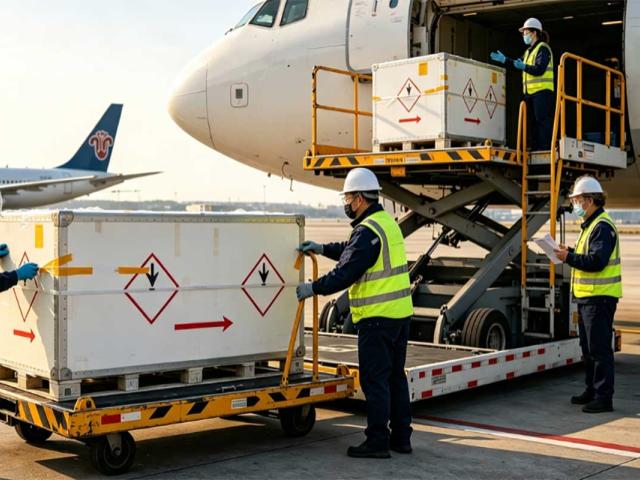
Dangerous goods air transport is strictly regulated by IATA DGR, with the most common category in air freight being Class 9—lithium batteries (UN3480/UN3481). UN3480 (lithium-ion batteries shipped alone) is prohibited as cargo in passenger aircraft bellies, limited to all-cargo aircraft only, with a recommended state of charge ≤30%. Lithium batteries contained in equipment (UN3481) can be transported in passenger aircraft bellies. Handling dangerous goods by air requires a valid IATA DGR certificate (valid for 2 years). Violations or misdeclarations may result in fines up to $50,000 and license revocation.
1. What is Dangerous Goods Air Transport?
Dangerous Goods (DG) refers to goods that may cause harm to personal safety, property, or the environment during air transport. Due to the enclosed high-altitude environment of aircraft, the risk level of air transport of dangerous goods is much higher than surface transport, and thus subject to extremely strict regulations.
Core regulatory framework:
- IATA DGR (Dangerous Goods Regulations) — The global industry standard for air transport of dangerous goods, updated annually
- ICAO TI (Technical Instructions) — Technical instructions from the International Civil Aviation Organization, adopted by national aviation regulatory authorities
- National civil aviation regulations — e.g., China's Civil Aviation Administration (CAAC) "Regulations on the Transport of Dangerous Goods by Civil Aviation"
Key differences between air and sea transport of dangerous goods:
| Comparison Item | Air Dangerous Goods | Sea Dangerous Goods |
|---|---|---|
| Regulatory rules | IATA DGR (annual updates) | IMDG Code (biennial updates) |
| Restriction level | Stricter (higher risk in aircraft environment) | Relatively lenient |
| Lithium battery transport | Strict control (UN3480 prohibited in passenger aircraft bellies) | Relatively lenient |
| Packaging grades | Must meet IATA DGR packing instructions | Must meet IMDG packing instructions |
| Training requirements | Recurrent training every 2 years, DGR certificate | Recurrent training every 5 years |
2. Nine Classes of Dangerous Goods (Air Transport Version)
| Class | Name | Typical Air Cargo Items | Special Air Transport Restrictions |
|---|---|---|---|
| Class 1 | Explosives | Fireworks, ammunition, detonators | Usually prohibited from air transport (except for limited special shipments) |
| Class 2 | Gases | Lighters, compressed air cylinders, fire extinguishers | Strictly restricted; most require special DGR handling procedures |
| Class 3 | Flammable Liquids | Paint, glue, alcohol, solvents | Common air transport chemicals; require Category II or higher packaging |
| Class 4 | Flammable Solids | Sulfur, activated carbon, matches | Activated carbon must be confirmed sufficiently cooled before air transport |
| Class 5 | Oxidizers | Hydrogen peroxide, bleach, fertilizers | Strictly prohibited from contact with combustible materials |
| Class 6 | Toxic/Infectious Substances | Pesticides, chemical intermediates, virus samples | Infectious substances (UN2814) require special approval |
| Class 7 | Radioactive Material | Medical radiation sources, testing instruments | Requires approval from the National Nuclear Safety Administration |
| Class 8 | Corrosives | Sulfuric acid, sodium hydroxide, battery acid | Requires corrosion-resistant inner packaging + absorbent material |
| Class 9 | Miscellaneous Dangerous Goods | Lithium batteries, magnets, dry ice, life-saving equipment | Most commonly air-transported dangerous goods class |
🔴 The most commonly air-transported dangerous goods are Class 9 lithium batteries—almost all electronic products containing lithium batteries (phones, laptops, power banks, power tools) involve dangerous goods compliance issues during air transport.
3. Lithium Battery Air Transport Special Topic
Lithium batteries are the most common and most closely watched category of dangerous goods in current air transport. IATA DGR regulations for lithium battery transport are tightened year by year.
3.1 Classification of Lithium Batteries
| UN Number | Name | Description |
|---|---|---|
| UN3090 | Lithium metal batteries (shipped alone) | Non-rechargeable batteries (e.g., button cells) |
| UN3091 | Lithium metal batteries contained in equipment | Batteries already installed in equipment |
| UN3480 | Lithium-ion batteries (shipped alone) | Rechargeable batteries (e.g., 18650 lithium batteries) |
| UN3481 | Lithium-ion batteries contained in equipment | Batteries already installed in phones/computers, etc. |
3.2 Key Requirements for Lithium Battery Air Transport
UN3480 (Lithium-ion batteries shipped alone) — Strictest category
| Requirement | Description |
|---|---|
| All-cargo aircraft only | UN3480 prohibited as cargo in passenger aircraft bellies (since 2016) |
| State of Charge (SoC) limit | Recommended SoC not exceeding 30% (reduces thermal runaway risk) |
| Packing Instruction PI965 | Must be packed per IATA DGR PI965 (Category I or II packaging) |
| Labeling requirements | Must affix lithium battery mark + Cargo Aircraft Only label |
| Documentation requirements | Dangerous Goods Declaration + Lithium Battery Test Summary (UN38.3) |
UN3481 (Lithium-ion batteries contained in equipment)
| Requirement | Description |
|---|---|
| Can be carried on passenger aircraft | Batteries installed in equipment can go in passenger aircraft bellies |
| Packing Instructions PI966/967 | Equipment must prevent accidental activation; batteries must be protected from short circuit |
| Quantity limits | Subject to maximum per shipment (varies by airline) |
3.3 Required Documents for Lithium Battery Air Transport
- UN38.3 Test Summary: Proof that the battery has passed UN38.3 tests (impact, thermal shock, overcharge, etc.—8 tests)
- MSDS (Material Safety Data Sheet): Battery composition and hazard description
- Dangerous Goods Declaration (DGD): Dangerous goods transport declaration signed by the shipper
- Lithium Battery Test Report: Test certificate issued by a third-party testing body
3.4 Lithium Battery Air Transport Compliance Checklist
- [ ] Battery model has passed UN38.3 test ✅
- [ ] State of charge ≤ 30% ✅
- [ ] Outer box affixed with lithium battery mark ✅
- [ ] Outer box affixed with "Cargo Aircraft Only" label (UN3480) ✅
- [ ] Dangerous Goods Declaration completed and signed ✅
- [ ] MSDS prepared with the shipment ✅
- [ ] Packaging meets PI965/PI966/PI967 requirements ✅
- [ ] Operators hold valid DGR certificate ✅
4. Other Common Air Transport Dangerous Goods
4.1 Magnets/Magnetic Materials
Magnetic materials can affect aircraft compass and navigation systems, so strict limits apply:
- Limit: At any point 2.1m from the surface of the package, magnetic field strength ≤ 0.418 A/m (0.00525 Gauss)
- Exceeding limit: Magnetic materials exceeding the limit must be declared as Class 9 dangerous goods
- Common items: Speakers, motors, magnet materials, electromagnetic equipment
4.2 Dry Ice (Solid Carbon Dioxide, UN1845)
Dry ice is commonly used for cold chain packaging of temperature-controlled goods:
- Exemption: ≤ 2.5kg per shipment may be transported without dangerous goods declaration (but must be noted on the AWB)
- Exceeding quantity: Over 2.5kg must be handled as Class 9 dangerous goods
- Packaging requirement: Packaging must allow carbon dioxide gas to escape (not completely sealed)
- Label: Outer box must bear "Dry Ice" label indicating net weight of dry ice
4.3 Chemicals (Classes 3/6/8)
Common chemicals transported by air include:
| Chemical | Dangerous Goods Class | Transport Notes |
|---|---|---|
| Alcohol-based disinfectants | Class 3 Flammable Liquid | Stricter restrictions when alcohol concentration >70% |
| Paint/thinner | Class 3 Flammable Liquid | Flash point must be within DGR allowable range |
| Pesticides | Class 6 Toxic / Class 3 Flammable | Must provide MSDS and pesticide registration certificate |
| Chemical intermediates | Depends on composition | Classification determined by each component |
5. Dangerous Goods Air Transport Operation Process
5.1 Basic Process
① Goods classification → ② Select packaging → ③ Apply labels/marks →
④ Complete Dangerous Goods Declaration → ⑤ Book space (indicate DG) →
⑥ Deliver → Security check → Build pallet (per DG segregation requirements) → ⑦ Load onto aircraft (designated position)
5.2 Key Operation Points
Booking space:
- Must specify dangerous goods when booking, provide UN number, dangerous goods class, packing group
- Some airlines have restrictions on dangerous goods (e.g., do not accept certain classes)
Pallet building/loading:
- DG ULDs must be labeled with dangerous goods marks
- Segregation requirements exist among Classes 1/2/3/4/5/6/8/9; cannot be mixed
- Lithium battery ULDs must be loaded in all-cargo aircraft designated safe positions (e.g., nose-side restricted area or ventilated area)
Documentation:
- Dangerous Goods Declaration (DGD) in duplicate, signed by shipper
- AWB must state "Shipper's Declaration for Dangerous Goods"
- Accompanying dangerous goods documents must travel with the shipment
5.3 Airports Capable of Handling Dangerous Goods
Not all airports have dangerous goods handling capability. Pearl River Delta situation:
| Airport | DG Handling Capability | Notes |
|---|---|---|
| Hong Kong (HKG) | ✅ Full | International standard DG handling facilities |
| Guangzhou Baiyun (CAN) | ✅ Full | South China DG handling center |
| Shenzhen Bao'an (SZX) | ✅ Full | Recently expanded DG operation area |
| Macau (MFM) | ⚠️ Limited | Most DG must be routed via Hong Kong |
6. Consequences of Dangerous Goods Violations
Violating dangerous goods air transport rules is not a minor issue—consequences are severe:
| Violation Scenario | Consequence |
|---|---|
| Failure to declare dangerous goods | Fine up to $50,000 + civil damages (per national laws) |
| Non-compliant packaging | Cargo rejected, detained, destroyed |
| Missing labels/marks | Security check failure, flight delay, rebooking/return costs |
| Illegal lithium battery transport | IATA/ICAO notification, airline blacklisting |
| Misdeclaration of dangerous goods | Criminal prosecution (misdeclaration of DG is illegal) |
| Causing an incident | Full compensation + criminal liability |
📌 Case: In 2023, a freight forwarder misdeclared lithium batteries (declared as general cargo) causing a cargo hold smoke alarm. The civil aviation authority imposed a fine and revoked the air freight agency qualification. Compliant shipping is the most basic prerequisite for air transport of dangerous goods.
7. Frequently Asked Questions
Q1: My product contains lithium batteries. Is it considered dangerous goods?
Yes. Any product containing lithium batteries (phones, laptops, power banks, power tools, Bluetooth earphones, etc.) is considered dangerous goods in air transport and must be handled per Class 9 dangerous goods requirements.
Q2: A small amount of dry ice is used for cold chain packaging. Do I need to declare it as dangerous goods?
Dry ice ≤2.5kg per shipment is exempt from dangerous goods declaration, but must be noted on the AWB as "Dry Ice, UN1845, Net weight X kg". If exceeding 2.5kg, it must be handled as Class 9 dangerous goods.
Q3: Can I still handle dangerous goods after my DGR certificate expires?
No. The IATA DGR certificate is valid for 2 years. Upon expiration, you must retake training and pass the exam to continue handling dangerous goods.
Q4: Can all airlines transport dangerous goods?
No. Some airlines (especially low-cost carriers and smaller airlines) have strict category restrictions on dangerous goods, or may not accept dangerous goods at all. You must confirm the airline's DG policy before booking.
Need to ship dangerous goods by air? Bofeng Logistics has a professional team trained in IATA DGR, providing one-stop services for dangerous goods identification, packaging, declaration, and transport.
📞 Hotline: 130-7567-8958 | ✉️ Email: info@zhbfwl.com
Further reading:
- Article 05: Classification Guide for Airworthy Cargo
- Article 06: Air Cargo Packaging and Pallet Building Operating Standards
- Maritime Manual Article 09: Special Cargo by Sea: Dangerous Goods, Oversized Items, Refrigerated Cargo Guide
- Dangerous goods by sea (IMDG) provides complementary reference to this article's air DGR
Related reading
Related Logistics Services
Bofeng Logistics offers the following related services, feel free to inquire: