
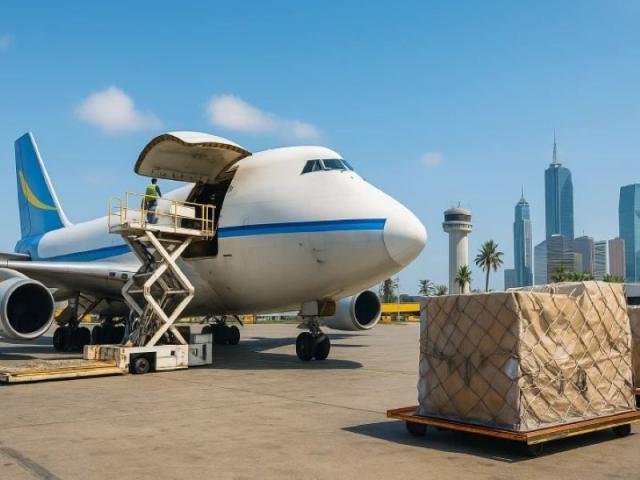
Air cargo uses ULDs (Unit Load Devices) for loading, with the most common being PMC pallets (318×244 cm, capacity 4.6–6.8 tons) and AKE containers (LD-3, capacity ~1,588 kg). The three core principles of pallet building: center of gravity in the ULD center zone, heavy cargo at the bottom and light on top, nets must cover all cargo and be tightened. Operating characteristics of Pearl River Delta airports: Shenzhen SZX has high efficiency for e-commerce small packages, Guangzhou CAN has well-established wide-body freighter ULD operations, Hong Kong HKG’s HACTL automated ULD storage system is world-leading.
I. Basic Requirements for Air Freight Packaging
1.1 Differences Between Air Freight and Sea Freight Packaging
Sea freight containers usually withstand high stacking pressure and external impact, but air freight cargo faces different physical environments during transport:
| Environmental Factor | Air Freight Characteristics | Packaging Requirements |
|---|---|---|
| Pressure changes | Cargo hold pressure changes during flight (equivalent to ~2,400m altitude) | Sealed containers need pressure relief holes |
| Temperature changes | Ground high temp → high altitude low temp → ground high temp (temperature difference can exceed 50°C+) | Packaging materials must withstand wide temperature range |
| Vibration frequency | High-frequency vibration during flight | Internal support and cushioning are more critical |
| Stacking pressure | Air freight does not stack as densely as sea freight (usually single or double layer within ULD) | Vertical compression resistance requirement is lower than sea freight |
| Handling frequency | Air freight has more handling stages (cargo station receiving → security check → pallet building → loading) | Outer packaging must withstand multiple handling operations |
1.2 General Packaging Specifications
| Requirement | Description |
|---|---|
| Sufficiently strong outer carton | Recommended double-wall corrugated cardboard box (at least 3 layers), or plywood box/wooden crate |
| Adequate cushioning | Fill internal voids with foam/bubble wrap/air bags to prevent shifting during transport |
| Clear outer markings | Product name, piece number, destination airport code, consignee info, total pieces (e.g., "1/5") |
| Fragile marking | Affix "FRAGILE" label on fragile items; if necessary, affix direction marker "THIS SIDE UP" |
| Prohibited packaging | Do not use straw/wicker packaging with risk of insect eggs; solid wood packaging requiring heat treatment or fumigation must have IPPC mark |
| Prohibited items | Do not use old cartons (reduced load-bearing capacity), do not use cloth bags or woven bags (cannot protect and cannot be palletized) |
1.3 Special Cargo Packaging Requirements
| Cargo Type | Special Packaging Requirements |
|---|---|
| Lithium batteries | Must comply with UN38.3 test standard, affix lithium battery label on outer carton, packaging must prevent short circuits |
| Liquids | Inner packaging must be leak-proof, outer layer must contain absorbent material (sufficient to absorb all liquid) |
| Powders | Double-layer sealed packaging to prevent leakage contaminating other cargo |
| Magnets/magnetic materials | Must be demagnetized or provide magnetic test report; packaging must indicate magnetic material |
| Valuable cargo | Recommended to use lockable wooden crate; do not disclose cargo content on outer packaging |
| Temperature-controlled cargo | Use insulated container (EPS/polyurethane) + ice packs/dry ice/temperature-controlled phase change materials |
II. ULD (Unit Load Device) Types and Selection
ULD (Unit Load Device) is a loading tool used in air freight to combine loose cargo into a standard unit. It is one of the main operational differences between air freight and sea freight.
2.1 Basic ULD Categories
| Category | Description | Common Models |
|---|---|---|
| Pallet | Flat aluminum plate + fixed net | PMC (P6P), PAG, PGA |
| Container | Enclosed box (also called "can" or "Igloo") | AKE (LD-3), AMF, AAP |
| Bulk hold | No ULD, loose cargo loaded directly | Narrow-body aircraft belly |
2.2 Detailed Common ULD Models
| Model | Type | Outer Dimensions (cm) | Max Payload | Compatible Aircraft | Typical Use |
|---|---|---|---|---|---|
| AKE (LD-3) | Container | 156×153×163 | ~1,588 kg | Wide-body belly (777/787/A330) | Loose cargo consolidation, most common small ULD |
| AMF | Container | 318×153×163 | ~2,242 kg | 747 main deck | Larger volume cargo |
| PMC (P6P) | Pallet | 318×244×160 (incl. cargo height) | ~4,624–6,804 kg | Freighters / wide-body belly | Most common standard pallet |
| PAG (PGA) | Pallet | 318×244×244 (incl. cargo height) | ~5,670–6,804 kg | 747/777 freighters | High pallet, suitable for tall cargo |
| PLA (P1P) | Pallet | 318×154×160 (incl. cargo height) | ~2,500–3,200 kg | Wide-body belly | Half pallet, smaller batches |
2.3 ULD Types Supported by Different Aircraft
| Aircraft | Belly ULD Types | Main Deck ULD Types (Freighter) |
|---|---|---|
| Boeing 777-300ER | AKE / PMC | — (no main deck) |
| Boeing 777F | AKE / PMC | PMC / PAG |
| Boeing 747-400F | AKE / PMC | PMC / PAG / AMF |
| Airbus A330-300 | AKE | — (no main deck) |
| Airbus A350-900 | AKE / PMC | — (no main deck) |
| Airbus A350F (upcoming) | AKE / PMC | PMC / PAG |
| Boeing 737-800BCF | Bulk hold | Bulk hold |
III. Pallet Building (Build-up) Operation Standards
3.1 Preparations Before Pallet Building
- Confirm ULD availability: Check ULD for damage (cracks, deformation, net damage)
- Confirm cargo readiness: Cargo has passed security check, outer packaging intact, markings complete
- Verify cargo information: Piece count, weight, description match AWB details
- Prepare pallet building materials: Stretch wrap, straps, edge protectors
3.2 Pallet Building Operation Steps
Step 1: ULD positioning → Place ULD on build-up platform and lock
Step 2: Base protection → Lay protective film/pad on ULD base
Step 3: Cargo stacking → Stack radially from ULD center outward, heavy cargo at bottom, light on top
Step 4: Center of gravity control → Ensure cargo weight is evenly distributed in ULD center area
Step 5: Securing → Use net + straps to secure cargo, prevent shifting during transport
Step 6: Weighing & labeling → Weigh after completion and mark total weight, ULD number
Step 7: Inspection & confirmation → Check ULD label, center of gravity, strap tightness
3.3 Key Points of Pallet Building
Center of Gravity Control — Most important safety requirement
- Cargo center of gravity must be near the central vertical axis of the ULD
- Off-center loading (shifted CG) affects aircraft trim balance; severe cases may prevent ULD from being loaded
- If off-center exceeds ULD’s tolerance limit, repalletizing is required
Stacking Rules
- Place heaviest cargo at the bottom layer (low CG, more stable)
- Fragile items on top to avoid compression
- Minimize gaps between boxes (fill with cushioning material)
- Cargo must not exceed ULD boundaries (overhang requires special attention)
Securing Requirements
- Net covers all cargo; all net hooks engaged in ULD locking holes
- Individual cargo exceeding 150 kg requires additional strap securing
- Straps must be tightened without slack
ULD Labeling Each ULD must bear the following labels:
| Label | Content |
|---|---|
| ULD identification label | ULD model + number + airline |
| Weight label | Total weight (including ULD tare) |
| Dangerous goods label | If containing dangerous goods, affix corresponding DG label |
| Special cargo label | PER (perishable) / AVI (live animals) / VAL (valuable) etc. |
3.4 Pallet Building Operation Diagram
┌───────────────────────┐
│        ULD Net         │  ← Covers all cargo and locked
├───────────────────────┤
│    ┌───┐ ┌───┐ ┌───┐  │
│    │Lgt│ │Lgt│ │Lgt│  │  ← Upper layer: light cargo
│    └───┘ └───┘ └───┘  │
│    ┌───┐ ┌───┐ ┌───┐  │
│    │Hvy│ │Hvy│ │Hvy│  │  ← Bottom layer: heavy cargo
│    └───┘ └───┘ └───┘  │
│    ┌───┐ ┌───┐ ┌───┐  │
│    │Hvy│ │Hvy│ │Hvy│  │  ← Bottommost layer: heaviest cargo
│    │est│ │est│ │est│  │
│    └───┘ └───┘ └───┘  │
├─── ─ ─ ─ ─ ─ ─ ─ ─ ───┤
│     ULD Base (Pallet)    │
└───────────────────────┘
        ◎ CG Position
    (ULD center area)
IV. Common Packaging and Pallet Building Issues
| Issue | Consequence | Solution |
|---|---|---|
| Oversized cargo | Cannot fit into ULD or aircraft door | Confirm ULD/aircraft compatibility before shipping |
| Off-center / CG shift | ULD cannot be loaded; requires repalletizing | Distribute weight evenly during stacking |
| Damaged outer packaging | Cargo may be damaged during transport | Use sufficiently strong outer carton |
| Unclear markings | Operational errors at destination | Print clear labels; use tamper-proof label tags if possible |
| Net not used | Cargo may fall off ULD | All pallet building must use net |
| ULD tare weight exceeded | Overload prevents loading | Weigh after pallet building to confirm within limits |
| Dangerous goods inner packaging violation | Rejected by airline, fines | Strictly follow DGR requirements |
| Missing lithium battery label | Security check fails | Outer carton with lithium batteries must have lithium battery label |
V. Pallet Building Operation Characteristics at Pearl River Delta Airports
| Airport | Operation Characteristics | Special Requirements |
|---|---|---|
| Shenzhen Bao'an (SZX) | High proportion of e-commerce cargo; high efficiency in standard small-package pallet building; SF’s own pallet building system | E-commerce cargo sorting must be pre-classified by destination |
| Guangzhou Baiyun (CAN) | China Southern main base; wide-body freighter and belly pallet building operations; large ULDs (PMC/PAG) common | International and domestic cargo operations in separate areas |
| Hong Kong (HKG) | HACTL operation efficiency world-leading, equipped with automated ULD storage system; transit cargo pallet building operations complex | Cross-border cargo involves transport connection from land border to airport |
Need air freight packaging solutions or pallet building support? Bofeng Logistics offers full-service support from packaging advice to pallet building operations. Contact us for more information.
📞 Hotline: 130-7567-8958 | ✉️ Email: info@zhbfwl.com
Extended Reading:
- Article 05: Airworthy Cargo Classification Guide
- Article 07: Complete Guide to Dangerous Goods by Air (DGR)
- Article 11: Full Process of Export Air Freight Operations
Related Logistics Services
Bofeng Logistics offers the following related services, feel free to inquire: