
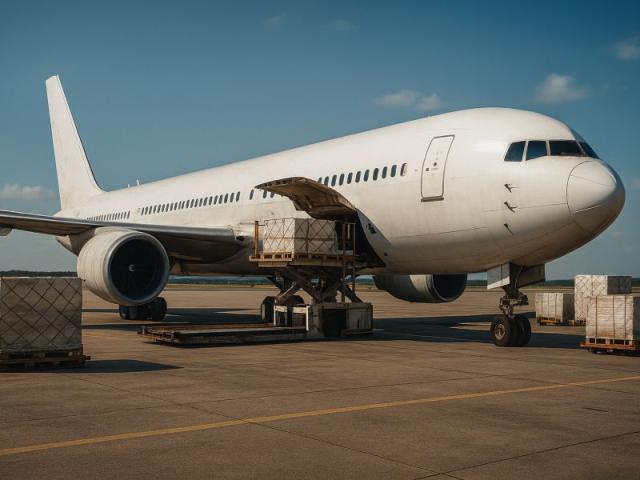
Online tool: use the air volumetric-weight calculator to estimate volumetric and chargeable weight instantly.
Air freight charges use the "greater of" principle—dimensional weight (length × width × height cm ÷ 6000) and actual gross weight are compared, and the larger value is used as the chargeable weight. For example, a cargo with dimensions 120×80×90 cm and actual weight 85 kg has a dimensional weight of 144 kg, so the chargeable weight is 144 kg. Low-density cargo can effectively reduce dimensional weight through optimized packaging (compression, smaller boxes, vacuum packing). International couriers (DHL/UPS/FedEx) use a divisor of ÷5000 (higher than the ÷6000 used for general air freight), making general air freight more economical than courier services for large shipments.
I. Why is air freight charged by dimensional weight?
Imagine you have an aircraft with fixed cargo space. One ton of cotton and one ton of steel differ several times in volume but occupy the same payload tonnage—this is unfair.
To solve this, the air cargo industry introduced the concept of DIM Weight (Dimensional Weight):
Dimensional weight = The "virtual weight" obtained by converting the cargo volume using a specific conversion factor.
When charging, the greater of actual gross weight and dimensional weight is used as the chargeable weight—this is the industry-wide "greater of" rule for air freight.
Business logic behind it
| Cargo Type | Actual Weight (kg) | Volume (m³) | Dimensional Weight (kg) | Chargeable Weight (kg) | Which one the airline uses |
|---|---|---|---|---|---|
| Steel parts | 1,000 | 0.5 | 83 | 1,000 | Actual weight |
| Cotton | 1,000 | 5.0 | 833 | 1,000 | Still actual weight (small difference) |
| Empty foam box | 100 | 3.0 | 500 | 500 | Dimensional weight—takes up space |
The "greater of" rule fairly reflects two types of capacity consumption: actual weight represents fuel consumption, and dimensional weight represents space consumption.
II. Formula for calculating dimensional weight
2.1 International standard formula
The standard calculation in the air freight industry is:
Dimensional weight (kg) = Length (cm) × Width (cm) × Height (cm) ÷ 6000Note: International couriers (e.g., DHL/UPS/FedEx) typically use a divisor of ÷5000 (see comparison below). Please refer to the specific carrier's published coefficient.
2.2 Calculation steps
Step 1: Measure the outer packaging dimensions
- Use the longest point, widest point, and highest point (including packaging)
- Accurate to centimeters (cm), round up
Step 2: Calculate the dimensional weight of a single piece
Single piece dimensional weight = Length × Width × Height ÷ 6000Step 3: Combined charging for multiple pieces
When a shipment contains multiple pieces, calculate the dimensional weight of each piece separately, then sum them to get the total dimensional weight. Compare this with the total actual gross weight and take the larger value.
2.3 Examples
Example 1: Low-density cargo (charged by dimensional weight)
A machine outer box dimensions 120cm × 80cm × 90cm, actual gross weight 85kg
Dimensional weight = 120 × 80 × 90 ÷ 6000
                  = 864,000 ÷ 6000
                  = 144 kg
Actual gross weight 85kg Dimensional weight 144kg → Chargeable weight = 144 kg
Example 2: High-density cargo (charged by actual weight)
A box of steel fittings outer dimensions 60cm × 40cm × 30cm, actual gross weight 35kg
Dimensional weight = 60 × 40 × 30 ÷ 6000
                  = 72,000 ÷ 6000
                  = 12 kg
Actual gross weight 35kg > Dimensional weight 12kg → Chargeable weight = 35 kg
Example 3: Combined charging for multiple pieces
A shipment contains 3 boxes:
| Box No. | Dimensions (cm) | Actual Weight (kg) | Dimensional Weight (kg) |
|---|---|---|---|
| Box 1 | 100×60×50 | 40 | 100×60×50÷6000 = 50 |
| Box 2 | 80×50×40 | 30 | 80×50×40÷6000 = 26.7 |
| Box 3 | 120×80×60 | 60 | 120×80×60÷6000 = 96 |
| Total | — | 130 | 172.7 |
Total actual weight 130kg Total dimensional weight 172.7kg → Chargeable weight = 173 kg (rounded up to 0.5kg)
III. Distinguishing low-density vs. high-density cargo
3.1 Judgment criteria
Compare the actual gross weight with the dimensional weight:
| Type | Judgment | Charging method |
|---|---|---|
| High-density cargo (Heavy cargo) | Actual weight ≥ Dimensional weight | Charged by actual weight |
| Low-density cargo (Light/bulky cargo) | Actual weight Dimensional weight | Charged by dimensional weight |
Industry reference density:
| Type | Density | Typical cargo |
|---|---|---|
| High-density | > 300 kg/m³ | Steel parts, machinery, hardware tools |
| Medium-density | 167–300 kg/m³ | Electronics, clothing, accessories |
| Low-density | 167 kg/m³ | Foam products, plastic parts, empty packaging, cotton goods |
Critical density = 6000 ÷ 1,000,000 × 1000 = 167 kg/m³ (i.e., 167kg per cubic meter)
3.2 Methods to reduce chargeable weight
If you are shipping low-density cargo, try the following methods to reduce dimensional weight:
| Method | Operation | Effect |
|---|---|---|
| Optimize outer packaging | Remove excess packaging, reduce box size | Directly reduces volume |
| Vacuum compression | Vacuum-pack clothing, cotton goods, etc. | Reduces volume by 50-70% |
| Disassemble and repack | Disassemble detachable items and pack in separate boxes | Reduces gaps, improves space utilization |
| Rearrange packing | Repack irregularly shaped items in a more efficient arrangement | Reduces excess space in outer box |
| Avoid nested boxes | Do not put a large box inside a small box; choose a box that fits the actual size | Reduces extra volume |
IV. Dimensional weight calculation coefficients for different channels
Important reminder: Different transport channels use different dimensional weight conversion coefficients, which directly affect the final cost.
| Channel | Coefficient | Formula | Notes (as of 2026) |
|---|---|---|---|
| General air freight | ÷6000 | L×W×H(cm) ÷ 6000 | IATA standard, globally used |
| International courier (DHL/UPS/FedEx) | ÷5000 | L×W×H(cm) ÷ 5000 | Divisor is 5000, dimensional weight is 20% higher than air freight |
| Domestic air freight | ÷6000 | L×W×H(cm) ÷ 6000 | Consistent with IATA standard |
| Rail transport | ÷6000 | L×W×H(cm) ÷ 6000 | Same as sea/air freight |
| LCL sea freight | ÷1000 | L×W×H(cm) ÷ 1,000,000 → m³ | Charged by cubic meters (1 CBM = 1 m³) |
4.1 Example of difference between air freight and courier
Same cargo using different channels:
Cargo dimensions: 100cm × 80cm × 60cm, actual weight 80kg
| Channel | Calculation | Dimensional weight | Chargeable weight | Difference |
|---|---|---|---|---|
| General air freight (÷6000) | 100×80×60÷6000 | 80kg | 80kg | — |
| International courier (÷5000) | 100×80×60÷5000 | 96kg | 96kg | Chargeable weight 20% higher |
This means that for the same cargo, the chargeable weight for international courier is 20% higher than for general air freight. That is why large shipments are better suited to general air freight than to courier services.
V. Practical tips for air freight charging
5.1 Optimize packaging to reduce dimensional weight
For large-volume low-density cargo, optimizing packaging is the most direct way to reduce costs:
- Case: A shipment of foam products to Europe, original packaging 120×80×90cm, actual weight 60kg
- Before optimization: Dimensional weight = 120×80×90÷6000 = 144kg → Chargeable weight 144kg
- After optimization (compression + smaller box to 90×60×50cm): Dimensional weight = 90×60×50÷6000 = 45kg → Chargeable weight 60kg
- Cost savings of 58%
5.2 Combined shipment vs. separate shipments
For multiple pieces, should they be combined into one shipment or sent separately? This affects the chargeable weight.
- Combined as one shipment: Compare total dimensional weight with total actual weight, take the larger value.
- Separate shipments: Each shipment calculates its own dimensional weight and actual weight independently; the sum may be larger.
When there are both heavy and light items, combining them into one shipment can sometimes reduce the overall chargeable weight.
5.3 Pairing heavy cargo with light cargo
If you can ship light cargo together with heavy cargo in the same consignment, the overall density can be brought closer to the critical value, reducing "wasted" chargeable weight. This is a common technique used by experienced freight forwarders.
5.4 Correct approach when requesting quotes
When asking a freight forwarder for a quote, provide both the total weight and total volume so that the forwarder can accurately calculate the chargeable weight and give a precise quote.
Example of a proper quote request:
"One shipment to Los Angeles, USA, 20 boxes of electronics,
Total actual weight 350kg, total volume 2.8 CBM,
Please quote general air freight rate."
VI. Frequently Asked Questions (FAQ)
Q1: What is the minimum chargeable weight unit for air freight?
General air freight is usually billed in increments of 0.5kg or 1kg, with partial amounts rounded up. For example, a chargeable weight of 12.1kg is billed as 12.5kg or 13kg. Couriers use 0.5kg increments.
Q2: Where does "1 CBM = 167 kg" come from?
1 CBM = 1 m³ = 1,000,000 cm³. Using the ÷6000 coefficient, 1,000,000 ÷ 6000 ≈ 167 kg. That is why the industry often says "air freight: 1 cubic meter equals 167 kg," which is the boundary for distinguishing low-density and high-density cargo.
Q3: What if there is a dispute over actual weight?
The actual weighing result from the carrier (airline or cargo terminal) prevails. You can verify the weighing data at the cargo terminal before shipment. If you have any objection, you may request a re-weigh in person.
Q4: When calculating dimensional weight, do we measure the outer box or inner box?
Outer box. Measure the maximum external dimensions of the cargo (including packaging and pallet height). If the cargo is shipped without packaging (bare), measure the maximum dimensions of the cargo itself.
Q5: Are there additional charges for oversized items?
Yes. Single items exceeding a certain weight threshold (usually 150kg or 300kg) incur an overweight surcharge; items with a single side exceeding a certain length (e.g., 300cm) incur an overlength surcharge. Specific standards vary slightly between airlines.
VII. Quick dimensional weight reference table
| Volume (cm) | Dimensional weight (÷6000) | Density | Judgment |
|---|---|---|---|
| 1 CBM | 167 kg | 167 kg/m³ | Critical value |
| 0.5 CBM | 83 kg | 167 kg/m³ | Half of critical |
| 0.2 CBM | 33 kg | 167 kg/m³ | — |
| 60×40×40 cm | 16 kg | — | Small standard box reference |
| 120×80×80 cm | 128 kg | — | Large standard pallet reference |
Easy to remember: 1 CBM ≈ 167 kg
If you need an accurate air freight cost estimate, please contact Bofeng Logistics—we can match the most economical air freight channel based on your cargo's volume and weight.
📞 Hotline: 130-7567-8958 | ✉️ Email: info@zhbfwl.com
Related Logistics Services
Bofeng Logistics offers the following related services, feel free to inquire: