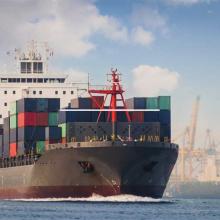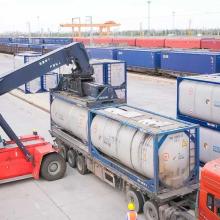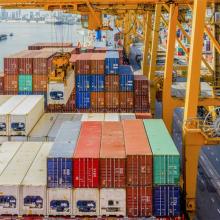

When cargo exceeds the internal dimensions or weight limits of standard dry containers, specialized containers are required. Open-top, hard-top, and flat-rack containers are the three most commonly used solutions for out-of-gauge cargo.
I. Core Parameter Comparison of the Three Container Types
| Parameter | Open-Top 20OT | Open-Top 40OT | Hard-Top 20HT | Flat-Rack 20FR | Flat-Rack 40FR |
| External Dimensions (mm) | 6,058×2,438×2,591 | 12,192×2,438×2,591 | 6,058×2,438×2,591 | 6,058×2,438×2,591 | 12,192×2,438×2,591 |
| Internal Length (mm) | 5,898 | 12,032 | 5,898 | 6,028 | 12,088 |
| Internal Width (mm) | 2,330 | 2,330 | 2,330 | 2,240 | 2,240 |
| Internal Height (mm) | 2,391 | 2,391 | 2,530 (taller than OT) | 2,240 | 1,980 |
| Maximum Payload (kg) | 28,200 | 28,800 | 28,200 | 40,000 | 45,000 |
| Tare Weight (kg) | 2,400 | 4,100 | 3,100 | 3,200 | 5,500 |
| Top Structure | Tarpaulin + removable bows | Tarpaulin + removable bows | Removable steel roof | No top | No top |
| Side Structure | Corrugated steel panels | Corrugated steel panels | Corrugated steel panels | No side walls | No side walls |
| Removable End Walls | Non-removable | Non-removable | Non-removable | Foldable | Foldable |
II. Open-Top Container
Applicable Scenarios
Open-top containers have a waterproof tarpaulin cover and allow cargo to be loaded from above. Suitable for cargo that is over-height but does not exceed the container frame height.
Suitable Cargo Types:
- Cargo exceeding the standard container door height (>2,280mm) but not exceeding 2.3m
- Equipment that needs to be lifted in from above
- Large glass sheets and stone slabs
- Long steel pipes and timber (may protrude beyond the container, subject to out-of-gauge handling)
Usage Method
Open-Top Container Loading Procedure:
1. Open the tarpaulin roof → Remove bows → Open the top
2. Crane lifts cargo into the container from above
3. Cargo in position → Secure/lash
4. Install bows → Cover with tarpaulin → Secure tarpaulin with lashings
| Operational Point | Standard |
| Maximum cargo height | ≤30 cm below the top of the frame (otherwise tarpaulin cannot be secured) |
| Tarpaulin securing | Lashing ropes on bows must have ≥8 attachment points |
| Waterproofing | Sealant tape recommended at tarpaulin seams |
| Out-of-gauge declaration | Over-height cargo must be declared to the terminal and shipping line |
Open-Top Container Costs
| Cost Item | Reference Amount | Notes |
| Special container surcharge (20ft) | ¥500–1,000 | Additional cost over standard 20GP |
| Special container surcharge (40ft) | ¥800–1,500 | Additional cost over standard 40GP |
| Terminal out-of-gauge handling fee | ¥300–800 | Incurred when special lifting is required |
| Tarpaulin/bow damage compensation | ¥2,000–5,000 | If damage occurs |
III. Hard-Top Container
Applicable Scenarios
Hard-top containers are similar to open-top containers, but the roof is a removable steel structure rather than tarpaulin. Suitable for scenarios where the cargo needs load-bearing capacity above it.
Core Differences from Open-Top Containers:
| Comparison | Open-Top Container | Hard-Top Container |
| Roof Material | Waterproof tarpaulin | Removable steel roof |
| Steel Roof Load Capacity | Not stackable | Stackable 1 layer high |
| Removal/Installation Time | 10 minutes | 30–60 minutes (crane required) |
| Applicable Scenarios | Over-height light cargo | Over-height heavy cargo + stacking empty containers for return |
| Market Availability | Abundant | Limited (book in advance) |
Suitable Cargo:
- Over-height cargo requiring rigid overhead protection
- Return shipping scenarios where empty containers need to be stacked
- Over-height machinery and equipment
IV. Flat-Rack Container
Applicable Scenarios
Flat-rack containers have no side walls or roof – only a floor and end walls – allowing loading from any direction. Suitable for over-weight, over-sized, and irregularly shaped cargo.
Suitable Cargo Types:
| Cargo Type | Typical Specifications | Recommended Container Type |
| Construction vehicles | Small excavators/loaders | 20FR (≤8 tons) |
| Large equipment | Generator sets/boilers | 40FR (10–30 tons) |
| Steel structures/bridge components | >12m over-length items | 40FR (requires OOG declaration) |
| Marine parts | Propellers/shaft systems | 20FR or 40FR |
| Large molds | Injection molding machines/die-casting molds | 20FR (≤20 tons) |
| Steel coils (extra-large) | >8 tons/coil | 20FR (easier bottom securing) |
Flat-Rack Usage Key Points
| Key Point | Description |
| Lashing and securing | All cargo must be lashed to the bottom lashing rings |
| Center-of-gravity control | The cargo's center of gravity must be aligned with the container's centerline |
| Out-of-gauge declaration | Any dimension (length/width/height) exceeding the container profile must be declared |
| Terminal confirmation | Out-of-gauge cargo must be confirmed in advance that the terminal has the handling capability |
| Lashing plan | It is recommended that a professional lashing company provide the lashing plan |
Flat-Rack Lashing Ring Layout
20ft Flat-Rack Lashing Ring Layout (floor top view):
┌──────────────────────────────────────┐
│ ○──○──○──────────────○──○──○  │ ← Lashing rings on both sides
│ │                                  │
│ │                                  │
│ ○──○──○──────────────○──○──○  │
└──────────────────────────────────────┘
  Approximately 6–8 lashing rings per side, load capacity ≥2,000 kg each
V. Container Selection Decision Flow
Does the cargo exceed standard container limits?
    │
    ├── Over-height only (>2.3m) → Open-top container
    │
    ├── Over-height + stacking required → Hard-top container (less common, book early)
    │
    ├── Over-weight (>28 tons) or irregular shape → Flat-rack container
    │
    └── Over-length (>12m) → Flat-rack container (OOG declaration)
            │
            └── Over-length >15m → Charter a vessel (even a flat-rack won't suffice)
VI. Cost Comparison of the Three Container Types (Reference)
| Container Type | Premium vs. Same-Size Dry Container | 20ft Reference Surcharge | 40ft Reference Surcharge |
| Open-Top | +50%–100% | ¥800–1,500 | ¥1,000–2,500 |
| Hard-Top | +80%–150% | ¥1,000–2,000 | ¥1,500–3,000 |
| Flat-Rack | +100%–200% | ¥1,500–3,000 | ¥3,000–6,000 |
The above surcharges do not include out-of-gauge handling fees, lashing fees, or terminal special operation fees. The actual total cost must be confirmed per shipment.
VII. Booking Precautions
| Precautions | Description |
| Book early | Special containers are in limited supply; book 2–3 weeks in advance |
| Provide pre-stowage plan | Include cargo drawings, weight, center-of-gravity position, and loading/unloading method |
| Confirm terminal capability | Not all terminals have out-of-gauge handling capabilities |
| Lashing plan review | The shipping line may require the lashing plan to be reviewed and approved |
| Insurance | Out-of-gauge cargo should be separately insured, as standard policies may be insufficient |
| Empty return arrangement | The container return location for special containers must be confirmed in advance |
Data Note: Cost references are industry average estimates. Actual costs are affected by routing, container availability, and terminal handling charges. Special container surcharges should be confirmed with the shipping line per shipment. Data as of July 2026.
Have over-height/over-weight cargo to ship? Send us your cargo drawings and dimensions, and Bofeng Logistics will help you choose the most cost-effective out-of-gauge cargo transport solution.
Out-of-Gauge Cargo Consultation: info@zhbfwl.com
Related Logistics Services
Bofeng Logistics offers the following related services, feel free to inquire: