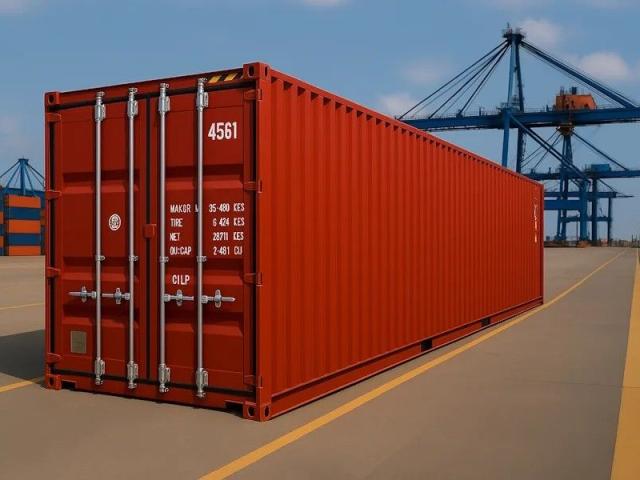
Every container has a unique "ID number" — the container number — and a CSC nameplate that displays safety information. Understanding them is a fundamental skill in container operations.
I. Container Number Format
Container numbers are defined by the ISO 6346:2022 standard, consisting of 11 characters divided into three parts:
Example Container Number: MSCU 123456 7
           │││││ ││││││ │
           │││││ ││││││ └─ ⑧ Check Digit
           │││││ └──┴──┴──┴──┴── ⑥-⑦ Serial Number (6 digits)
           └┴┴┴┴─ ①-④ Owner Code (4 letters)
                    ⑤ Equipment Category Identifier (1 letter: U = General Container, J = Equipment, Z = Trailer)
Explanation of Each Part
| Position | Name | Character Type | Meaning |
| 1-3 | Owner Code | Uppercase letters | Identification of the container owner (BIC registered code) |
| 4 | Equipment Category Identifier | Uppercase letter | U = General dry/reefer container, J = Equipment, Z = Trailer/chassis |
| 5-10 | Serial Number | Digits | 6-digit sequential number assigned by the owner |
| 11 | Check Digit | Digit | Verification digit to validate the first 10 characters |
Common Owner Codes
| Code | Owner | Country |
| MSCU | MSC (Mediterranean Shipping Company) | Switzerland |
| MAEU | Maersk (Maersk Line) | Denmark |
| CMAU | CMA CGM | France |
| COSU | COSCO (COSCO Shipping) | China |
| OOLU | OOCL (Orient Overseas Container Line) | Hong Kong, China |
| EISU | Evergreen (Evergreen Marine) | Taiwan, China |
| HLXU | Hapag-Lloyd | Germany |
| NYKU | ONE (Ocean Network Express) | Japan |
| CIMU | CIMC (China International Marine Containers) | China |
| TGHU | Triton (Triton Leasing) | USA |
Owner Code Registration: All owner codes are managed and registered by the Bureau International des Containers (BIC), with an annual fee required. Owner codes registered in China must be applied for through the BIC official website.
Container Type Code (Not Part of the Container Number)
The container number does not include container type information. Another marking on the container body is the ISO Size/Type Code, typically displayed together with the container number:
| Code | Meaning | Explanation |
| 22G1 | 20GP Dry Container | 2 = 20 feet, 2 = height 2.591m, G1 = General purpose container |
| 42G1 | 40GP Dry Container | 4 = 40 feet, 2 = height 2.591m |
| 45G1 | 40HQ High Cube | 4 = 40 feet, 5 = height 2.896m |
| 22R1 | 20ft Reefer Container | 2 = 20 feet, R1 = Reefer container |
| 22U1 | 20ft Open Top Container | 2 = 20 feet, U1 = Open top container |
II. Check Digit Calculation
The check digit is used to verify whether the container number is correct. The calculation method is as follows:
Calculation Steps:
- Convert letters to numbers according to the conversion table
- Multiply each digit by the corresponding power-of-2 weight
- Divide the sum by 11; the remainder is the check digit
Letter-to-Number Conversion Table
| Letter | Number | Letter | Number | Letter | Number |
| A | 10 | J | 20 | S | 30 |
| B | 12 | K | 21 | T | 31 |
| C | 13 | L | 23 | U | 32 |
| D | 14 | M | 24 | V | 34 |
| E | 15 | N | 25 | W | 35 |
| F | 16 | O | 26 | X | 36 |
| G | 17 | P | 27 | Y | 37 |
| H | 18 | Q | 28 | Z | 38 |
| I | 19 | R | 29 | — | — |
Note: The conversion table does not include the digits 0 and 11. This is to distinguish the letter O from the digit 0, and to avoid the check digit being 11 (a two-digit check digit is impossible, so letter-number equivalents above 10 are skipped accordingly).
Calculation Example
Container Number: MSCU 123456 → What is the check digit?
Step 1: Convert letters to numbers M=24, S=30, C=13, U=32, 1=1, 2=2, 3=3, 4=4, 5=5, 6=6
Step 2: Multiply by weights (from 2⁰ to 2⁹)
24×1  +  30×2  +  13×4  +  32×8  +  1×16  +  2×32  +  3×64  +  4×128  +  5×256  +  6×512
 =24  +  60   +  52    +  256   +  16    +  64    +  192   +   512   +  1,280  +  3,072
 = 5,528
Step 3: Divide by 11 and take the remainder 5,528 ÷ 11 = 502 remainder 6
Check Digit = 6 ✓
Verification Tool: Systems at most shipping lines and terminals automatically verify the check digit when entering container numbers. If the check digit is incorrect, the system will report an error, prompting a check for input mistakes in the container number.
III. CSC Safety Approval Plate
The CSC Nameplate (CSC Safety Approval Plate) is a mandatory certification marking for containers used in international transport, permanently fixed in a clearly visible position on the container door.
Detailed Explanation of Nameplate Fields
┌──────────────────────────────────────────────┐
│        CSC SAFETY APPROVAL                     │
│        CN/CCS/00123/2026                       │ ← Approval Country/Authority/Approval No./Year
│                                                │
│        DATE MANUFACTURED : 2026-03            │ ← Date of Manufacture
│        IDENTIFICATION NO. : MSCU1234567       │ ← Container Number
│        MAXIMUM GROSS WEIGHT : 30,480 KG       │ ← Max Gross Weight (container + cargo)
│                               67,200 LB       │ ← Imperial unit
│        ALLOWABLE STACKING WEIGHT : 192,000 KG │ ← Allowable Stacking Weight (MGW × 1.8)
│                                  423,280 LB   │
│        RACKING TEST LOAD : 15,240 KG          │ ← Transverse Racking Test Load
│                              33,600 LB        │
│                                                │
│        ┌─── EXAMINATION SCHEDULE ───┐          │
│        │  PES : 2031-03 (1st)       │          │ ← Next Periodic Examination Date
│        │  ACEP: 2028-09             │          │ ← ACEP Expiry Date
│        └──────────────────────────────┘          │
└──────────────────────────────────────────────┘
| Field | Meaning | Data Source |
| Approval Country/Authority | CN = China, CCS = China Classification Society | Issued by CCS |
| Maximum Gross Weight (MGW) | Tare weight of container + maximum allowable cargo weight | Design value |
| Allowable Stacking Weight (ASW) | Maximum load-bearing weight when containers are stacked | Typically = MGW × 1.8 |
| Racking Test Load (RTL) | Container's ability to resist transverse deformation | Test value |
| PES Examination Date | Deadline for the next periodic examination | Calculated by examination cycle |
| ACEP Expiry Date | Validity period of the Approved Continuous Examination Programme | Approval document |
Nameplate Updates for Each Examination Regime
| Scenario | Action | Cost Reference |
| PES examination passed | Update PES date on nameplate (or update records) | ¥200-500 (including inspection fee) |
| ACEP renewal | Update ACEP expiry date | ¥100-300 |
| Nameplate lost/damaged | Apply for reissue from original approval authority | ¥100-200 |
| Ownership change | Update owner code/update nameplate | ¥200-400 |
IV. Other Markings
4.1 Country Codes
| Code | Country |
| CN | China |
| US | USA |
| GB | UK |
| DE | Germany |
| JP | Japan |
| SG | Singapore |
4.2 Maximum Gross Weight Markings
The following markings are typically also found on the container body:
- MGW (Max Gross Weight): Maximum gross weight (container + cargo)
- TARE: Tare weight of the container body
- NET: Maximum payload (NET = MGW - TARE)
4.3 International Union of Railways Marking (RIV/UIC)
Containers used for railway transport require the RIV marking, indicating compliance with International Union of Railways standards.
4.4 High Cube Warning Marking
High cube containers such as 40HQ and 45HQ (container height >2.591m) must have a yellow/black high cube warning marking on both sides of the container body and above the container doors, reminding personnel to be aware of height restrictions.
Data Note: Container number format references the ISO 6346:2022 standard. CSC nameplate fields reference the CSC Convention and China Classification Society (CCS) inspection regulations. Data as of July 2026.
Need to verify a container number or check a CSC nameplate? Send us a photo, and we will verify whether the inspection date is valid for free.
Container Number Consultation: 13075678958 | info@zhbfwl.com
Related Logistics Services
Bofeng Logistics offers the following related services, feel free to inquire: