What is a Pallet, and What Are Its Classifications?
According to the Chinese national standard "Logistics Terminology," a pallet is defined as a horizontal platform device used for containerizing, stacking, handling, and transporting goods and products as unit loads. As a containerization device similar to shipping containers, pallets are now widely used in production, transportation, storage, and circulation, and are considered one of the two key innovations in the 20th-century logistics industry. As an important handling, storage, and transportation device in logistics operations, pallets work in conjunction with forklifts and play a huge role in modern logistics. The benefits pallets bring to the modern logistics industry are primarily reflected in: enabling unitization, standardization, and normalization of item packaging, protecting items, facilitating logistics and commercial flow. Pallets are also known as skids or platforms.
Pallet Dimensions
There are currently 6 sizes in the international pallet standard. From the perspective of international trade, each national interest group hopes other countries adopt its own pallet standard, so its goods can fully utilize other countries' logistics equipment and facilities, entering their markets smoothly and at low cost, while being unwilling to bear any costs for other countries to change their industry standards by changing pallet standards. Therefore, a country generally does not easily change its own pallet size standard. From a commodity trade perspective, the pallet standard serves as a technical trade barrier, capable of promoting exports or protecting the domestic market.
1. China's pallet standards select the two specifications of 1000*1200 and 1100*1100.
2. ISO6780 "Flat Pallets for Intercontinental Materials Handling—Principal Dimensions and Tolerances" adopts an inclusive approach, listing 6 pallet specifications side by side as global international standards. They are: 1200mm*1000mm, 1200mm*800mm, 1219mm*1016mm, 1140mm*1140mm, 1100mm*1100mm, and 1067mm*1067mm.
Classification of Pallets
I. Flat Pallets
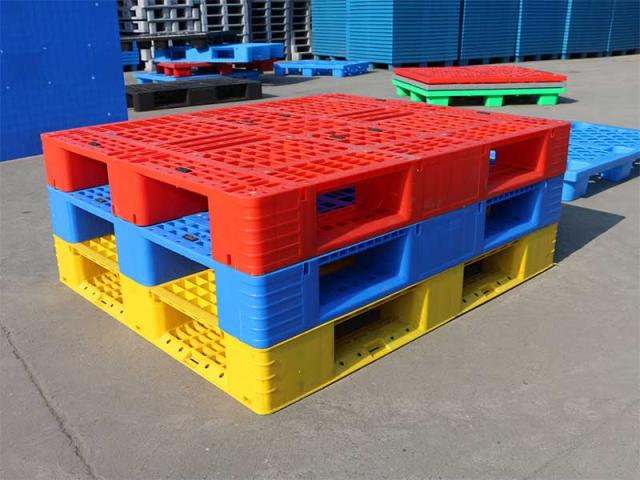
Flat pallets have the widest range of use, the largest utilization quantity, and the best versatility. Common flat pallets can be further subdivided into three types: ① Classification by deck surface. There are four types: single-sided, single-faced usable, double-faced usable, and winged; ② Classification by forklift entry. There are three types: two-way entry from one direction, two-way entry from opposite directions, and four-way entry; ③ Classification by material. There are five types: wooden flat pallets, steel flat pallets, plastic flat pallets, composite material flat pallets, and paper pallets.
II. Post Pallets
Post pallets are divided into fixed-type and removable-type. Their basic structure features steel posts at the four corners of the pallet, with the tops of the posts connectable by horizontal beams to form a frame structure. The main functions of post pallets are: firstly, to support heavy items using the posts for stacking higher; secondly, to prevent the goods placed on the pallet from collapsing during transportation and handling.
III. Box/Bin Pallets
Box/bin pallets are pallets with side panels on all four sides; some have a top plate, while others do not. The side panels are of three types: fixed, collapsible/foldable, and removable. The surrounding panels include solid, slatted/perforated, and mesh types. Therefore, the box/bin pallet with slatted/perforated or mesh side panels is also called a cage pallet or warehouse cage. Box/bin pallets offer strong protection, preventing stack collapse and cargo damage; they can carry irregularly shaped goods that cannot be stably stacked, giving them a wide range of applications.
IV. Roller/Wheeled Pallets
Compared to post pallets and box/bin pallets, roller/wheeled pallets feature small wheels on the bottom. Therefore, roller/wheeled pallets offer advantages such as short-distance mobility, self-maneuvering, or roll-on/roll-off handling capabilities, showcasing their wide applicability and versatility.
V. Special/Specialty Pallets
Due to the high operational efficiency, safety, and stability of pallets, especially in situations requiring rapid handling, the importance of pallet utilization is highlighted.
Related Services
Bofeng Logistics offers the following services. Contact us for a quote:
Related Logistics Services
Bofeng Logistics offers the following related services, feel free to inquire: