
Qingdao Shi
Shandong Sheng
China
Qingdao Port
1. Port Overview
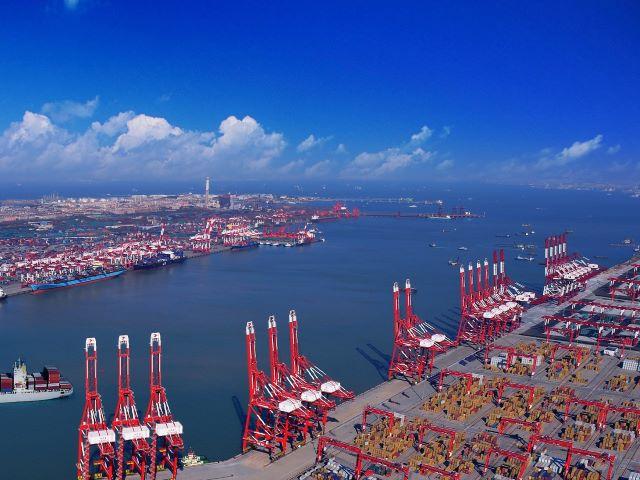
Qingdao Port is located on the shores of Jiaozhou Bay on the southern coast of the Shandong Peninsula, on the edge of the Yellow Sea. It is an important foreign trade port in northern China and an international shipping hub in Northeast Asia. The port uses Jiaozhou Bay as a natural barrier; inside the bay, the water is deep and the waves are small, and it is ice-free year-round, providing the natural conditions for large vessels to berth around the clock. This is also the geographical basis for Qingdao Port's long-term position as a hub among the ports of northern China.
In terms of location, Qingdao Port faces Japan and South Korea and is backed by the Shandong Peninsula and the areas along the Yellow River basin, making it one of the most convenient sea outlets for the Yellow River basin. The Shandong Province port and waterway layout plan establishes a world-class marine port cluster pattern with Qingdao Port as the leader, Yantai Port and Rizhao Port as the two wings, and Weihai Port and others as supplements. In this pattern, Qingdao Port serves as a trunk-line hub, while port areas such as Rizhao and Yantai connect to it as feeder branches, forming a two-tier "trunk line—branch line" network.
Statistics based on the Ministry of Transport's port scope show that in 2025, Qingdao Port completed a cargo throughput of 741 million tons, a year-on-year increase of about 4.1%, of which foreign trade cargo was 533 million tons; container throughput was 32.89 million TEU, a year-on-year increase of about 6.5%. Both indicators ranked fourth among China's coastal ports (2024: 712 million tons and 30.87 million TEU). In the Baltic International Shipping Center Development Index, Qingdao's ranking rose from 15th in 2024 to 13th in 2025, continuing to lead the port cluster in northern China.
When citing Qingdao Port data, attention must be paid to the statistical scope: the throughput in the annual report of Qingdao Port International Co., Ltd. (601298) includes joint ventures and associates, and is not the same as the whole-port scope—its cargo throughput is lower than that of the whole port, while its container throughput is higher than that of the whole port. The two figures are often simultaneously abbreviated as "Qingdao Port throughput." In addition, news flashes such as "cumulative total exceeded 700 million tons during the year" refer to the point of breakthrough rather than the full-year value, and must also be distinguished when cited.
Bofeng Logistics uses Qingdao Port as one of the main ports of departure for export cargo from North China and the areas along the Yellow River basin. Exports of mechanical equipment, vehicles, and steel from the Shandong Peninsula, as well as cargo from Henan, Shaanxi, Shanxi, and other places that is consolidated by rail, can all complete customs declaration, port consolidation, and loading operations at Qingdao Port.
2. Port Scale and Facilities
There are two definitions for the division of port areas at Qingdao Port, and the basis must be specified when citing them. According to port planning, Qingdao Port includes six areas: the Old Port Area (Dagang Port Area), Huangdao Port Area, Qianwan Port Area, Haixi Bay Port Area, Dongjiakou Port Area, and Aoshan Bay Port Area; while under the operating port area definition disclosed by the listed company Qingdao Port International (601298), it also includes the Weihai Port Area, which was incorporated after the 2019 equity transfer. The main port areas are described below by operational function:
- Qianwan Port Area: the core port area for container operations, with 24 container berths, a maximum berthing capacity of 200,000-ton class, and multiple dedicated container berths with a water depth of 17.5 meters, capable of handling ultra-large container ships of more than 10,000 TEU
- Dongjiakou Port Area: focused on bulk cargo and crude oil; the ore berths have a maximum designed berthing capacity of 300,000-ton class (marine structures designed for 400,000-ton-class bulk carriers), and the crude oil and refined oil berths have a maximum designed berthing capacity of 300,000-ton class (marine structures designed for 450,000-ton-class oil tankers)
- Huangdao Port Area: loading, unloading, storage, and transport of crude oil and liquid chemicals
- Dagang Port Area: traditional cargo types such as general cargo and grain, along with some operational adjustments following the relocation of certain urban functions
- Weihai Port Area: incorporated into Qingdao Port's operating system after the 2019 equity transfer of Weihai Port
The Qianwan fully automated container terminal is a landmark facility of Qingdao Port. Phase I entered commercial operation in May 2017, Phase II was commissioned in November 2019, and Phase III was commissioned in December 2023; Phase III is called the country's first fully domestically produced and fully independent automated container terminal. For container terminals, automation upgrades mainly affect yard operation efficiency and workforce allocation; for cargo owners, the direct benefit is that the timing of container pickup and return appointments becomes more predictable.
Dongjiakou Port Area's ore and crude oil capacity further expanded in 2025. After the second 400,000-ton-class ore terminal passed completion acceptance, Dongjiakou formed a "dual 400,000" layout, becoming one of the few port areas in northern China capable of berthing two 400,000-ton-class ore carriers at the same time. This capacity mainly serves steel enterprises' imported ore demand and is not closely related to container business, but it reflects Qingdao Port's port profile of "dual pillars of bulk cargo and containers."
The number of berths, water depths, and designed throughput capacity will be adjusted with expansion and channel improvement projects; the current data published by the terminal operator and port administrative authorities shall prevail.
3. Main Routes
3.1 Domestic Coastal Routes
Qingdao Port's domestic trade container shipping covers major ports along the Bohai Rim, East China, Southeast Coast, South China, and Southwest coasts:
| Destination Region | Major Ports | Route Type |
|---|---|---|
| Bohai Rim | Tianjin, Dalian, Yingkou, Qinhuangdao | Domestic coastal route |
| East China | Shanghai, Ningbo, Lianyungang, Nanjing, Nantong | Domestic coastal route |
| Southeast Coast | Quanzhou, Xiamen, Fuzhou | Domestic coastal route |
| South China | Guangzhou Nansha, Shenzhen Shekou, Dongguan, Huangpu | Domestic coastal route |
| Southwest and Hainan | Haikou, Yangpu, Qinzhou, Fangchenggang | Domestic coastal route |
Within the Shandong port system, feeder connections are also in place: Qingdao Port serves as a trunk-line hub, while port areas such as Rizhao and Yantai connect to it via feeder services. Cargo is first consolidated at feeder ports and then transshipped to trunk-line vessels at Qingdao. This model is similar to the river feeder connection logic in the Pearl River Delta.
The table above lists the destinations reachable by Qingdao Port's domestic trade containers. Reference sailing times are subject to the shipping company's current schedules. Domestic trade containers account for about 20% of Qingdao Port's container throughput; the port's container volume is mainly foreign trade.
3.2 Main International Routes
The international routes of the Port of Qingdao form an advantageous hub cluster in five major directions—Japan and South Korea, Southeast Asia, the Middle East, India-Pakistan, and Europe and America—with the route network reaching more than 180 countries and regions and over 700 ports:
| Direction | Main Ports of Call | Notes |
|---|---|---|
| Japan and South Korea | Busan, Incheon, Tokyo, Osaka | Route density ranks among the top coastal ports in China, with clear advantages in short-sea express services |
| Southeast Asia | Singapore, Port Klang, Ho Chi Minh City, Laem Chabang | Covers major ASEAN base ports |
| Middle East and India-Pakistan | Dubai, Karachi, Nhava Sheva | Places equal emphasis on direct calls by mainline services and transshipment connections |
| Europe and America | Major European base ports; major base ports on the U.S. West Coast and East Coast | Primarily deep-sea mainline services, with space fluctuating seasonally |
There are multiple statistical definitions for the number of routes at the Port of Qingdao (the total number of routes, the number of foreign-trade routes, and the number of maritime routes are not the same). The table above groups routes by direction and does not enumerate the number of each. Specific sailing schedules and port call order are subject to booking confirmation.
4. Hinterland and Cargo Mix
The hinterland of Qingdao Port covers all of Shandong Province and extends into the Yellow River basin. Its cargo mix is characterized by "equal emphasis on containers and bulk cargo":
- Exports from Qingdao Port: laden container cargo, machinery and equipment, vehicles, steel, general cargo
- Imports to Qingdao Port: crude oil, iron ore, grain, pulp, bauxite
Among the bulk cargo categories on the import side, crude oil, iron ore, bauxite, and grain are mainly imported through foreign trade, while coal is mainly brought in through domestic trade. Pulp imports rank among the highest among coastal ports nationwide, directly related to demand from the papermaking industry in Shandong and surrounding areas. At the export end, laden containers have grown relatively quickly in recent years and are the main source of improved profitability for the container segment.
Cargo suitable for shipping via Qingdao Port: heavy cargo such as machinery and equipment, vehicles, and steel is suitable for FCL transport, with 20GP and 40GP being commonly used container types; short-sea cargo to Japan and South Korea can rely on high-frequency schedules, making delivery arrangements relatively flexible; cargo from the Yellow River basin that is brought to the port by rail needs to allow connecting time between rail arrival and vessel loading.
Bofeng Logistics Experience Sharing: Qingdao Port's container volume structure is characterized by "foreign trade trunk routes + deep hinterland." For cargo owners on the Shandong Peninsula, Qingdao Port's advantages are high density of short-sea routes and many direct calls on trunk lines; to Japan, South Korea, and Southeast Asia, transshipment is basically unnecessary. For cargo owners in the central and western regions who bring cargo to the port by rail, the key is to arrange the time gap between rail arrival at the station and the vessel cutoff—rail arrivals fluctuate, while the cutoff time is firm. We recommend scheduling the rail arrival date with a buffer before the cutoff, rather than cutting it close to the cutoff. In addition, Qingdao Port's automated terminal has strict timeliness requirements for container pickup and return appointments; trucks need to complete the appointment before arriving at the port, otherwise waiting may occur.
5. Operational Notes
Operations at Qingdao Port require close attention to two aspects: the nature of the cargo and seasonal timing. Regarding dangerous goods, Qingdao Port Group has clear restrictions on the operational scope for containerized dangerous goods: Class 1 explosives, Class 6.2 infectious substances, and Class 7 radioactive materials are strictly prohibited from being loaded, unloaded, or stored within the port; Class 2.3 toxic gases, Class 4.3 substances which, in contact with water, emit flammable gases, and Class 5.2 organic peroxides must be directly loaded and discharged between vehicles and ships and may not be stored in the port area; some Class 3 flammable liquids with water-reactive properties must likewise be directly loaded and discharged from June 1 to October 31 each year. The above rules may be fine-tuned annually; the currently effective "Port Dangerous Goods Operations Endorsement" shall prevail.
In terms of seasonal timing, Qingdao Port has no ice period and can operate normally year-round; however, August to October each year is the export peak season, when mainline shipping space and trailer resources are relatively tight. For cargo with tight delivery schedules, it is advisable to book space in advance. The free container use period is usually subject to the regulations of the shipping company and the terminal; exceeding it will incur container detention fees.
FAQ
Q: What is the positioning of Qingdao Port among northern ports?
Answer: The official positioning of Qingdao Port is an international shipping hub in Northeast Asia, and it is also an important foreign trade port in northern China. Together with Yantai Port and Rizhao Port, it forms Shandong's world-class marine port cluster. Within this cluster, Qingdao Port serves as the trunk-line hub and a concentration point for foreign trade trunk lines, while Yantai and Rizhao connect to it via feeder branch lines.
Q: Can Qingdao Port handle domestic sea freight?
Answer: Yes. Qingdao Port’s domestic trade container routes cover major ports along the Bohai Rim, East China, Southeast China, South China, and the Southwest coast. However, domestic trade containers account for about 20% of Qingdao Port’s container volume, and Qingdao Port is mainly focused on foreign trade overall. Whether there are direct sailings to a specific destination port must be confirmed according to the current shipping schedule.
Q: What should be noted when exporting mechanical equipment from Qingdao Port?
Answer: Mechanical equipment is usually shipped as full container loads. The key points to focus on are securing inside the container and the accuracy of declaration particulars. Over-dimensional and overweight equipment should have the terminal’s loading and unloading equipment conditions confirmed in advance and over-limit declarations completed; equipment containing oil or batteries must be provided with corresponding certificates as required by the shipping company. These requirements are not entirely the same across shipping companies, so they need to be confirmed item by item when booking.
6. Bofeng Logistics Services
Bofeng Logistics provides the following services at Qingdao Port:
- Full Container Load (FCL): 20GP, 40GP, 40HQ, and other standard container types; both port-to-port and door-to-door are available
- Less than Container Load (LCL): consolidation and shipment for small and medium batches of machinery and equipment parts, daily necessities, and other goods
- Domestic Shipping: North-South domestic trade container transport serving the Bohai Rim, East China, and South China
- Customs Clearance and Warehousing: export customs declaration, commodity inspection documents, port drayage, and warehousing/storage
- Value-Added Services: cargo insurance, labeling and sorting, out-of-gauge cargo loading/unloading coordination, and destination port customs clearance and delivery coordination
Service Highlights: Familiar with the arrangements for connecting the two port-delivery routes of the Shandong Peninsula and the Yellow River Basin; for cargo delivered to the port by rail, we can design timing plans between rail arrival at the station and the cargo cut-off; space and schedules for short-sea routes to Japan and Korea are coordinated by the same team, reducing waiting in transshipment.
📍 Contact us for real-time freight rates.
Further Reading
- Domestic Ocean Shipping Services: FCL and LCL solutions for domestic coastal container transportation
- International Ocean Export Services: FCL and LCL export ocean shipping solutions
- Guide to Major Chinese Ports: Comparison of the positioning and route characteristics of major domestic container ports
Related ports: Yantai Port | Rizhao Port | Lianyungang Port
Prepared by the Bofeng Logistics team; content reviewed in September 2026. Port throughput and facility data are based on official releases from port authorities and terminal operators, and figures may differ between sources. Schedules and documentation requirements are subject to booking confirmation.