
Yantai Shi
Shandong Sheng
China
Yantai Port
1. Port Overview
Yantai Port is located in the northern part of the Shandong Peninsula, at the junction of the Yellow Sea and the Bohai Sea. It is the northern gateway to the Shandong Peninsula and an important port in the Bohai Rim Economic Circle. In the "one body, two wings" layout of Shandong Port, Yantai Port is an important northern wing and complements Qingdao Port's mainline hub function.
Two aspects of Yantai Port deserve separate mention. The first is its capacity structure of "strong in bulk cargo and stable in containers": the West Port Area has a 300,000-DWT ore terminal that can also accommodate 400,000-DWT vessels, as well as several 300,000-DWT crude oil berths. Its handling capacity for iron ore, bauxite, and crude oil ranks among the top in northern ports; its container business is mainly based on near-sea routes and domestic trade routes, with steady growth in scale. The second is its finished vehicle segment: Yantai Port is the fifth-largest coastal port in China for finished vehicle logistics distribution and the third-largest foreign trade export port. In 2024, finished vehicle shipments were about 737,000 units, of which international transshipment exceeded 330,000 units—a volume that stands out among northern ports.
Statistics using the Ministry of Transport's port definitions show that in 2025 Yantai Port completed a container throughput of 5.56 million TEU, a year-on-year increase of about 9.2%, ranking 13th among coastal ports nationwide; its cargo throughput was 544 million tonnes, a year-on-year increase of about 8.4%, of which foreign trade cargo was 192 million tonnes. Its cargo throughput ranked eighth among coastal ports nationwide and around tenth among coastal ports worldwide. In 2024, Yantai Port's cargo throughput exceeded 500 million tonnes; the official wording was "exceeding 500 million tonnes and containers exceeding 5 million TEU," and in 2025 it continued to grow on this basis.
It should be noted that claims circulating online such as "Yantai Port's containers are about 3 million TEU" or "containers 469,000 TEU" are inaccurate. The former was roughly the level in 2020–2021, while the latter is clearly wrong in order of magnitude. When citing, current-period data under the Ministry of Transport's methodology should be used.
2. Port Scale and Facilities
Yantai Port consists of the Zhifu Bay Port Area, West Port Area, Longkou Port Area, Penglai Port Area, etc., with the division of functions as follows:
- Zhifu Bay Port Area: Container, passenger and cargo ro-ro, and breakbulk/bulk cargo operations; finished vehicle operations are also concentrated here; it is a traditional old port area.
- West Port Area: An operations area for ore, coal, crude oil, liquid chemicals, LNG, and fertilizer; it is the core new port area in the planning of Yantai Port and takes over the transferred functions of the Zhifu Bay Bonded Port Area.
- Longkou Port Area and Penglai Port Area: Regional operations areas, handling breakbulk/bulk cargo and local cargo sources.
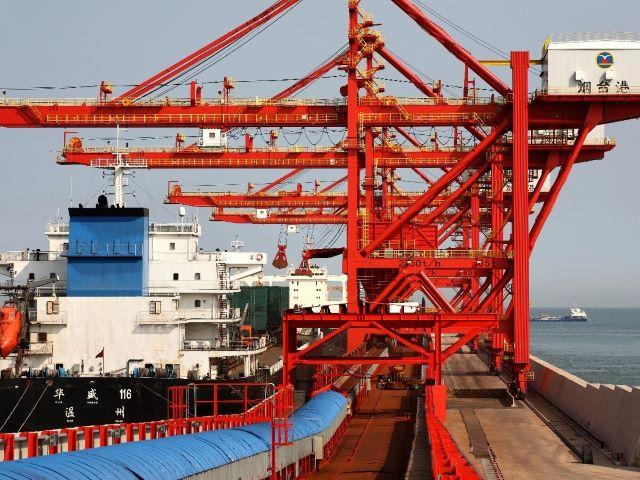
Deep-water berths are a hardware highlight of Yantai Port. The port areas have a total of 104 berths of various types, including 94 production berths and 10 workboat berths. Among the production berths, 65 are of 10,000-ton class and above; there are 7 berths of 300,000-ton class and above, including 3 300,000-ton-class ore berths and 4 300,000-ton-class crude oil berths. It is the only port in China with 4 300,000-ton-class crude oil berths. The West Port Area has built a 300,000-ton-class ore terminal that also accommodates 400,000-ton-class vessels and a 300,000-ton-class crude oil terminal, making it a major deep-water port on the south shore of the Bohai Sea.
The ore terminal in the West Port Area is called the "world's first fully automated dry bulk terminal." It combines a large terminal, a large bonded zone, and automated operations, and is supported by an iron ore blending base. It is important to distinguish that the automation here refers to dry bulk operations and is not the same as an automated container terminal. Also note that the official description of this terminal is "300,000-ton class with consideration for 400,000-ton class," not a "400,000-ton-class terminal"; when citing berth class, the former wording should be used.
The number, class, and designed throughput capacity of berths may change with engineering adjustments; the current data published by the terminal operator and port administrative authority shall prevail.
3. Main Routes
3.1 Domestic Coastal Routes
Yantai Port's domestic trade container routes cover the Bohai Rim, East China, Southeast Coast and South China Coast, and can connect to ports along the Yangtze River via transshipment:
| Direction | Major Ports | Notes |
|---|---|---|
| Bohai Rim | Dandong, Dalian, Yingkou, Jinzhou, Qinhuangdao, Jingtang, Tianjin | Dense domestic trade routes around the Bohai Rim |
| East China | Shanghai | Transshipment via Shanghai to ports along the Yangtze River |
| Southeast Coast | Quanzhou, Xiamen | Domestic trade container routes |
| South China | Shenzhen, Guangzhou Huangpu | Domestic trade container routes |
Yantai Port operates domestic trade container routes in cooperation with more than 20 shipping companies and is regarded by the industry as one of the northern domestic trade container transshipment hub ports guarding the throat of Bohai Bay. In addition, the Yantai–Dalian railway ferry (Yanda Ferry) provides another cross-Bohai passage; via this route, cargo can avoid detouring around Shanhaiguan, and the overland mileage is significantly shortened compared with the detour.
The table above lists the route directions of Yantai Port's domestic trade container services. Reference transit times are subject to the shipping company's current schedule; please confirm current arrangements with us before shipping.
3.2 Main International Routes
Yantai Port's international routes are mainly short-sea routes, consistent with its geographical location facing Japan and South Korea:
| Direction | Main Ports of Call | Notes |
|---|---|---|
| South Korea | Incheon, Pyeongtaek | According to public information from 2025, there are 9 sailings per week, with an average sea voyage of about 14 hours, enabling evening departure and morning arrival |
| Japan | Major Japanese ports | Short-sea route |
| Finished vehicle exports | Major global automobile markets | Supported by ro-ro berths and a finished vehicle logistics system |
Yantai Port has relatively limited direct calls on ocean-going trunk routes, and container cargo to and from Europe and America is usually transshipped via domestic hub ports. For specific sailing schedules and transshipment routes, please refer to the booking confirmation.
4. Hinterland and Cargo Mix
The hinterland of Yantai Port covers the Jiaodong Peninsula, northern Shandong, and the southern shore of Bohai Bay. Its cargo mix consists mainly of imported bulk commodities and exported industrial goods and finished vehicles:
- Exports from Yantai Port: finished vehicles, fertilizers, steel products, aquatic products
- Imports through Yantai Port: iron ore, bauxite, crude oil, LNG, grain
On the import side, the most distinctive cargoes are bauxite and crude oil. According to public information, in 2024 Yantai Port's bauxite imports exceeded 50 million tonnes and single-cargo throughput exceeded 130 million tonnes, while cumulative crude oil throughput exceeded 150 million tonnes. These two types of cargo mainly serve the aluminum and refining and chemical industries in Shandong and surrounding areas. On the export side, finished vehicles rely on ro-ro berths and dedicated yards, forming an international transshipment channel.
Cargo suitable for shipping through Yantai Port: finished vehicles exported by ro-ro require advance confirmation of sailing schedules and yard arrangements; fertilizers, steel products, and similar cargoes are suitable for container or bulk shipping; aquatic product exports involve quarantine requirements, and frozen goods require end-to-end cold chain; bulk commodities such as bauxite and iron ore are shipped by bulk carrier, and very large vessels need to be arranged according to berth class and tide levels.
Bofeng Logistics Experience Sharing: The two segments of Yantai Port operate on different logic. The bulk cargo segment focuses on berth class and storage capacity; its core competitiveness is an ore terminal that handles 300,000-tonne-class vessels and also 400,000-tonne-class vessels, plus bonded storage yards; the container segment focuses on sailing schedules and transshipment routes. Domestic trade schedules to the Bohai Rim and East China are relatively frequent; near-sea foreign trade is mainly toward South Korea, while ocean-going trade requires an additional transshipment leg. When we handle cargo from the Jiaodong Peninsula, we usually divert it by cargo category: finished vehicles and bulk cargo go through Yantai proper, while large-volume containerized foreign trade cargo is decided after comparing the overall transit time of routing via Yantai transshipment versus going directly via Qingdao. One point requires special attention in finished vehicle exports—ro-ro sailing schedules are scarce and fixed, the arrival time of vehicles at the port must be strictly aligned with the sailing schedule, and excessive yard storage time will incur additional charges.
5. Operational Notes
When operating at Yantai Port, three points require special attention. First, the correspondence between cargo types and operating areas: bulk cargo is in the West Port Area, while containers and commercial vehicles are in the Zhifu Bay Port Area. Before arranging trailers, the specific operating area must be confirmed to avoid unnecessary back-and-forth. Second, the nature of the cargo: aquatic product exports require quarantine inspection; frozen goods require an unbroken cold chain, and reefer containers and plug points must be confirmed at the time of booking. Dangerous goods and liquid chemicals must be handled at designated terminals and declared in advance. Third, seasons and weather. This must be assessed separately by port area and cannot be generalized: the Zhifu Bay Port Area and West Port Area are located on the outer side of the northern coast of the Shandong Peninsula; in normal years, there is no severe ice condition and navigation is basically normal. The Longkou Port Area, however, is located at the mouth of Laizhou Bay and is significantly affected by sea ice—according to public information, in a typical ice year, the ice period in Laizhou Bay is about 2.5 to 3 months, with ice up to 40 cm thick, and the average ice period at the Longkou Port Area is about 85 days. Therefore, winter shipments should be assessed according to the specific operating port area; for cargo involving Longkou, it is advisable to leave buffer in scheduling. In addition, Yantai is located at the junction of the Yellow Sea and the Bohai Sea. In winter, when affected by cold air, sea conditions are poor, which may affect operations and shipping schedules; for cargo with tight delivery deadlines, it is advisable to reserve buffer.
The free container usage period and reefer container usage rules are generally subject to the regulations of the shipping company and the terminal; overdue use will incur container detention fees.
FAQ
Q: What is the current container throughput of Yantai Port?
Answer: According to the Ministry of Transport's port statistics, Yantai Port's container throughput in 2025 was 5.56 million TEU, up about 9.2% year on year; in 2024, Yantai Port officially stated that its container volume "exceeded 5 million TEU." The "about 3 million TEU" circulating online is old data from around 2020 to 2021 and is now outdated.
Q: What is the division of labor between Yantai Port and Qingdao Port?
A: In the "one body, two wings" layout of Shandong ports, the Port of Qingdao serves as a trunk-line hub and a concentration point for foreign trade mainlines, while the Port of Yantai is an important northern wing, focused mainly on bulk cargo handling, short-sea routes, domestic trade routes, and finished vehicle business. The two ports have complementary functions: ocean-going trunk-line cargo is usually shipped via direct call at Qingdao, while cargo for the Bohai Rim and domestic trade is more conveniently routed through Yantai.
Q: What should be noted when exporting commodity vehicles from Yantai Port?
A: For exporting finished vehicles through Ro-Ro berths, three things need to be confirmed as priorities: alignment between the vessel schedule and arrival time at port, storage arrangements and fee rules at the yard, and the declaration documents for the vehicles themselves. Ro-Ro schedules are relatively fixed and have limited sailings; if the vehicle arrival time at port is out of sync with the vessel schedule, storage fees will be incurred. Yantai Port is China's third-largest coastal port for foreign trade exports of finished vehicles. The supporting services for this business are relatively mature, so it is advisable to discuss the vessel schedule with us as early as possible.
6. Bofeng Logistics Services
Bofeng Logistics provides the following services at Yantai Port:
- Full Container Load (FCL) Service: Standard container types such as 20GP, 40GP, and 40HQ; both port-to-port and door-to-door are available
- Less than Container Load (LCL) Service: Consolidation and shipment for small and medium-sized batches of fertilizers, steel components, and daily consumer goods
- Domestic Sea Freight: Domestic trade container transport to and from the Bohai Rim, East China, Southeast China, and South China
- Customs Declaration and Warehousing: Export customs declaration, commodity inspection documentation, aquatic product quarantine coordination, warehouse storage and distribution
- Value-Added Services: Cargo insurance, labeling and sorting, scheduling coordination for ro-ro export of finished vehicles, destination port customs clearance and delivery coordination
Service Features: Bulk cargo and container services are scheduled separately, with operating areas and vessel types matched according to cargo category; for finished vehicle exports, schedule verification of vessel departures and arrival times can be provided; transport arrangements for frozen goods and reefer containers are coordinated by the same team, reducing waiting in cold chain links.
📍 Contact us for real-time freight rates.
Further Reading
- Domestic ocean shipping services: FCL and LCL solutions for domestic coastal container transport
- International ocean export services: FCL and LCL export ocean shipping solutions
- Guide to Major Chinese Ports: Comparison of the positioning and route characteristics of major domestic container ports
Related ports: Dalian Port | Weihai Port | Qingdao Port
Prepared by the Bofeng Logistics team; content reviewed in September 2026. Port throughput and facility data are based on official releases from port authorities and terminal operators, and figures may differ between sources. Schedules and documentation requirements are subject to booking confirmation.