Client Background
Zhongshan is a traditional food processing base in the Pearl River Delta. A large number of food processing plants are clustered in Xiaolan, Guzhen, and Minzhong, mainly producing frozen products, prepared dishes, baking ingredients, and grain, oil, and seasoning products, which are sold to major cities in the Pearl River Delta and also cover the Hong Kong and Macau markets. The protagonist of this case is a food processing enterprise in Zhongshan that specializes in frozen food and fresh cooked products, with customers mainly being restaurants, supermarkets, and food wholesalers in Macau. Macau's local food supply is highly dependent on the mainland. There are many restaurants, with high purchasing frequency and small shipment volumes per order but dense batches. The company operates a supply rhythm of "multiple deliveries per week, sorted by store."
Macau covers only 33 square kilometers. With the combined dining demand of residents and tourists, the density of restaurants is high, and the food supply chain basically relies on road corridors in the Pearl River Delta. In the past, cold-chain food going to Macau often had to be transferred via Hong Kong or detoured through other ports, with multiple loading/unloading and repeated warehousing along the way—and this segment is where cold-chain breaks most often occur. For food companies, the key to cold-chain transportation is not "delivering the goods," but "delivering the goods at the required temperature"—incomplete temperature records, mid-route power outages, or insufficient pre-cooling; if any link goes wrong, the goods may face failed inspection or quality damage when arriving in Macau, and the loss of one truckload far exceeds the freight cost itself.
Before finding Bofeng, the company mainly relied on fragmented logistics resources for cold-chain shipments to Macau: the mainland segment first found a less-than-truckload cold-chain carrier to consolidate cargo, then transferred in Shenzhen or Guangzhou, and found another vehicle for the cross-border segment, with customs declaration and temperature control each handled separately. The entire chain was handled by multiple carriers in segments, and it was unclear who monitored the temperature and who was responsible if it went wrong. Once, in summer, when shipping a batch of frozen meat, the refrigeration shut down for several hours during transfer warehouse storage. When inspection arrived in Macau, the temperature record showed a gap, and the entire batch was required to be returned. The company both lost the freight and customer trust.
The company also asked local freight forwarders, and the answers were mostly "we do little on the Macau route, and even fewer will take cold chain." This reflects a major difference between Macau logistics and Hong Kong logistics: on the Hong Kong route, there are multiple Shenzhen-Hong Kong ports and ample cold-chain resources; on the Macau route, there are few dedicated cold-chain service providers, and many forwarders would rather take the Hong Kong route than touch Macau cold chain. What the company needed was a service provider that could connect the entire cold-chain link of "Zhongshan factory → Zhuhai hub → bridge corridor → Macau delivery" with end-to-end temperature control, replacing multi-segment subcontracting with single-responsibility accountability.
Key Challenges
Challenges under the old model center on four points:
- High risk of cold chain disruption: With many transshipment links, goods are loaded and unloaded multiple times and repeatedly moved between warehouses, and the risk of refrigeration interruption rises with each additional link. During hot summer periods, the temperature inside containers rises especially noticeably while queuing at ports. A single disruption can undo the entire batch of goods;
- Un-traceable temperature control: Each segment's carrier manages its own stretch, so temperature records are inconsistent and discontinuous. When customs inspection requires temperature control records, a complete report cannot be produced, and shipments stuck at inspection or even returned happen from time to time;
- Uncontrollable delivery times: Arrival times cannot be promised on scattered routes. Food depends on freshness—half a day late can be the difference between "near-expiry product" and "normal product." Macau restaurant clients are highly sensitive to delivery schedules;
- Ambiguous division of responsibility: With segmented carriage, when cold chain damage or temperature exceedance occurs, responsibility is shifted back and forth among multiple carriers. The after-sales process drags on, and customer trust is gradually worn away.
The price of these challenges is not just freight costs, but the "quality reputation" that food companies value most—one broken cold chain or one returned shipment may cause a Macau restaurant client to reassess the entire supply line.
Transport Requirements
- Route: Zhongshan factory → Zhuhai warehouse/hub → via Hong Kong-Zhuhai-Macau Bridge → Macau, door-to-door cold chain direct delivery;
- Products: Frozen food and fresh cooked food products, mainly in two temperature zones: chilled (0~8°C) and frozen (-18°C and below);
- Volume: 3-4 shipments per week, each batch mainly loaded in refrigerated box trucks, separated by temperature zone and sorted by store;
- Time: About 40 minutes' drive from Zhongshan to Zhuhai, and the entire journey via the bridge to Macau can be controlled within half a day; delivery across Macau takes 2-4 hours;
- Special requirements: Full-process temperature control, electronic temperature reports provided for customs inspection; delivery by district based on Macau store locations; temperature checked at handover;
- Billing method: Charged per trip/vehicle, with a flat rate for temperature control and delivery, making costs predictable;
- Insurance: Insured based on cargo value, claims available throughout the cold chain.
The above requirements may seem scattered, but in fact they all point to one goal: making every batch of fresh food "arrive at what temperature, when, and in what condition" predictable.
Solution
Bofeng customizes the "Zhongshan Cold Chain Direct to Macau" solution for enterprises, integrating cold chain vehicle types, bridge passage, and Macau delivery into one controllable chain:
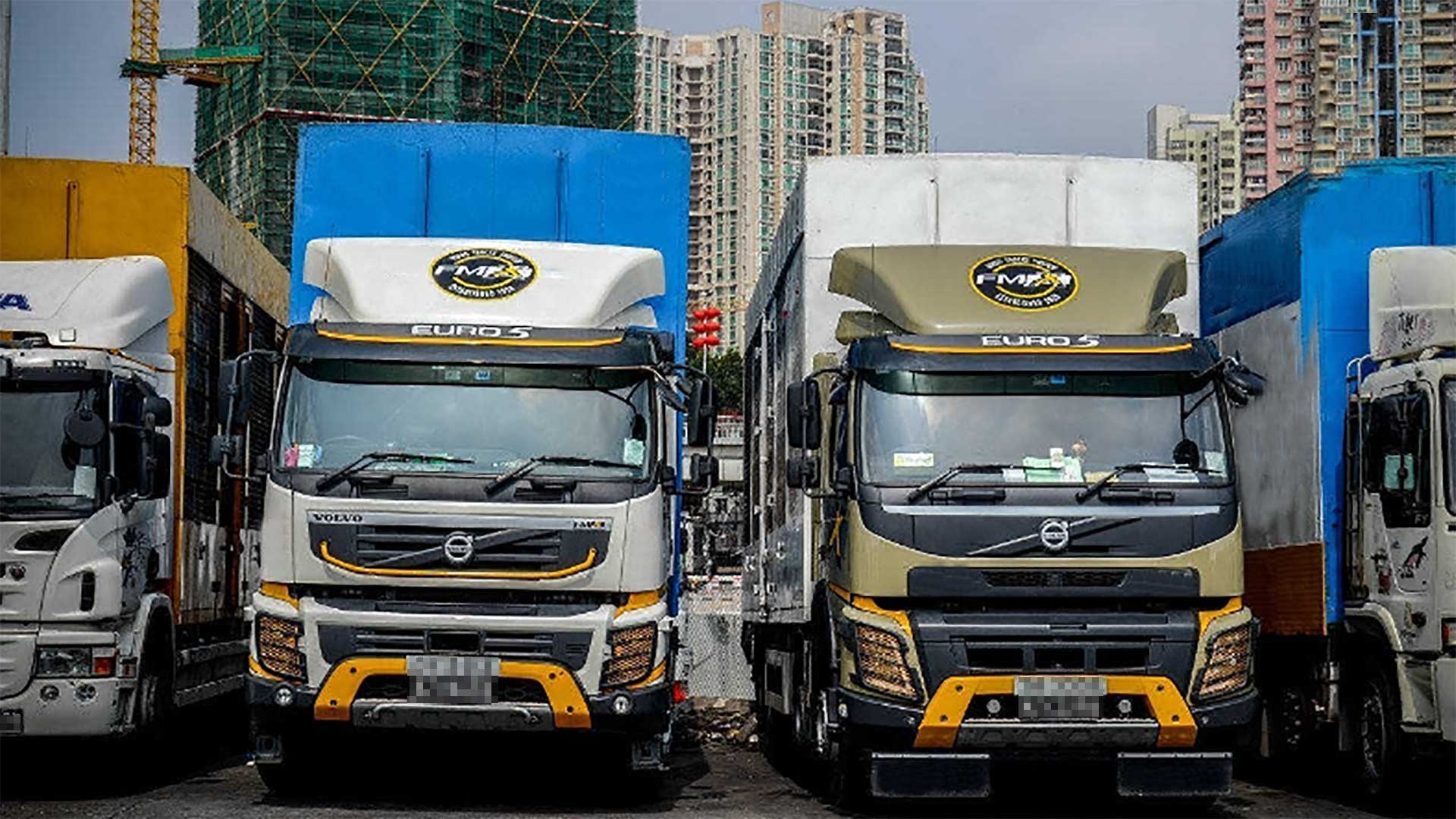
- Cold chain vehicle types and pre-cooling management: Use refrigerated box trucks with independent refrigeration units. Complete two-way pre-cooling before loading — the cargo is pre-cooled in the cold storage to the transport temperature in advance, and the refrigerated truck's refrigeration unit is turned on in advance to pre-cool the compartment. Pre-cooling lasts no less than 30 minutes in summer and no less than 15 minutes in winter; loading is completed within 15 minutes to shorten the time the compartment door is open and reduce cold air loss. Frozen and chilled cargo are loaded in separate compartments to avoid mixing and temperature crossing; pre-cooling time is extended accordingly in summer. Check temperature control data every 2 hours during transit, with special attention to compartment temperature changes while waiting at the port;
- Full-process temperature control and traceability: Each vehicle is equipped with dual-backup temperature recorders, with sensors placed at the center of the cargo compartment rather than at the cold air outlet, collecting data in real time and syncing electronic temperature reports. Temperature control data is continuous, complete, and exportable for customs inspection and customer reference. Food imports have clear requirements for temperature records; temperature data is kept for review as required. Complete and continuous records throughout the entire journey are precisely the prerequisite for smooth customs clearance, avoiding common cold chain compliance issues such as "incomplete temperature records" at the source;
- Direct cold chain passage via the Hong Kong-Zhuhai-Macau Bridge: After loading in Zhongshan, it takes about 40 minutes to reach Zhuhai, then direct clearance through the Hong Kong-Zhuhai-Macau Bridge port. The bridge port implements one-stop customs clearance; a cold chain vehicle can complete customs inspections by both sides in a single stop, with clearance taking only 15-25 minutes and short waiting times. During high-temperature periods, the temperature rise inside the compartment is limited. Compared with detouring through other ports, the bridge offers a shorter drive and faster clearance, making it a land route with better guarantees for both timeliness and temperature control for cold chain food entering Macau;
- Zone-based delivery across Macau: After clearance, a local Macau cold chain delivery team delivers by zones in the Peninsula and Cotai, completing delivery across the territory in 2-4 hours. At handover, temperature is checked and stores are verified, and signed receipts are returned along with synced temperature control data, forming a closed loop where "temperature is recorded and handover has evidence.";
- Fixed-schedule supply: There are 3-4 fixed shipment departures per week. On the Macau side, 20+ catering stores and supermarkets are grouped by area and assigned by route, and stores arrange receiving and shelving according to arrival times. With fixed schedules, supply rhythm is stable and predictable, and adding extra departures during peak seasons is also justified;
- Contingency plan for anomalies: In the event of uncontrollable factors such as port inspections or typhoon-related suspension of shipping, customers are notified immediately and receiving times on the Macau side are coordinated, while complete temperature control data is retained for records to minimize the impact on delivery.
Take a typical shipment day after cooperation as an example: In the early morning, the enterprise completes pre-cooling and loading; in the morning, it departs from the Zhongshan factory, arrives in Zhuhai about 40 minutes later, clears customs through the Hong Kong-Zhuhai-Macau Bridge port, and enters Macau around noon. The Macau delivery team distributes by route across the Peninsula and Cotai, completing handover at all stores in the afternoon, with electronic temperature reports returned along with signed receipts. From loading to final-stop signing, the entire process is controlled within half a day.
The solution has another key design for the cold chain: treating "temperature" as a delivery indicator equally important as "timeliness." In the past, enterprises only cared about whether the goods arrived; now there is an additional concern — what the temperature was when the goods arrived. Electronic temperature reports travel with the vehicle and are returned with signed receipts. When receiving goods on the Macau side, the temperature is checked and records are verified, which is equivalent to conducting a "temperature physical examination" for every truckload of food. For catering customers, this traceable record means they have evidence to check when facing quality concerns; for enterprises, temperature data in turn serves as a basis for improving pre-cooling and loading processes — which link had the door open too long, or which season had longer port queuing times, can all be seen from the data, and the next shipment can be proactively adjusted. Temperature management has thus shifted from "relying on experience" to "looking at data," and every improvement in the cold chain is traceable.
For food enterprises, the core value of this solution is turning the past "fragmented segments and temperature loss" into "one vehicle to the end, full-process temperature control": from the goods being loaded at the Zhongshan factory to being signed for at Macau stores, the temperature remains within the required range throughout, with no "broken chain" gaps in between.
Results
| Indicator | Before Cooperation (Fragmented Segments) | After Cooperation (Direct Cold Chain) | Improvement |
|---|---|---|---|
| Total transit time (Zhongshan → Macau) | Mostly next day or later | Within half a day on the same day | Shortened by about 1 day |
| Cold chain break risk | Multiple transfers prone to chain breaks | One truck to destination, no transfers | Significantly reduced |
| Temperature control traceability | Discontinuous records | Full-journey electronic temperature control reports | Complete and verifiable |
| Cargo damage / loss rate | Occasional returns | Below 1% | Noticeably reduced |
| Macau delivery time | More than 1 day | 2-4 hours | Greatly shortened |
After the cooperation, what the company felt most noticeably was "no more anxiety about sending cold chain shipments to Macau": the total transit time was shortened from the original next-day-or-later to within half a day on the same day, allowing Macau catering outlets to arrange receiving according to fixed arrival times; temperature control records were continuous and complete, and the first-pass rate at inspections improved significantly, with the previous feeling of uncertainty before inspections basically disappearing; the loss rate dropped to below 1%, and returns caused by temperature issues decreased substantially. The number of supplied stores expanded from the initial few to 20+ restaurant outlets and supermarkets, and the supply frequency increased from 1-2 times per week to 3-4 times per week. Macau has gradually become a stable growth market for the company.
For Macau catering customers, stable cold-chain deliveries allow them to stock up according to customer traffic and put items on shelves according to the menu, ensuring fresh food quality; for the company, a replicable direct cold-chain delivery route means the Macau market has changed from a "high-risk business" into "stable growth." As the two parties enter the second year of cooperation, the company has made direct cold-chain delivery a regular supply method for Macau and is considering replicating the same temperature-control solution for shipments to Hong Kong.
Data statement: The above are data from this case (as of July 2026), reflecting the individual performance during the customer's cooperation period and do not constitute a service commitment.
The two parties have entered the second year of cooperation. The above data are case records of cold-chain bulk shipments from Zhongshan to Macau over the past 12 months.
Client Testimonial
"In the past, sending cold chain goods to Macau required multiple transfers, temperature records were incomplete, and we would get nervous at every inspection. Now cold chain trucks go directly via the Hong Kong-Zhuhai-Macau Bridge, with electronic temperature-control reports for the entire journey. Deliveries can reach Macau stores in half a day, losses have decreased, and our Macau customers are much more stable."
— Customer feedback from Bofeng Logistics' Macau logistics dedicated line (published with authorization and desensitized)
Need a similar logistics solution? Contact us — a plan within 30 minutes.
Phone:13075678958 | WhatsApp:+86 13075678958 | Email:info@zhbfwl.com
Get a Quote