
A container may look like just an "iron box," but its structure has undergone rigorous design and testing—it must withstand the pressure of being stacked 12 tiers high, resist the impact of Force 12 winds and waves at sea, and remain sealed within a temperature range of -40°C to +70°C.
I. Overall Structure of a Container
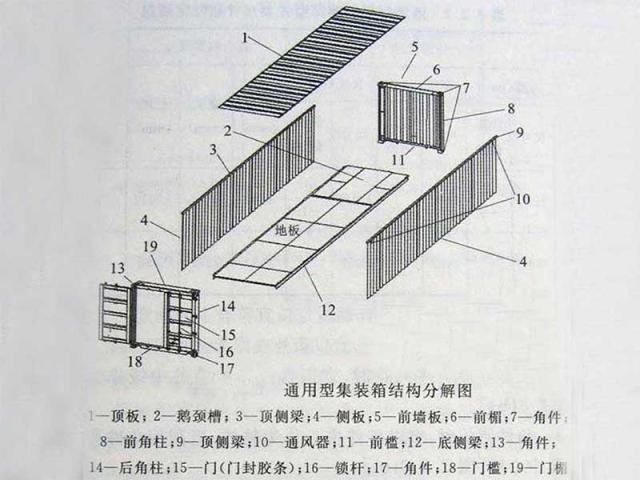
The structure of a standard dry container can be divided into the following main parts:
                    ┌──────────────────────┐
                    │       Roof Sheet     │ ← Corrugated steel sheet; bears rain, snow, and stacking pressure
                    │  ┌────────────────┐   │
      ┌─────────────┤  │ Container interior │   │
      │  Left side wall     │  │                │   │
      │  (corrugated panel) │  │                │   │
      │             │  │                │   │
      │             │  │                │   │
      │             │  └────────────────┘   │
      │             │       Floor            │
      └─────────────┴──────────────────────┘
    Corner casting← ─ ─ ─ ─ ─ ─ ─ ─ ─ ─ ─ ─ ─ ─ →Corner casting
Door| Structural component | Function | Material |
| Corner Casting | Connection point for lifting/stacking/securing | Cast steel |
| Roof Sheet | Waterproof, resistant to stacking pressure | Corrugated steel sheet (1.5–2.0 mm) |
| Side Wall | Structural support, protects cargo | Corrugated steel sheet (1.5–2.5 mm) |
| Floor | Carries cargo weight | Hardwood plywood (APG/MDG) |
| Door | Cargo access | Steel plate + sealing strip |
| Bottom Rail | Longitudinal support for the container body | C-shaped steel |
| Top Rail | Longitudinal support for the container body | Profiled steel |
II. Detailed Explanation of Each Component
2.1 Corner Casting
Corner castings are the most important structural components of a container—they are the only load-bearing points for lifting, stacking, and securing.
| Position | Function | Load Rating |
| Four top corner castings | Lifting points during hoisting | Single-point load capacity ≥15 tons |
| Four bottom corner castings | Load-bearing points during stacking | Single-point load capacity ≥30 tons |
| Side slots | Lashing and securing (twist-lock connection) | Single-point load capacity ≥10 tons |
Three key holes of corner castings:
- Top hole: hook connection point, used for lifting
- Side hole: twist-lock connection point, used for securing on ships/trailers
- Bottom hole: locating pin hole during stacking
Standard basis: The dimensions and strength of corner castings shall comply with the ISO 1161 standard, and the dimensional tolerance for each hole position shall be ≤1 mm.
2.2 Container Doors
Container doors are one of the weakest parts of a container and the components most prone to problems.
| Container Door Component | Function | Common Failures |
| Door panel | Seal the container body | Impact deformation, door cannot close |
| Door hinge | Door opening and closing | Corrosion causing difficulty in opening and closing |
| Locking bar | Lock the container doors | Bending, cannot fully lock |
| Door handle | Operate the locking bar | Breakage |
| Sealing strip | Waterproof sealing | Aging causing water ingress |
| Locking mechanism | Secure locking | Jamming or damage |
Container door opening angle standards:
- Left door: opening ≥270°
- Right door: opening ≥270°
- Both doors opened simultaneously: ≥180°
2.3 Floor
The floor bears the entire weight of the cargo and is the component requiring the most attention during loading.
| Floor Type | Material | Thickness | Load-Bearing Capacity | Advantages and Disadvantages |
| APG hardwood | Apitong plywood | 28 mm | 🟢 Strong | Durable but expensive |
| MDG hardwood | Meranti plywood | 28 mm | 🟢 Strong | High cost-effectiveness, commonly used |
| Bamboo floor | Bamboo plywood (new type) | 28 mm | 🟡 Medium | Environmentally friendly but poor water resistance |
| All-steel floor | Steel plate (for special containers) | 5 mm | 🟢 Extremely strong | Limited to special containers such as flat racks |
Floor load-bearing standards:
- Single-wheel load capacity: ≥2,730 kg (spacing ≤500 mm)
- Dual-wheel load capacity: ≥5,460 kg (spacing ≤1,000 mm)
- Concentrated load: ≥4,000 kg (500 mm × 500 mm area)
Loading tip: When loading with a forklift, the forklift wheels should travel along the direction of the floor longitudinal beams and avoid rolling across the floor transversely—the transverse load capacity is only 30% of the longitudinal capacity.
2.4 Side Walls and Roof Panel
The side walls and roof panel use a corrugated steel plate design; the corrugated structure increases strength while reducing weight.
| Part | Steel Plate Thickness | Corrugation Depth | Lateral Force Resistance |
| Side wall | 1.5-2.5 mm | 30-50 mm | ≥15 tons (at the upper side rail) |
| Roof panel | 1.5-2.0 mm | 15-25 mm | Snow load resistance ≥500 kg/m² |
2.5 Bottom Rails and Top Rails
| Beam Type | Material | Cross-Sectional Shape | Function |
| Bottom Rail | C-shaped steel | Channel steel | Bear cargo weight and stacking pressure |
| Top Rail | Special-shaped steel | Rectangular steel tube | Bear stacking pressure and lifting force |
| Fork Pocket | Reinforced steel plate | — | Provide load-bearing points for forklift transport |
III. Comparison of Three Container Body Materials
| Comparison Dimension | Steel Container | Aluminum Container | Glass-reinforced Plastic Container (GRP) |
| Weight | Heaviest (2,200kg/20GP) | Light (1,800kg/20GP) | Medium (2,000kg/20GP) |
| Strength | 🟢 High | 🟡 Medium | 🟡 Medium |
| Corrosion Resistance | 🟡 Requires rust prevention treatment | 🟢 Excellent | 🟢 Excellent |
| Repair Difficulty | 🟢 Easy (weldable) | 🟡 Requires specialized process | 🔴 Difficult |
| Service Life | 10-15 years | 12-18 years | 8-12 years |
| Cost | Baseline price | 20%-30% higher | 15%-25% higher |
| Market Share | ~85% (absolutely dominant) | ~10% | ~5% |
Mainstream Choice: About 85% of dry cargo containers worldwide use steel structures because of low manufacturing costs, easy maintenance, and high recycling value. Aluminum containers are mainly used for refrigerated containers (good heat dissipation and corrosion resistance), while glass-reinforced plastic containers are mainly used in chemical and special scenarios.
IV. Service Life and Scrapping of Containers
| Container Age | Status | Use | Maintenance Focus |
| 0-5 years | 🟢 New container | High-end customers, food-grade transportation | Normal use, regular inspections |
| 5-10 years | 🟡 Good | General commercial transportation | Need to check the floor and container door seals |
| 10-15 years | 🟠 Usable | Low-value cargo, inland transportation | Need to focus on rust and structural damage |
| >15 years | 🔴 Old | Under current CSC regulations, the inspection interval is shortened to 12 months | Recommend evaluating repair costs and residual value |
Frequently Asked Questions
How can you tell whether a container can still be loaded?
Check three points: whether the container doors open and close smoothly and lock securely; whether the interior floor is damaged or warped; whether the side walls and roof have penetrating rust holes. If any of these three does not meet the standard, request a different container before loading. When picking up the container, also check the next inspection date on the CSC safety approval plate.
Who is responsible if the floor is damaged during loading?
It depends on the loading method and whether there is overloading. A forklift driving across the floor sideways or a concentrated single-point load exceeding limits is a loading operation issue; if caused by corrosion or structural damage to the container itself, the party providing the container is responsible. Taking photos before and after loading as records is the easiest way to allocate responsibility.
Further Reading
- Container Dimensions and Specifications: Internal/External Dimensions and Weight Limits of 20GP/40GP/40HQ/45HQ
- Container Type Encyclopedia: Parameter Comparison of 8 Container Types and Selection Guide
- What Is Moisture Damage in Ocean Shipping Containers?
- Full Container Circulation Process: The Complete Lifecycle from Empty Container Pickup to Empty Container Return
- Terminal Operation Process: The Full Process of Port Entry, Storage, Loading, Discharging, and Container Pickup
Data Note: Structural parameters are cited from ISO 668:2020, ISO 1161 standards, and the container specification tables of various shipping companies; the actual condition of the container shall be subject to the CSC plate and on-site inspection results.
Want to confirm the container condition before loading? Send photos to Bofeng Logistics; we will help determine whether a container change is needed and check in advance during the container pickup process.Online Consultation
Phone / WhatsApp: 130-7567-8958 | Email: info@zhbfwl.com
Content verified in October 2026
Related Logistics Services
Bofeng Logistics offers the following related services, feel free to inquire: