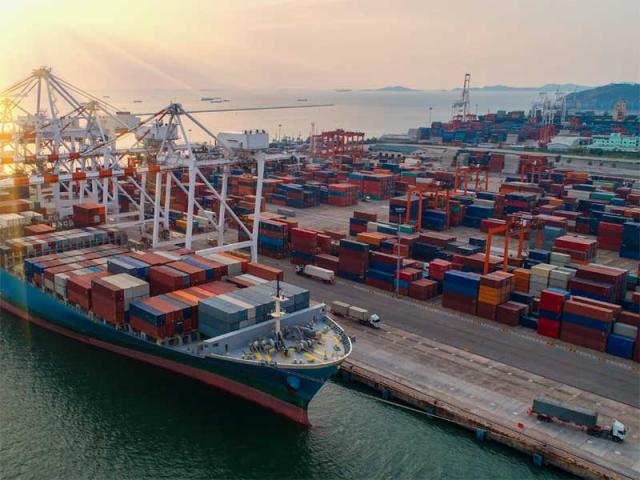
Container operations at the terminal are both the most efficient and the most complex link in the entire maritime shipping chain. Understanding terminal operations helps you plan shipment schedules effectively and avoid additional costs.
1. Panoramic Overview of Terminal Operations
Export Direction (Outbound):
Factory Stuffing → Truck In-Gate → Gate Inspection → Yard Drop-Off → Crane Loading → Vessel Departure

Import Direction (Inbound):
Vessel Berthing → Crane Unloading → Yard Transfer → Stacking → Container Pick-Up & Gate-Out → Truck to Factory
2. Export Direction: Detailed Operations
2.1 Gate-In Process
Step | Operation | Documents Required | Time |
① Gate-In Booking | Reserve a gate-in time slot with the terminal | S/O (Shipping Order Confirmation) | 1 day before return |
② Gate Inspection | Truck passes through gate; terminal verifies container number and seal number | S/O + Seal Number | 5–10 min |
③ Weighing | Weighbridge check (VGM verification) | — | 1 min |
④ Yard Drop-Off | Terminal designates a stacking area | — | 10–15 min |
2.2 Export VGM (Verified Gross Mass) Requirements
Under the IMO SOLAS Convention, all export containers must provide a Verified Gross Mass (VGM) before loading.
VGM Method | Approach | Accuracy Requirement | Cost |
Method 1 | Weigh the entire unit (truck over weighbridge) | ±500 kg | ¥50–100/time |
Method 2 | Sum of cargo weight + packaging + container tare weight | Requires precise calculation | No extra cost |
The VGM submission deadline typically coincides with the CY closing time; missing it means the container cannot be loaded.
2.3 Yard Stacking
After entering the terminal, containers are stacked in designated areas according to the vessel's stowage plan.
Stacking Priority | Description |
By Vessel / Voyage | Containers for the same vessel are grouped together |
By Destination Port | Containers bound for the same port are placed in adjacent areas |
By Weight | Heavy containers on the bottom, lighter ones on top |
For Reefers | Reefers are placed in positions with power supply access |
2.4 Loading Operations
Step | Operation | Equipment | Efficiency |
① Yard Retrieval | Internal trucks move containers from the yard to the quayside | Internal Tractor | 30–50 containers/hr |
② Crane Loading | STS crane lifts containers onto the vessel in assigned positions | STS Crane | 25–40 moves/hr |
③ Securing | Dockworkers lock containers in place with twist locks | Twist Locks | — |
3. Import Direction: Detailed Operations
3.1 Unloading Process
Step | Operation | Time |
① Vessel Berthing | Pilot guides vessel to berth | As soon as berth is available |
② Unlashing | Remove twist locks and lashing bars between containers | 30 min after berthing |
③ Crane Unloading | STS crane lifts containers from vessel to the terminal | 25–40 containers/hr |
④ Yard Stacking | Internal trucks transport containers to designated yard positions | 30 min after unloading |
3.2 Container Pick-Up Process
Step | Operation | Documents Required | Time |
① Clear Customs | Bill surrender → customs declaration → tax payment → release | D/O + Customs Declaration | 1–5 days |
② Pick-Up Booking | Reserve a pick-up time slot with the terminal | Release Notification | 1 day in advance |
③ Gate-Out Pick-Up | Truck enters terminal, container number verified → pick up and exit | Release Order + Container No. | 10–20 min |
3.3 Free Storage Period
Terminal | Reference Free Storage Period |
Port of Shanghai | 7 days |
Port of Ningbo | 5–7 days |
Port of Shenzhen | 5–7 days |
Port of Rotterdam | 5–7 days |
Port of Hamburg | 5–7 days |
4. Key Terminal Equipment
Equipment Name | Purpose | Efficiency |
STS Crane | Lifting containers between vessel and terminal | 25–40 moves/hr |
RTG (Rubber-Tired Gantry) | Stacking and retrieving containers in the yard | 15–25 containers/hr |
Reach Stacker | Container handling and stacking (≤5 tiers high) | Flexible but lower efficiency |
Internal Tractor | Transport between yard and quayside | — |
AGV (Automated Guided Vehicle) | Internal transport in automated terminals | High efficiency but large upfront investment |
5. Key Terminal Time Concepts
Term | Meaning | Consequence of Missing It |
CY Closing | Latest time for laden container return to terminal | ❌ Miss the vessel |
Customs Cut-off | Latest time for customs release | ❌ Cannot load onto vessel |
SI Cut-off | Latest time for shipping instruction submission | ⚠️ Amendment fees incurred |
ETD | Estimated Time of Departure | — |
ETA | Estimated Time of Arrival | — |
Free Time | Free storage period at the terminal | Storage charges accrue if exceeded |
Data Note: Terminal operation procedures are based on the operating manuals of major Chinese ports (Shanghai/Ningbo/Shenzhen). Free storage periods and demurrage rates are industry reference values; individual terminal policies may be adjusted, so confirmation before operations is recommended. Data current as of July 2026.
Need a fast container pick-up after cargo arrives at port? Bofeng Logistics provides one-stop import services: bill surrender → customs clearance → tax payment → container pick-up.
Import Services Consultation: info@zhbfwl.com