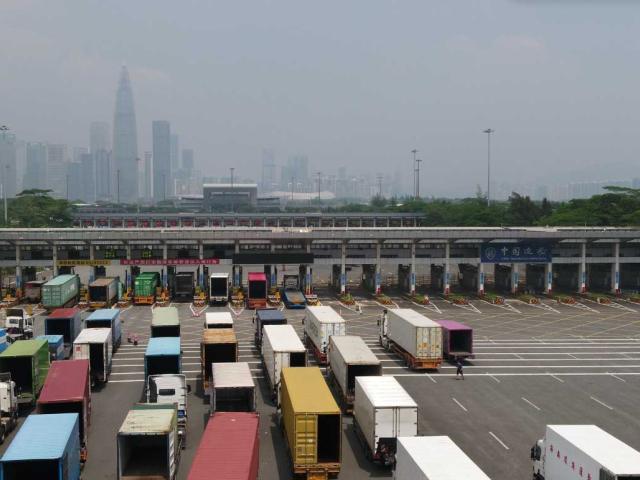
Sino-Hong Kong vehicle customs clearance is a core part of China-Hong Kong logistics. Goods must pass through customs inspections at both borders when traveling from the mainland to Hong Kong. The co-location clearance model at Shenzhen Bay Port has reduced clearance time from 60-90 minutes to 20-30 minutes, while Huanggang Port offers 24-hour clearance. Shenzhen Bay's co-location model is currently the fastest method for Sino-Hong Kong vehicle clearance; with exit and entry inspections conducted at the same location, the vehicle needs to stop only once. Understanding the clearance mode and process helps in arranging shipment times reasonably, avoiding delays in the overall logistics efficiency caused by the clearance process. The efficiency of cross-border clearance directly determines the transit time for goods from mainland factories to Hong Kong warehouses and is one of the core links in China-Hong Kong logistics.
1. Export Clearance Process (Mainland → Hong Kong)
A Sino-Hong Kong truck going from a mainland factory to entering Hong Kong must go through four stages:
Mainland Export Declaration. Submit the export customs declaration form to the mainland customs before the goods are dispatched. General cargo is automatically reviewed and released by the electronic system without requiring inspection. If the system selects it for inspection, cooperation with customs for a container check is needed, which adds 1-2 working days. The export declaration can be handled on behalf of the company by Bofeng Logistics; the company does not need its own import-export license. The core of export customs declaration is accurately declaring the product name and HS code. Incorrect declarations may lead to inspection or rejection. Companies should verify cargo information before dispatch to ensure accurate declaration. The core of export customs declaration is accurately declaring the product name and HS code; incorrect declarations may lead to inspection or rejection.
Port Exit Inspection. After the truck arrives at the port, mainland customs conducts an exit inspection on the vehicle. In the Shenzhen Bay co-location model, exit and entry inspections are completed at the same location, requiring the truck to stop only once. At traditional ports (Huanggang, Wenjindu, etc.), vehicles must stop at the respective port areas on both sides for inspection.
Transit Section. The truck travels across the port connector road from the mainland side to the Hong Kong side. The port connector road is typically about 2-5 km long, with a travel time of 5-10 minutes.
Hong Kong Entry Declaration. Hong Kong customs inspects the entering vehicles and goods. As Hong Kong is a free port, entry declarations for general cargo are simplified; electronic filing is sufficient for clearance, and container inspections are usually not required.
2. Import Clearance Process (Hong Kong → Mainland)
The import customs clearance process from Hong Kong to the mainland is similar to the export direction but includes an additional import declaration step:
1. Pick up goods on-site in Hong Kong 2. The truck exits through the Hong Kong side of the port 3. Enters the mainland side of the port via the port connector road 4. Mainland customs import declaration – requires import contracts, invoices, packing lists, and special documents (e.g., 3C certification, food hygiene permit) 5. Customs review and release (the inspection rate for imports is usually higher than for exports, approximately 5-10%) 6. After release, goods are delivered across the mainland
The inspection rate for import clearance is higher than for exports. Therefore, for imported goods, it is advisable to allow longer customs declaration time and prepare documents in advance. For high-value or urgent imports, full-truckload (FTL) transportation is recommended to reduce the overall time risk posed by inspections. It is recommended to reserve 2-3 working days for customs declaration to handle potential inspections.
3. Factors Affecting Clearance Efficiency
Clearance efficiency is affected by the following factors: port selection (Shenzhen Bay fastest: 20-40 minutes, Huanggang: 30-60 minutes), departure time (severe congestion during daytime peak hours), inspection status (general cargo e-clearance requires no waiting; inspection takes 1-2 days), and holidays (clearance hours adjust during mainland and Hong Kong holidays; it is recommended to arrange 2-3 days in advance before long holidays). It is advised to reserve 1-2 working days of buffer time when planning shipments. The entire fastest process from shipment in Shenzhen to arrival in Hong Kong can be controlled within 6-8 hours, from Guangzhou about 8-12 hours, and from Dongguan about 5-7 hours. Choosing the correct port and arranging shipment time reasonably are key to improving clearance efficiency.
4. Complete Shipment Operation Process
The complete operation process from submitting cargo information to the goods being signed for in Hong Kong:
Step 1: Submit Cargo Information. Send the product name, weight, volume, piece count, and origin/destination to Bofeng Logistics. The logistics provider recommends shipping options and quotes based on the cargo information, usually within 30 minutes. Before dispatching, confirm whether the goods belong to special categories (bulky, cold chain) and the loading/unloading conditions at the pickup address. The more accurate the cargo information, the more precise the provider's solution recommendations and quotes!
Step 2: Confirm Order. After confirming the plan, arrange for a Sino-Hong Kong truck to pick up the goods at the designated address at the agreed time. Pickup can be arranged in major cities within Guangdong Province, such as Shenzhen, Dongguan, Guangzhou, Foshan, Zhongshan, and Zhuhai. Goods from other locations are transshipped via the Zhuhai warehouse.
Step 3: Loading and Transportation. After loading, the goods are cleared through Shenzhen Bay or Huanggang Port to reach Hong Kong. For less-than-truckload (LTL) shipments, goods must first be consolidated at the warehouse, classified, and loaded before being cleared together. Full-truckload (FTL) shipments can go directly to the port for clearance. The entire process for LTL takes about 2-3 days, while FTL arrives in Hong Kong on the same day.
Step 4: Delivery in Hong Kong. After arriving at the Hong Kong warehouse, goods are delivered to the final address across Hong Kong. For Macau-bound goods, they are transshipped via the Zhuhai warehouse and then delivered via the Hong Kong-Zhuhai-Macao Bridge, with a travel time of approximately 30 minutes.
The operation process for import (Hong Kong → Mainland) is similar: after pickup in Hong Kong, goods enter the mainland via the port, where Bofeng Logistics handles customs clearance procedures. Imported goods require reporting documents, including contract, invoice, and packing list, and all documents must be prepared in advance to ensure smooth clearance.
Related reading
- Hong Kong Import Controls: Licence and Food/Drug Compliance
- Hong Kong Re-export Trade Operations: Procedures and Documentation
- Macau Customs Clearance and Import Control
- Hong Kong Logistics Line Services
5. Documents Required for Export Customs Declaration
Export customs declaration typically requires an export goods declaration form, commercial invoice, packing list, contract (if any), and an exit goods clearance order (for legally inspected goods). Electronic declaration for general cargo is sufficient; paper documents are not needed. Additional relevant supporting documents are needed for special goods like cold chain items. Proper mastery of each step in customs clearance ensures efficient passage of goods – the entire process from Shenzhen to Hong Kong can be controlled within 6 hours at its fastest, and from Guangzhou about 8-12 hours. Bofeng Logistics handles a large volume of customs clearance procedures for Sino-Hong Kong trucks daily and is familiar with the operational procedures of various ports.
Data as of: July 2026
Need China-Hong Kong customs clearance services? Contact us.
Consultation: 13075678958 | info@zhbfwl.com
Related Logistics Services
Bofeng Logistics offers the following related services, feel free to inquire: