Classification and Functions of "Shipping Container Seals"
1. Classification of "Shipping Container Seals"
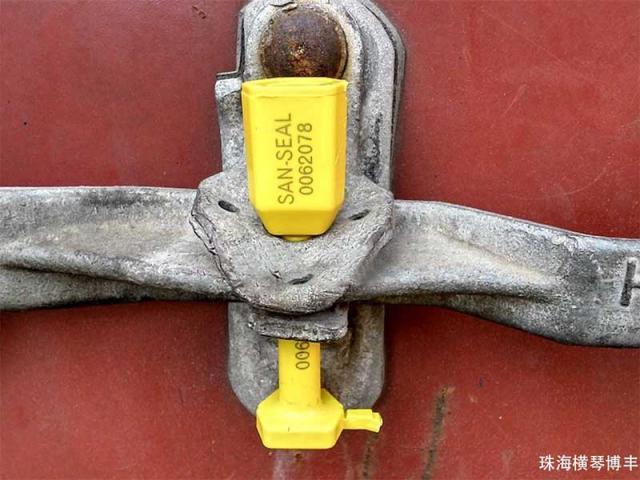
Based on who applies the seal, they can be divided into: factory seals (applied by the export factory); customs seals (applied by customs); carrier seals (applied by the shipping line); and terminal temporary seals (applied by the terminal). Based on material and function, they can be divided into: high-security seals (also known as bolt seals), cable seals, plastic seals, metal strip seals, and padlock seals.
2. When to Apply a Temporary "Shipping Container Seal" at the Terminal
When the seal on the container door is accidentally damaged during unloading; and when the container is devanned at the terminal after discharge, and the consignee takes the first batch of cargo.
3. Operational Procedures for "Shipping Container Seals"
- For containers transported from Zhongshan by barge to Yantian and then loaded onto a deep-sea vessel, each container is cleared in Zhongshan and then transferred in Yantian. The following two methods are used before loading onto the barge in Zhongshan:
- The rear door of the container is fitted with the seal of the deep-sea carrier, and customs clearance is done using this seal number (customs does not add its own seal). The export factory typically adds a temporary factory seal when stuffing the container to prevent cargo theft during overland transport from the factory to Zhongshan Port. In rare cases, if the responsibility of the deep-sea carrier starts at the factory gate (under Door to Door or Door to CY terms), the carrier's seal may be applied at the factory upon stuffing.
- Only the barge carrier's seal is applied to the container, while the deep-sea carrier's seal is added before loading onto the ocean vessel. When the barge clears customs in Zhongshan via the manifest, customs enters the manifest into the computer (containing each container's seal number for record-keeping). Upon arrival in Yantian, local customs checks the container number online to verify consistency.
- For containers trucked from Dongguan to Shekou for loading onto a deep-sea vessel for export, cleared in Dongguan and transferred at Shekou: Only the customs seal is applied in Dongguan. The carrier seal is added at Shekou before loading onto the deep-sea vessel. However, if the shipping line is responsible for overland transport from Dongguan to Shekou (Door to CY, Door to Door), the carrier's seal is applied in Dongguan.
- For routes from Zhongshan through Hong Kong to overseas destinations: Some companies place two seals on the container's rear door—one from the feeder carrier serving the Zhongshan–Hong Kong leg, and another from the main vessel's carrier for the Hong Kong–overseas leg. The seal number field in bill-of-lading-related documents can show just one seal number. If customs inspects the container, both seals are cut; upon completion, two new seals are reapplied, and the documents show the New Seal Number.
4. Notes
A shipping line's "shipping container seal" bears the carrier’s name (often in abbreviation, such as COSCO, MSC, PIL) and a string of Arabic numerals. The carrier usually provides the seals to its agent, which then applies them after the factory has completed stuffing. Carrier seals are typically bolt seals, very sturdy, requiring heavy-duty bolt cutters to open the container doors; some refer to them as the "master seal." Generally, the seal should be applied to the right door leaf (the lower leaf), because the locking mechanism's keeper is welded onto the right door (the right leaf covers the left). Thus, closing requires closing the left leaf first, then the right—reversed for opening. Theoretically, a seal can be applied to any of the four door handles.
Related Services
Bofeng Logistics offers the following services. Contact us for a quote:
Related Logistics Services
Bofeng Logistics offers the following related services, feel free to inquire: