
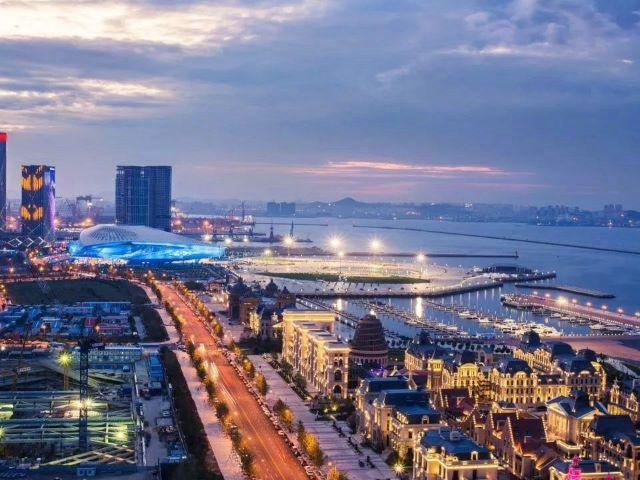
Dalian Shi
Liaoning Sheng
China
Dalian Port
1. Port Overview
Dalian Port is located at the southern tip of the Liaodong Peninsula, at the junction of the Yellow Sea and the Bohai Sea, and is an international shipping center in Northeast Asia and an important national hub seaport. The port area faces the Yellow Sea; it is broad and deep and ice-free in winter, providing natural conditions for year-round operation of large vessels. In some years, light floating ice may occur in winter, but it does not affect normal operations.
Dalian Port and Yingkou Port together form the two pillars of Liaoning's port system, but their positioning is not the same. Yingkou Port is Northeast China's largest domestic-trade container port, while Dalian Port is Northeast China's foreign-trade gateway: according to public information, about 96% to 98% of Northeast China's foreign-trade containers, 100% of commodity vehicles, and more than 60% of imported crude oil are transshipped through Dalian Port. This structure determines that Dalian Port's route network is centered on foreign-trade trunk lines, while domestic-trade container business is mainly handled by the Yingkou Bayuquan port area.
Statistics based on the Ministry of Transport's port definition show that in 2025 Dalian Port completed container throughput of 5.48 million TEU, a year-on-year increase of about 1.5%, ranking around 14th among China's coastal ports; cargo throughput was 300 million tonnes, a year-on-year decrease of about 6.2%, of which foreign-trade cargo was 123 million tonnes. In 2024, Dalian Port's cargo throughput was 319 million tonnes, and container throughput was 5.401 million TEU, a year-on-year increase of about 7.4%, a five-year high.
It should be noted that Dalian Port ranks relatively high in the Container Port Performance Index (CPPI)—this index is published by the World Bank and S&P Global, and in the edition released in September 2025 (covering the period from 2020 to 2024), Dalian Port ranked 4th globally. CPPI measures operational efficiency such as ship time in port, which is completely different from the ranking basis for container throughput; when citing it, it must be specified that it is a performance index, otherwise it will be confused with throughput rankings.
2. Port Scale and Facilities
Dalian Port is composed of Dayaowan Port Area, Nianyuwan Port Area, Dalian Bay Port Area, Taipingwan, Changxing Island, and other areas, with the following division of functions:
- Dayaowan Port Area: the main port area for container operations, also handling automobiles and bulk grain; Phase IV of Dayaowan has 2 dedicated 200,000-tonne-class container berths (Nos. 22 and 23), with a designed bottom elevation of approximately -20 m in the berthing water area, capable of berthing 200,000-tonne-class container ships at full load; Berth No. 15 has a water depth of approximately 18 m and can accommodate 12,000 TEU container ships
- Nianyuwan Port Area: loading, unloading, storage, and transportation of oil products
- Dalian Bay Port Area: oil products, ore, and bagged grain
- Changxing Island: crude oil tank farm, including bonded tanks
Crude oil is the most prominent segment of Dalian Port's facility capacity. The port area has a 450,000-tonne-class crude oil berth and a 300,000-tonne-class crude oil terminal, and can receive 450,000-tonne-class oil tankers. Its total crude oil storage capacity is approximately 9.85 million cubic meters, of which the bonded tanks on Changxing Island account for approximately 4.75 million cubic meters, and the crude oil futures delivery warehouse capacity is approximately 3.35 million cubic meters. Its annual crude oil throughput capacity is approximately 80 million tonnes. This capacity serves the imported crude oil demand of refining and chemical enterprises in Northeast China and around the Bohai Rim.
In terms of containers, Dayaowan has Northeast China's first automated terminal upgraded and converted from a traditional container terminal, using remote-control and unmanned container truck operations. It is an intelligent upgrade of an existing terminal, rather than a newly built fully automated terminal. In addition, Dalian Port has a 70,000-tonne-class automobile ro-ro berth and the country's only in-port dedicated railway automobile ro-ro terminal for finished vehicles, with an annual throughput capacity of nearly 500,000 vehicles; in 2024, the automobile terminal's throughput was approximately 732,000 vehicles.
Berth class and water depth data are subject to adjustment with reconstruction and expansion projects, and different sources vary considerably in their records of channel water depth. The current data published by the terminal operator and port administrative authority shall prevail.
3. Main Routes
3.1 Domestic Coastal Routes
The Port of Dalian's domestic container business is mainly based on Bohai Rim feeder-line connections and transshipment. It should be specially noted that large-scale domestic-trade trunk-line containers in the northeast direction are mainly handled by the Port of Yingkou: after the integration of Liaoning ports, the Port of Dalian actively scaled back its domestic-trade container business in the Northeast hinterland. According to public data, its domestic-trade container volume in 2020 fell by more than 60% year on year, and the related cargo sources shifted to Yingkou. Therefore, the container data of the Port of Dalian in 2019 and after 2020 are not suitable for direct comparison, and treating the Port of Dalian as a "major domestic-trade container port" would also be inconsistent with the actual situation.
| Direction | Main Ports | Notes |
|---|---|---|
| Bohai Rim | Yantai, Weihai, Qinhuangdao, Jinzhou | Self-operated Bohai Rim feeder-line platform, covering more than ten ports in Liaoning, Hebei, and Shandong |
| Transshipment connections | Connect to foreign-trade trunk lines via Bohai Rim feeder lines | Regional feeder cargo is consolidated at the Port of Dalian before connecting to trunk lines |
| Bohai Bay railway ferry | Yantai | China Railway Bohai Railway Ferry, route Lüshun–Yantai, sea voyage about 6.5 hours |
Liaoning Port Co., Ltd. has more than 80 domestic-trade container routes, covering more than 30 major ports in the Bohai Rim, East China, South China, Southeast China, and Southwest China. A considerable portion of its domestic-trade container business is concentrated in the Yingkou Bayuquan Port Area, while the Port of Dalian more serves the functions of Bohai Rim feeder lines and transshipment connections.
Regarding the Bohai Bay railway ferry, it needs to be made clear that the port end of this corridor is Lüshun, not the Dagang Port Area of the Port of Dalian. It is operated by China Railway Bohai Railway Ferry. After freight vehicles board the ship, they cross the Bohai Sea by sea for about 6.5 hours to reach Yantai. Compared with detouring via Shanhaiguan, it can shorten the railway distance by more than 1,600 kilometers. It is a "sea + rail" intermodal corridor and is a different matter from container liner services. When arranging cargo for rail-to-port consolidation, sailing schedules need to be checked separately.
The table above lists the reachable directions of the Port of Dalian's domestic routes. Reference sailing times are subject to the shipping company's current schedules. The share of domestic-trade containers in the Port of Dalian's container volume is lower than that of the Port of Yingkou. Please confirm specific schedules with us.
3.2 Main International Routes
Dalian Port's international shipping route network covers Northeast Asia, Southeast Asia, Europe, North America, and South America. It is the main export channel for foreign trade containers in Northeast China:
| Direction | Main Ports of Call | Notes |
|---|---|---|
| Japan and South Korea | Major ports in Japan and South Korea | Route density ranks among the top coastal ports in China, with essentially full coverage of core ports in RCEP member countries |
| Southeast Asia | Vietnam, Thailand, Singapore, etc. | New routes in recent years have been relatively concentrated here |
| Europe and the Mediterranean | Base ports in Europe and the Mediterranean | New routes launched in 2025 |
| North America and South America | Base ports on the U.S. West Coast, U.S. East Coast, and South America | In 2024, new foreign trade trunk routes were launched to South America, Mexico, and India |
Dalian Port has about 106 container routes in total, connecting 160 countries and regions and more than 300 ports. Its route structure places equal emphasis on near-sea routes to Japan and South Korea and ocean-going routes to Europe and America, and service frequency to Japan and South Korea is its traditional advantage.
Specific sailing schedules, port call order, and transshipment arrangements are subject to booking confirmation. New ocean-going routes are subject to seasonal adjustments; before shipment, we recommend confirming the current schedules with us.
4. Hinterland and Cargo Mix
Dalian Port's hinterland covers the three northeastern provinces and eastern Inner Mongolia, and its cargo structure is characterized by "foreign trade imports being mainly bulk goods and exports mainly containerized goods":
- Exports from Dalian Port: foreign-trade containerized cargo, refined oil, steel, bulk grain
- Imports via Dalian Port: crude oil, iron ore, foreign-trade soybeans, finished vehicles (Ro-Ro)
Finished vehicles are a distinctive sector of Dalian Port. The automobile Ro-Ro business relies on a 70,000-tonne-class Ro-Ro berth and an in-port dedicated railway Ro-Ro terminal, forming a "sea + rail" finished-vehicle transshipment corridor. In 2024, the automobile terminal's throughput was about 732,000 vehicles, mainly domestic trade. Crude oil and iron ore serve Northeast China's refining and steel industries.
Cargo suitable for shipping via Dalian Port: foreign-trade containerized cargo is Dalian Port's core cargo category, with direct calls available for both short-sea routes to Japan and South Korea and ocean routes to Europe and the Americas; bulk exports such as refined oil and steel are carried in bulk or tank containers; finished vehicles are shipped via Ro-Ro berths, and sailing schedules and terminal space arrangements need to be confirmed in advance.
Bofeng Logistics Experience Sharing: Dalian Port's positioning determines how it is used—for Northeast China's foreign trade, Dalian is basically the default option; for Northeast China's domestic trade, you should instead compare Yingkou. In practice, the problem we encounter most is shippers confusing the two—for example, arranging domestic-trade containers via Dalian and missing Yingkou's more frequent sailings, or putting cargo that needs direct deep-sea service through Yingkou for transshipment, adding an extra barge leg. The assessment method is straightforward: first check whether the flow is domestic or foreign trade, then check whether the destination port has direct sailings; after these two steps, the port is basically determined. In addition, Ro-Ro terminal space and sailing schedules for finished vehicles are tightly linked; for finished-vehicle exports, it is advisable to lock in the sailing schedule as early as possible rather than waiting until the vehicles arrive at the port to arrange it.
5. Operational Notes
Three key points need special attention when operating at Dalian Port. First, port assignment: for the same shipment, "Dalian" and "Yingkou" may differ significantly in drayage distance and sailing schedule, so when booking, confirm the actual operating port area to avoid sending trucks to the wrong port area. Second, cargo nature: dangerous goods must be handled at designated terminals and declared in advance; chemical bookings require an MSDS; dangerous cargo such as crude oil and refined oil shall be handled in accordance with relevant regulations. Third, seasonal factors: Dalian Port is ice-free in winter, and in some years slight floating ice may occur but does not affect operations; in winter, inland transport in Northeast China is significantly affected by snowfall, so sufficient buffer time should be reserved for cargo delivery to the port.
The free container usage period is usually subject to the regulations of the shipping company and terminal, and exceeding it will incur container detention fees. Regarding customs supervision, imported crude oil, iron ore, and grain each have corresponding regulatory requirements, and when a customs broker handles declaration, documents must be prepared as required.
FAQ
Q: What is the annual container throughput of Dalian Port?
Answer: According to the Ministry of Transport's port statistical basis, Dalian Port's container throughput in 2025 was 5.48 million TEU, up about 1.5% year-on-year; in 2024, it was 5.401 million TEU, up about 7.4% year-on-year, a five-year high. There are claims online of "about 7.5 million TEU," which do not match the official data for any year and are not recommended for use. It should also be noted that after the integration of Liaoning ports, Dalian Port actively scaled back its domestic-trade container business (in 2020, domestic-trade container volume fell by more than 60% year-on-year); therefore, data for 2019 and data after 2020 should not be directly compared, and when citing historical series, the statistical basis and integration background must be noted.
Q: Which is larger, Dalian Port or Yingkou Port?
Answer: It depends on which metric you look at. In terms of container throughput, Yingkou Port handled 5.85 million TEU in 2025, higher than Dalian Port's 5.48 million TEU; in terms of cargo throughput, Dalian Port handled 300 million tonnes in 2025, higher than Yingkou Port's 220 million tonnes. The official positioning of the two ports differs: Liaoning Province's wording is "with Dalian Port as an international hub port and Yingkou Port as a major port." Dalian Port focuses on being a foreign trade hub, while Yingkou Port focuses on domestic trade containers. They are complementary, and a simple ranking is not appropriate.
Q: Will Dalian Port be closed in winter?
Answer: Generally not. Dalian Port is a natural ice-free port and does not freeze in winter. In some years, light floating ice may appear from January to March, but it is thin and has no impact on port operations. What needs attention is the overland transport link from inland Northeast China to the port area; winter snowfall may affect the timeliness of cargo collection at the port.
6. Bofeng Logistics Services
Bofeng Logistics provides the following services at Dalian Port:
- Full Container Load (FCL): Standard container types such as 20GP, 40GP, and 40HQ; both port-to-port and door-to-door are available
- Less-than-Container Load (LCL): Consolidation and shipment for small- and medium-batch foreign trade cargo
- Domestic Shipping: Bohai Rim feeder services and domestic container transport toward East China and South China
- Customs Declaration and Warehousing: Export customs declaration, import customs clearance, commodity inspection documents, and customs brokerage for bulk cargo such as crude oil and grain
- Value-added Services: Cargo insurance, labeling and sorting, coordination of ro-ro export for commercial vehicles, and coordination of destination port customs clearance and delivery
Service Features: Foreign trade and domestic trade are arranged on separate routes. Foreign trade cargo uses Dalian’s direct mainline sailings, while domestic trade cargo is optimally arranged after comparing schedules between Yingkou and Dalian according to destination port; we are familiar with land transport arrangements for inland cargo consolidation to ports in Northeast China and can reserve extra time for winter shipments.
📍 Welcome to contact us for real-time freight rates.
Further Reading
- Domestic Ocean Shipping Services: FCL and LCL solutions for domestic coastal container transport
- International Ocean Export Services: FCL, LCL, and door-to-door export ocean freight solutions
- Guide to Major Chinese Ports: Comparison of the positioning and route characteristics of major domestic container ports
Related ports: Port of Yingkou | Port of Yantai | Port of Tianjin
Prepared by the Bofeng Logistics team; content reviewed in September 2026. Port throughput and facility data are based on official releases from port authorities and terminal operators, and figures may differ between sources. Schedules and documentation requirements are subject to booking confirmation.