
Yingkou Shi
Liaoning Sheng
China
Yingkou Port
1. Port Overview
Yingkou Port is located in Yingkou City, Liaoning Province, on the east coast of Liaodong Bay in the Bohai Sea. It is the largest domestic-trade container port in Northeast China and the port with the densest domestic-trade container routes in northern China. In its annual summary, Liaoning Port Group stated that it would "continue to consolidate Yingkou Port's advantageous position as the largest port for domestic-trade laden containers shipped by sea," while the Xiamen Port Authority publicly stated that "the volume of domestic-trade laden containers shipped by sea has consistently ranked first nationwide."
A defining feature of Yingkou Port is that it has taken "domestic trade" to the extreme. The cargo source structure in Northeast China is dominated by raw materials, grain, and steel, with outbound flows heavily concentrated along the coasts of East China and South China. Such cargo has higher requirements for maritime timeliness and sailing frequency than for ocean-going routes. Yingkou Port happens to be one of the nearest seaports to the Northeast hinterland; the Bayuquan Port Area has a short overland transport distance to the central Liaoning urban agglomeration, and combined with dense domestic-trade sailing schedules, it has formed stable "north-to-south grain transport" and "north-to-south steel transport" corridors.
Statistics under the Ministry of Transport's port statistical standard show that in 2025 Yingkou Port completed a container throughput of 5.85 million TEU, up about 5.1% year on year, ranking twelfth among China's coastal ports (5.56 million TEU in 2024); cargo throughput was 220 million tons, up about 0.5% year on year, of which foreign-trade cargo was 82.86 million tons, up about 11.5%. Domestic-trade containers account for the main portion of Yingkou Port's container volume. According to data cited by rating agencies, more than 60% of domestic-trade containers in Northeast China are transshipped via Yingkou Port.
Liaoning Province's official tiered layout for ports in the province is: "With Dalian Port as an international hub port, Yingkou Port as a major port, and Dandong Port, Panjin Port, Jinzhou Port, and Huludao Port as regionally important ports." This statement clearly indicates two points: Yingkou Port holds the position of a "major port" in Liaoning's port system, while Panjin Port, Jinzhou Port, and others are regional ports at the same level—therefore, when citing statistics and planning materials, Panjin Port's operating volume should not be merged into Yingkou Port.
It should be noted that statements such as "the largest port in Northeast China" depend on the statistical caliber: by container throughput, Yingkou leads Dalian; by cargo throughput, Dalian is higher; and the official positioning of the two ports also has different emphases. Yingkou Port's precise positioning is as the domestic-trade container hub port of Northeast China, complementing Dalian Port's foreign-trade hub positioning, rather than a simple ranking relationship.
2. Port Scale and Facilities
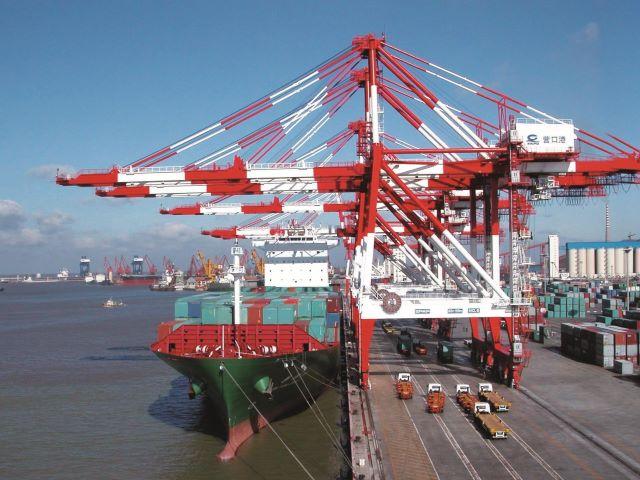
Yingkou Port consists of the Bayuquan Port Area, Xianrendao Port Area, and Yingkou Old Port Area, with container operations concentrated in the Bayuquan Port Area:
- Bayuquan Port Area: the main port area, handling container and bulk cargo operations; it currently has 6 harbor basins and more than 50 berths, with a maximum berth class of 300,000 DWT; among the container and general-purpose bulk and general cargo berths, there are five 100,000-DWT berths
- Xianrendao Port Area: primarily handles crude oil and liquid chemicals
- Yingkou Old Port Area: inland river and near-sea operations, smaller in scale
It should be noted regarding port area affiliation: in the port statistics of the Ministry of Transport, the port areas of Panjin Port and Suizhong Port are independent ports and are not counted under Yingkou Port; when citing Yingkou Port throughput data, the handling volumes of these two should not be included.
Yingkou Port's specialized terminals are known for bulk cargo: it has one 300,000-DWT ore terminal and one 200,000-DWT ore terminal, with berth lengths of approximately 404 m and 357 m respectively, equipped with six ship unloaders, and a comprehensive ore throughput capacity of about 50 million tonnes per year; it also has one 300,000-DWT crude oil berth. These capacities mainly serve the raw material imports of steel and refining/petrochemical enterprises in Northeast China.
As for the navigation channel, the channel in the Bayuquan Port Area is a 250,000-DWT one-way channel, capable of accommodating 250,000-DWT bulk carriers navigating on the tide, and can also accommodate 300,000-DWT bulk carriers navigating in a reduced-load condition; vessels below 70,000 DWT can navigate in both directions. According to Liaoning Port Co., Ltd., the Yingkou Port area has more than 80 production berths and a designed throughput capacity of about 208 million tonnes per year.
The number of berths, channel class, and designed throughput capacity are subject to adjustment as projects change, and different sources may use different definitions; the current data published by the port administrative authorities shall prevail.
3. Main Routes
3.1 Domestic Coastal Routes
Yingkou Port's domestic trade container routes cover 30 major ports along China's coast, with a total of 42 routes, making it one of the ports in the north with the densest domestic trade schedules:
| Direction | Major Ports | Schedule Density |
|---|---|---|
| East China | Shanghai, Ningbo, Taicang | Two or more sailings per day to Shanghai; one or more sailings per day to Ningbo and Taicang |
| South China | Guangzhou, Nansha | Two or more sailings per day to Guangzhou; Nansha is a premium domestic trade route |
| Shandong Peninsula | Yantai | One or more sailings per day |
| Along the Yangtze River | Wuhu, Wuhan | Direct river-sea route |
| Southwest Coast | Qinzhou | Newly opened routes in recent years |
The cargo categories of domestic trade containers are mainly steel, domestic trade bulk grain (corn), chemicals, and electromechanical products. "Bulk-to-container" and "road-to-water" are the two directions with more obvious growth in recent years—grain and coal originally transported in bulk have improved turnover efficiency by switching to container transport.
The table above lists the route directions and schedule conditions of Yingkou Port's domestic trade containers. For specific vessel schedules and space availability, please refer to booking confirmation. Port schedule density will be adjusted with seasons and shipping company capacity. Public reports in different years vary, so please check with us on the current arrangements before shipping.
3.2 Main International Routes
The foreign trade business scale of Yingkou Port is smaller than its domestic trade, and its international routes are mainly short-sea routes:
| Direction | Main Ports of Call | Notes |
|---|---|---|
| Japan and South Korea | Busan, Incheon, etc. | Mainly short-sea routes |
| Southeast Asia | Some base ports | Route density is lower than that of Dalian Port |
Yingkou Port's overall positioning is as a domestic trade hub, and the density and coverage of its foreign trade routes are lower than those of Dalian Port. Cargo requiring ocean-going trunk lines is usually transshipped via Dalian or feeder routes around the Bohai Rim. When booking, please confirm the transshipment route with us.
4. Hinterland and Cargo Mix
The hinterland of Yingkou Port covers the central Liaoning urban agglomeration, the three northeastern provinces, and eastern Inner Mongolia, making it one of the seaports closest to the Northeast hinterland:
- Shipped out via Yingkou Port (exports): domestic trade container cargo, steel products, domestic bulk grain such as corn, chemicals, and mechanical and electrical products
- Landed at Yingkou Port (imports): iron ore, crude oil, and grain
Hinterland characteristics determine the cargo source structure: Northeast China's steel, grain, and chemical industries are large in scale, and product flows are mainly to the coastal areas of East China and South China. Therefore, domestic trade containers are the mainstay of Yingkou Port's container volume; on the import side, iron ore and crude oil required by steel and refining/chemical enterprises dominate, and these are mostly handled by cargo-owner terminals or specialized terminals.
Cargo suitable for transport via Yingkou Port: steel products and grain categories are suitable for full-container transport, which can reduce cargo damage and handling steps compared with bulk cargo methods; chemical bookings require an MSDS; mechanical and electrical products and daily consumer goods are carried in domestic trade containers, with frequent sailing schedules and relatively ample space.
Bofeng Logistics Experience Sharing: The value of Yingkou Port lies in its sailing schedules. For cargo owners in domestic trade, the biggest concern is "when is there a ship" rather than "can it go direct." The sailing frequency from Yingkou Port to Shanghai and Guangzhou is rare among northern ports, and even urgent last-minute orders can usually be arranged onto one of the next few sailings. This is why we recommend that domestic trade cargo from Northeast China give priority to Yingkou. One thing to note is both ends: drayage at the origin end is tighter in winter and during the busy farming season, and the free container use period at the container return end varies by shipping company; overdue container demurrage/detention fees on domestic trade routes are not cheap. Our approach is to factor the container use period and arrival time into scheduling together, rather than waiting until the cargo arrives to consider returning the container.
5. Operational Notes
Port of Yingkou is located in Liaodong Bay of the Bohai Sea. Winter sea ice is a factor that must be given key consideration in operations and should not be presumed to have only a "minor impact." The Bayuquan Port Area is one of the port areas around the Bohai Rim more heavily affected by sea ice: according to public information, Bayuquan's average ice season is about 112 days, and the severe ice season is about 68 days (another account puts it at 95 days). Nearshore fast ice can reach 30 to 45 cm in thickness, and the port needs dedicated icebreakers and ice-class tugs to ensure navigation. Ice conditions vary greatly from year to year. In heavy ice years, there may be channel restrictions, reduced vessel loads, or schedule delays; in lighter ice years, navigation is basically normal. Whether there will be an impact and how significant it will be must be judged based on the current sea ice forecast and shipping line arrangements. We recommend confirming with us before winter shipments and allowing buffer in scheduling.
There are three other points to note. First, grain exports involve quarantine requirements. When switching domestic bulk grain to container transport, the container's cleanliness and moisture-proof conditions must be confirmed. Second, chemical bookings require an MSDS and confirmation of an acceptable terminal; dangerous goods must be declared in advance. Third, the channel is a one-way channel for 250,000-tonne-class vessels. Large bulk carriers need to navigate on the tide, and bulk cargo schedules should allow time for waiting for the tide.
Free container use periods are usually subject to shipping line and terminal rules. Domestic trade routes often have shorter container use periods than foreign trade routes, and overdue use will incur container detention fees.
FAQ
Q: Is Yingkou Port the "largest domestic trade container port in the country"?
Answer: In currently publicly available information, the official formulation "the country's largest domestic-trade container port" cannot be found. More authoritative statements are Liaoning Port Group's "continue to consolidate Yingkou Port's advantageous position as the largest port for domestic-trade loaded containers shipped by water," and the Xiamen Port Authority's "the volume of domestic-trade loaded containers shipped by water has long ranked first nationwide." "Domestic-trade loaded containers shipped by water" and "total domestic-trade container volume" are two different statistical scopes; when citing, it should be stated which one is meant.
Q: How should one choose between Yingkou Port and Dalian Port?
A: It mainly depends on the cargo flow direction and shipping schedule. For domestic-trade container cargo, Yingkou Port has a higher sailing frequency and a shorter overland transport distance to central Liaoning, so it is usually more suitable; for ocean-going foreign-trade cargo and cargo requiring direct calls on foreign-trade trunk routes, Dalian Port has broader route coverage. The two ports are positioned as complementary, not simply superior and inferior. For a particular shipment, it also depends on the current direct-sailing situation at the destination port.
Q: Will outbound shipments from Yingkou Port be affected in winter?
Answer: It will be affected by sea ice and needs to be assessed annually. The Bayuquan Port Area is one of the port areas around the Bohai Rim more severely affected by sea ice. According to public information, the average ice period is about 112 days, and the severe ice period is about 68 days. The thickness of nearshore fast ice can reach 30 to 45 centimeters, and the port needs to deploy icebreakers and ice-class tugs to ensure navigation. In heavy ice years, there may be channel restrictions, ship load reduction, or schedule delays, while in years with lighter ice conditions, operations are basically normal. Before shipping in winter, we recommend confirming with us the current sea ice conditions and the shipping company's arrangements, and leaving some buffer in the scheduling.
6. Bofeng Logistics Services
Bofeng Logistics provides the following services at the Port of Yingkou:
- Domestic Shipping: Domestic-trade container transportation from Northeast China to East China and South China; both FCL and LCL are available
- Full Container Load (FCL) Service: Standard container types such as 20GP, 40GP, and 40HQ; both port-to-port and door-to-door are available
- Less than Container Load (LCL) Service: Consolidated shipping for small and medium batches of chemicals, mechanical and electrical parts, and daily consumer goods
- Customs Declaration and Warehousing: Export customs declaration, grain quarantine coordination, preparation of chemical declaration documents, warehouse storage and distribution
- Value-added Services: Cargo insurance, labeling and sorting, scheduling coordination for container usage periods and arrival times, destination port delivery coordination
Service Features: Domestic trade is the main focus and foreign trade is supplementary, with the two lines arranged separately; we are familiar with the sailing schedule rhythm of northern domestic trade and can design phased shipment plans for large-volume cargo such as steel and grain; winter shipments can be rescheduled based on current ice-condition assessments.
📍 Contact us for real-time freight rates.
Further Reading
- Domestic Ocean Shipping Services: FCL and LCL solutions for domestic coastal container transportation
- International Ocean Export Services: FCL and LCL export ocean shipping solutions
- Guide to Major Chinese Ports: Comparison of positioning and route characteristics of major domestic container ports
Related ports: Dalian Port | Jinzhou Port | Tianjin Port
Prepared by the Bofeng Logistics team; content reviewed in September 2026. Port throughput and facility data are based on official releases from port authorities and terminal operators, and figures may differ between sources. Schedules and documentation requirements are subject to booking confirmation.