Jinzhou Shi
Liaoning Sheng
China
Jinzhou Port
1. Port Overview
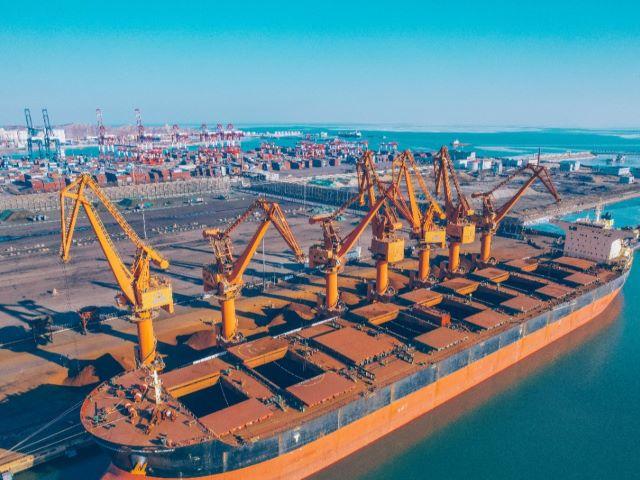
Jinzhou Port is located in Jinzhou Bay in western Liaoning Province and the northwestern part of the Bohai Sea. It is the nearest sea outlet for western Liaoning and eastern Inner Mongolia, as well as China's northernmost Class I commercial port open to the outside world along the coast and the only fully open international commercial port on the 400-kilometer coastline of the northwestern Bohai Sea. To the north, it connects with Mongolia and Russia's Siberia; to the south, it links with the southeastern coast and Japan and South Korea. It is one of the few ports in northern China that serves both seaward and landward corridors.
Jinzhou Port's most distinctive label is grain; officials and the industry often call it "the No. 1 Port for North-to-South Grain Transport." In domestic trade, bulk corn has long maintained a leading position in the seaborne volume of bulk corn among the eight Northeast ports; according to public information, it has ranked first among the eight Northeast ports for many consecutive years. In 2024, grain throughput exceeded 11 million tons; in 2025, bulk grain throughput was 14.6 million tons, a year-on-year increase of about 29.1%, of which domestic-trade bulk corn was 13.42 million tons, accounting for 33.8% of the total among the eight Northeast ports. Copper concentrate transshipment volume ranks first among Northeast ports. This status comes from its hinterland: western Liaoning and eastern Inner Mongolia are major corn-producing areas. After being connected to eastern Inner Mongolia via the Jinzhou-Chifeng Railway, grain can be collected at the port nearby and shipped by sea to the feed and processing industrial belts of East China and South China.
In terms of port throughput, according to the statistical bulletin of Jinzhou City (data source: the Municipal Transport Bureau), in 2025 Jinzhou Port completed cargo throughput of about 101 million tons (100.985 million tons), a year-on-year increase of about 0.9%; in 2024 it was 100.106 million tons, a year-on-year decrease of about 2.3%. It should be noted that Jinzhou Port is not on the list of "major ports" released by the Ministry of Transport; therefore, there is no public data under the Ministry of Transport's methodology, and citations should be based on the municipal statistical bulletin.
Regarding containers, the statistical basis requires special explanation, because figures circulating online contradict one another: on a whole-port basis, Jinzhou Port's container throughput in 2025 was 1.575 million TEU, down about 10.3% year on year, and in 2024 it was 1.757 million TEU, down about 4.5% year on year; while the listed company Jinzhou Port Co., Ltd. disclosed container throughput of 801,000 TEU, up about 19.5% year on year, and Jinzhou New Era Container Terminal handled 764,700 TEU—the latter two are itemized data for different operating entities in the same port area and cannot be directly compared with the whole-port basis, let alone mixed across years. In addition, the online claim that "Jinzhou Port's annual container throughput is about 1.2 million TEU" is 2017 data, while "3.6 million TEU" is the port's annual handling capacity rather than actual throughput; neither should be cited as recent throughput.
Bofeng Logistics' main business at Jinzhou Port is concentrated in two directions: first, domestic-trade bulk cargo such as grain and coal collected at the port by rail from western Liaoning and eastern Inner Mongolia; second, domestic-trade container transport in Jinzhou and surrounding areas.
2. Port Scale and Facilities
Jinzhou Port's port area is laid out along Jinzhou Bay and is divided into Basins 1 to 4. According to public information, the port has more than 20 berths, including one 250,000-ton-class oil berth (after reconstruction and expansion, its structural tonnage class was raised to 300,000 tons, and it can accommodate oil tankers of 50,000 to 300,000 deadweight tons), five 100,000-ton-class bulk and general cargo berths, and four 100,000-ton-class container berths. The design annual throughput capacity of the dedicated container berths is 3.6 million TEUs according to the company's official website—this refers to throughput capacity, not actual throughput, and the two should not be conflated.
Coal is a sector on which Jinzhou Port has focused its development in recent years. On the north side of Basin 4, three 70,000-ton-class specialized coal berths have been built and are in trial operation, with a design annual throughput capacity of about 35 million tons; there is also a planned specialized coal terminal project, with a larger planned number of berths and design throughput capacity, mainly serving the "north-to-south coal transport" corridor.
In terms of the navigation channel, Jinzhou Port's main channel has a total length of about 31 km, a bottom width of about 320 m, and a channel depth of about 17.9 m; it can accommodate reduced-load, one-way transit of 250,000-ton-class oil tankers and two-way transit of 50,000-ton-class and smaller vessels. According to public survey data, vessels with a draft of more than 15.6 m need to ride the tide when entering and leaving. The planned channel reconstruction and expansion project is intended to proceed according to standards of a total length of about 46.9 km, a bottom width of 336 m, and a depth of 21.5 m; after completion, the navigation class will be further upgraded. The No. 4 anchorage in the port area has an area of about 31.2 million square meters and a water depth of about 22 to 25 m.
The number and class of berths and the channel depth will be adjusted along with engineering works, and different sources use different definitions and scopes; the current data published by the port administrative authorities and terminal operators shall prevail.
3. Main Routes
3.1 Domestic Coastal Routes
Jinzhou Port’s domestic routes are mainly north–south coastal trunk lines, with container and bulk cargo organized separately:
| Direction | Major ports | Description |
|---|---|---|
| South China | Chiwan, Mawan, Guangzhou, Huangpu | Bulk liner and container liner routes; the main coverage area is the coastal areas of South China and Southwest China centered on Huangpu Port |
| East China | Shanghai, Zhangzhou, Xiamen | Bulk liner routes; the main coverage area is East China centered on Shanghai Port |
| Yangtze River and Pearl River systems | Major ports along the rivers | Radiating through South China and East China hubs |
Jinzhou Port has about 20 container liner routes, connecting major coastal ports from north to south and radiating to the Yangtze and Pearl River systems; foreign trade feeder services can transfer via Dalian Port to other directions. According to public information, in 2022, Jinzhou Port’s domestic trade containers accounted for about 25% of the market share among major ports in Northeast China.
The table above lists the main directions of Jinzhou Port’s domestic routes. Reference sailing times are subject to the shipping company’s current schedule. Jinzhou Port is known for bulk cargo and grain, and has a limited number of container routes. Before shipping, please confirm with us whether there is a direct sailing to the destination port at that time.
3.2 Main International Routes
Jinzhou Port’s international business has two main lines: the Russia direction and the near-sea direction:
| Direction | Main corridors or ports of call | Notes |
|---|---|---|
| Russia | Via the Jinzhou Port–Vladivostok foreign trade route and road-rail intermodal corridor | The foreign trade route and the "Jinzhou Port–Zhu'engadabuqi–Zabaykalsk–Moscow" international road-rail intermodal service have been launched |
| Europe | Broad-gauge block trains exiting via Manzhouli | Cooperation arrangements have been signed with Russian Railways and other institutions |
| Japan and South Korea | Near-sea routes | Near-sea routes to Japan, South Korea, etc. are being developed and have not yet reached scale |
According to public information, Jinzhou Port has shipping connections with more than 30 countries and regions, including Asia, Europe, Oceania, and the Americas. Foreign trade container cargo can also be transshipped to destinations around the world via Dalian Port and other ports.
Specific route operations and schedules will be adjusted as corridor construction progresses. Please confirm the current arrangements with us before booking.
4. Hinterland and Cargo Mix
The hinterland of Jinzhou Port is centered on western Liaoning (Jinzhou, Chaoyang, Fuxin, Huludao) and eastern Inner Mongolia (Chifeng, Tongliao). It is connected to eastern Inner Mongolia via the Jinzhou-Chifeng Railway and is one of the important energy transportation nodes for "North-to-South Coal Transport":
- Outbound from Jinzhou Port (exports): domestic-trade bulk corn, coal, oil products, and chemical products
- Inbound at Jinzhou Port (imports): foreign-trade soybeans, nickel ore, copper concentrate, alumina, and steel
Grain is the most representative cargo type at Jinzhou Port. Domestic-trade bulk corn is consolidated at the port by rail and then loaded onto southbound ships, serving the feed and deep-processing industries in East China and South China; on the import side, foreign-trade soybeans, nickel ore, copper concentrate, and other cargoes mainly serve the processing industries in Northeast China and eastern Inner Mongolia. Oil products and chemical products are another major segment.
Cargoes suitable for transport via Jinzhou Port: domestic bulk cargoes such as corn and coal are suitable for bulk carriers, and Jinzhou Port has mature operating conditions for bulk grain transshipment; oil products and chemical products must be handled at designated terminals and declared as required; containerized cargo is mainly oriented toward domestic trade and short-sea routes, suitable for domestic-trade demand from western Liaoning and eastern Inner Mongolia to East China and South China.
Experience Sharing from Bofeng Logistics: Jinzhou Port's advantages lie in the two words "proximity" and "specialization." For cargo owners in western Liaoning and eastern Inner Mongolia, going via Jinzhou means a shorter overland distance than going via Dalian or Yingkou, especially for grain consolidated at the port via the Jinzhou-Chifeng Railway—the connection between the rail arrival station and the port area is smooth; the operating conditions for bulk grain transshipment are also mature, and cargo damage control for grain categories via Jinzhou is relatively better. Container cargo owners need to confirm in advance whether there are direct sailings to the destination port—Jinzhou has a limited number of container routes, and some directions require transshipment via Dalian and other ports, adding extra time. When we handle cargo in this region, we usually first separate "bulk cargo or container," then confirm the route according to the destination port, and provide a plan after calculating both parts clearly.
5. Operational Notes
Operating at Jinzhou Port requires close attention to three points: navigation conditions, seasonal factors, and cargo characteristics. Regarding navigation conditions, the main channel has a water depth of about 17.9 meters; vessels with a draft of 15.6 meters or more must enter and leave on the tide, while large oil tankers are subject to reduced-load, one-way navigation arrangements; when scheduling vessel calls, tide-waiting time should be included. Regarding seasonal factors, Jinzhou Port has sea ice in winter. According to the official description, it is "frozen but not closed in winter": new ice and skin ice appear in December each year, sheet ice and grey-white ice appear in January and February, and drift ice mostly appears in January and February, but the port area does not freeze over and can operate year-round. To ensure winter navigation, the port arranges high-horsepower tugboats for 24-hour icebreaking escort, uses a formation method of "large leading small, heavy leading light" to guide vessels in and out of the port, and has formulated China's first "VLCC Pilotage Operating Regulations for Ice Areas at the Northernmost Port." Jinzhou Port is free from typhoon impact throughout the year. Regarding cargo characteristics, oil products and chemicals must be handled at designated terminals and declared in advance, and when booking dangerous goods, the acceptable terminal must be confirmed.
The free container usage period and bulk cargo storage rules are generally subject to the regulations of the shipping company and the terminal; exceeding them will incur container demurrage/detention or storage fees.
FAQ
Q: What is the container throughput of Jinzhou Port?
Answer: It depends on the statistical scope. On a port-wide basis, Jinzhou Port’s container throughput in 2025 was 1.575 million TEU, down about 10.3% year on year; in 2024 it was 1.757 million TEU, down about 4.5% year on year. On the basis of the listed company Jinzhou Port Co., Ltd., it was 801,000 TEU in 2025, up about 19.5% year on year, while Jinzhou New Era Container Terminal handled 764,700 TEU. These figures fall under the statistical scopes of different operating entities, so they cannot be directly compared or mixed across years. In addition, “about 1.2 million TEU” is 2017 data, and “3.6 million TEU” is annual throughput capacity rather than actual throughput; neither is suitable for citing as recent throughput.
Q: What advantages does Jinzhou Port have in grain transportation?
Answer: Jinzhou Port is known as the "No. 1 Port for North-to-South Grain Transportation." For many consecutive years, its domestic-trade bulk corn has ranked first in the seaborne volume of bulk corn among the eight ports in Northeast China. In 2024, its grain throughput exceeded 11 million tons; in 2025, its bulk grain throughput was 14.6 million tons, a year-on-year increase of about 29.1%, of which domestic-trade bulk corn was 13.42 million tons, accounting for 33.8% of the eight ports in Northeast China. Its advantages mainly come from its hinterland and corridors: western Liaoning and eastern Inner Mongolia are major corn-producing areas. After being connected to eastern Inner Mongolia via the Jinzhou-Chifeng Railway, grain can be gathered at the port nearby, and the port area has mature bulk grain handling conditions.
Q: Will Jinzhou Port suspend shipping in winter due to ice?
Answer: According to official statements, Jinzhou Port “freezes in winter but does not become icebound.” Each December, new ice and ice rind appear; January and February are the peak ice period, when ice plates and grey-white ice occur, but the port area does not freeze over and can remain operational year-round. The port also arranges high-horsepower tugboats to provide 24-hour icebreaking and navigation assistance, using a convoy formation of “large leading small, heavy leading light” to guide vessels in and out of the port. Actual ice conditions vary from year to year, so before shipping goods in winter, we recommend confirming the current conditions and vessel schedule with us.
6. Bofeng Logistics Services
Bofeng Logistics provides the following services at Jinzhou Port:
- Domestic Shipping: Domestic container transportation from Jinzhou to East China and South China, with both FCL and LCL available
- Full Container Load (FCL) Services: Standard container types such as 20GP, 40GP, and 40HQ; both port-to-port and door-to-door available
- Bulk Cargo and Bulk Grain Coordination: Arrangement of bulk carriers and yards for bulk cargo such as corn and coal, and confirmation of bulk grain handling conditions
- Customs Clearance and Warehousing: Export customs declaration, commodity inspection documents, grain quarantine coordination, warehouse storage and distribution
- Value-added Services: Cargo insurance, labeling and sorting, verification of rail-to-port and vessel schedule arrangements, destination port delivery coordination
Service Features: Bulk cargo and container operations are arranged separately, with bulk cargo such as grain and coal matched according to vessel type and yard conditions; we are familiar with rail-to-port arrangements from western Liaoning and eastern Inner Mongolia, and can verify rail arrival stations and customs cut-off times for cargo arriving at the port via the Jinzhou-Chifeng Railway.
📍 Contact us for real-time freight rates.
Further Reading
- Domestic Ocean Shipping Services: FCL and LCL solutions for domestic coastal container transport
- International Ocean Export Services: FCL, LCL, and door-to-door ocean export solutions
- Guide to Major Chinese Ports: Comparison of positioning and route characteristics of major domestic container ports
Related ports: Yingkou Port | Dalian Port | Tianjin Port
Prepared by the Bofeng Logistics team; content reviewed in September 2026. Port throughput and facility data are based on official releases from port authorities and terminal operators, and figures may differ between sources. Schedules and documentation requirements are subject to booking confirmation.