
Guangzhou Shi
Guangdong Sheng
China
Nansha Port
1. Port Overview
Nansha Port is located in Nansha District at the southernmost tip of Guangzhou. It lies at the geometric center of the Pearl River Delta and is the core deep-water port area of Guangzhou Port, as well as one of the most important container hubs in South China. Unlike the inland river port areas within the Pearl River Estuary, Nansha Port Area directly faces Lingdingyang and has the deep-water conditions to berth large container ships, thus handling most of Guangzhou Port's ocean-going trunk-line container volume.
A major characteristic of Nansha Port Area is that “Nansha” itself is the geographic hub of the west bank of the Pearl River: to the east, it connects to Dongguan and Shenzhen via the Humen Bridge and Nansha Bridge; to the west, it connects to Zhongshan, Foshan, Jiangmen, Zhuhai, and Zhaoqing via the expressway network; to the north, it connects to the national railway network via the Nansha Port Railway. For industrial belts such as Foshan home appliances, Zhongshan lighting, Jiangmen hardware, and Zhuhai mechanical and electrical products on the west bank of the Pearl River, the overland distance for cargo to Nansha is usually within 100 kilometers, resulting in low port delivery costs and stable transit times.
Public statistics show that in 2024, the container throughput of Nansha Port Area exceeded 20 million TEU, of which foreign trade containers exceeded 10 million TEU, accounting for about 50%. It became the second single port area in China, after Shanghai Yangshan, to cross the 20 million TEU threshold, ranking among the world's leading single port areas by throughput.
Bofeng Logistics has long-standing operational experience on the west bank of the Pearl River, and Nansha Port is one of our main ports of departure for export cargo from Foshan, Zhongshan, Jiangmen, Zhuhai, Zhaoqing, and other places. We also operate barge feeder services between Nansha and inland river terminals in the Pearl River Delta, and can provide combined “inland river feeder + Nansha mainline” solutions for origins without direct shipping services.
2. Port Scale and Facilities
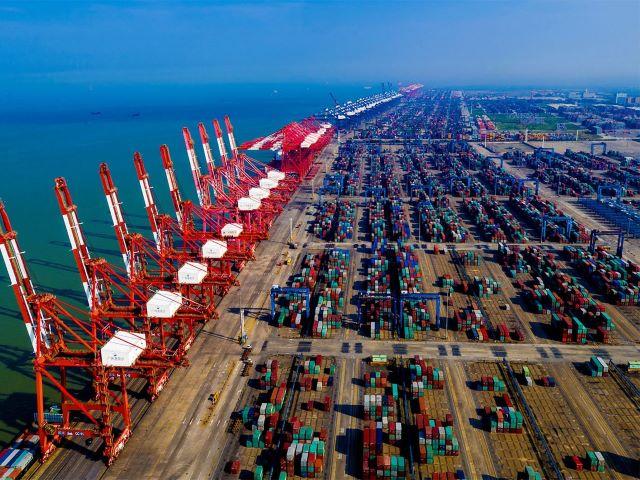
The container terminals in the Nansha Port Area are arranged contiguously under Phases I to IV, forming a large-scale, specialized operating area. The main facility features include:
- Deep-water berth cluster: Phases I to III are integrated, equipped with over ten 100,000-ton-class specialized container berths, capable of meeting the berthing needs of current mainstream large container ships
- Shoreline conditions: The main container shoreline is about 5,700 meters long, with an additional about 2,700-meter barge shoreline dedicated to transfer operations for inland river and coastal barges in the Pearl River Delta
- Seaward navigation channel: The channel depth is about 15 meters. Large container ships can enter and leave by riding the tide or under all-weather conditions, with further deepening planned for the long term
- Phase IV project: An automated container terminal using intelligent scheduling and remote control, it is one of the more highly automated container operating areas in South China
- Collection and distribution supporting facilities: The Nansha Port Railway runs directly into the port area, enabling sea-rail intermodal transport; around the port area are large container yards, bonded warehouses, and export supervised warehouses
The barge shoreline in the Nansha Port Area is an important feature distinguishing it from ordinary seaports. The Pearl River Delta has a dense waterway network. Many inland river terminals in Foshan, Zhongshan, Jiangmen, Zhaoqing, and other places connect to Nansha via “shuttle bus”-style barges. Cargo is first consolidated by barge to Nansha and then transshipped onto ocean-going mainline vessels. This model significantly reduces the cost of bringing cargo to port for small and medium-sized shippers on the west bank of the Pearl River.
The number of berths, water depth, and designed throughput capacity are subject to adjustment with expansion and channel improvement projects, and specific figures shall be subject to the current data published by the terminal operator and port authority.
3. Main Routes
3.1 Domestic Coastal Routes
Nansha Port is an important hub for domestic container transport in South China, with frequent schedules to major coastal ports:
| Destination port | Reference transit time | Route type |
|---|---|---|
| Shanghai Port | 3-4 days | Coastal route |
| Ningbo Port | 3-4 days | Coastal route |
| Qingdao Port | 4-5 days | Coastal route |
| Tianjin Port | 6-7 days | Coastal route |
| Xiamen Port | 2-3 days | Coastal route |
| Shenzhen Port | About 1 day | Pearl River Delta route |
3.2 Main International Routes
Nansha Port's international liner routes cover major trade destinations such as Southeast Asia, the Middle East, Australia, Europe, and America, among which routes serving countries along the "Belt and Road" account for a relatively high proportion:
| Destination Port | Reference Transit Time | Common Shipping Lines |
|---|---|---|
| Port of Singapore | 4-6 days | COSCO, OOCL, PIL |
| Port Klang | 5-7 days | OOCL, PIL |
| Port of Sydney | 12-15 days | COSCO, ANL |
| Port of Hamburg | 28-32 days | COSCO, CMA CGM |
Reference transit time is the sailing time from departure from the port of origin to arrival at the destination port. It does not include customs declaration at origin, customs clearance at destination, or container pickup time, nor does it include transshipment waiting. Actual transit times are affected by factors such as carrier route arrangements, weather, and port congestion. Please confirm the specific sailing schedule with us before shipping.
4. Hinterland and Cargo Mix
The hinterland of Nansha Port is centered on the west bank of the Pearl River and extends to the Pan-Pearl River Delta and the greater Southwest. Its cargo mix is characterized by "manufacturing exports as the mainstay and raw material imports as a supplement":
- Exports via Nansha Port: household appliances, ceramics and building materials, lighting, furniture, hardware products, machinery and equipment, daily consumer goods, textiles and apparel
- Imports via Nansha Port: timber and wood pulp, steel and nonferrous metals, chemical raw materials, machinery and equipment and production lines, grains and agricultural products
Goods suitable for transport via Nansha Port: Home appliances, ceramics, building materials, and other heavy and bulky goods are suitable for full-container transport, with 40GP and 40HQ being commonly used container types; small and medium batches of lighting, hardware, and daily consumer goods can be considered for LCL consolidation; imported bulk cargo such as timber and steel is usually carried by full container or breakbulk.
Bofeng Logistics Experience Sharing: The value of Nansha Port to cargo owners on the west bank of the Pearl River lies in "short land transport, barge connectivity, and comprehensive trunk routes." Goods from Foshan and Zhongshan travel a shorter land distance via Nansha than via the eastern Shenzhen port area; for goods from Jiangmen, Zhaoqing, and Zhuhai, even if there are no direct shipping services locally, they can first be consolidated by barge to Nansha and then connect to ocean-going trunk lines, avoiding long-distance land transport. One thing to note is that barge connection takes additional time, so shipment plans should leave a margin for the connection segment and confirm the connection between barge schedules and trunk-line schedules. We usually recommend that cargo owners inform us of the factory delivery date at the time of booking, and we will coordinate the connection and loading sequence in a unified manner.
5. Operational Notes
Operations in the Nansha Port Area are stable year-round, but the following points should be noted: First, there is a connection time between barge transfer and mainline vessel loading, so cargo consolidated by barge via Jiangmen, Zhaoqing, and other places should be allowed a longer port consolidation period; Second, during peak season (approximately July-October), mainline shipping space and trucking resources become tight, so it is advisable to book space in advance; Third, the Nansha Port Area is large, and Terminals Phases I to IV are in different locations. Before picking up or returning containers, the specific operating area must be confirmed to avoid trucks traveling back and forth.
The free container usage period at Nansha Port is usually 3-5 days, subject to the regulations of the shipping line and terminal; overdue use will incur container detention fees. Dangerous goods, reefer containers, and out-of-gauge cargo must be declared in advance at the time of booking, and an acceptable terminal must be confirmed.
FAQ
Q: How to choose between Nansha Port and Huangpu Port?
Answer: Nansha Port Area is a deep-water seaport that can directly berth ocean-going mainline vessels, making it suitable for exports to Europe, America, Southeast Asia, and other ocean-going destinations; Huangpu Port is located within the Pearl River Estuary and mainly serves domestic coastal routes, Pearl River Delta barges, and inland river feeder services. Export ocean cargo is usually shipped from Nansha, while for domestic shipping either can be used, depending on the destination port and sailing schedule.
Q: Can cargo on the west bank of the Pearl River be barged to Nansha for transshipment?
A: Yes. The Nansha Port Area has dedicated barge berths. Inland river terminals in Foshan, Zhongshan, Jiangmen, Zhaoqing, and other places have relatively frequent sailings to and from Nansha. After cargo is consolidated by barge to Nansha, it is transshipped onto mainline vessels, making this suitable for export destinations that have no direct shipping services locally.
Q: How long does the voyage from Nansha Port to Europe take approximately?
Answer: The reference sailing time from Nansha to major European base ports is about 28–32 days, excluding origin customs declaration, destination customs clearance, and transshipment waiting. Actual transit time is affected by route arrangements, the order of ports of call, and port congestion. Before shipment, we recommend confirming the current sailing schedule with us.
6. Bofeng Logistics Services
Bofeng Logistics provides the following services at Nansha Port:
- Full Container Load (FCL): Standard container types such as 20GP, 40GP, and 40HQ, available for both port-to-port and door-to-door service
- Less than Container Load (LCL): Consolidation and shipment for small and medium-sized batches of lighting, hardware, daily consumer goods, and other cargo
- Barge Connection: Barge consolidation and transshipment connection between inland river terminals in the Pearl River Delta and the Nansha port area
- Customs Declaration and Warehousing: Export customs declaration, commodity inspection documents, export supervised warehouse, and bonded warehousing
- Value-Added Services: Cargo insurance, labeling and sorting, destination port customs clearance, and delivery coordination
Service Features: Familiar with connection arrangements at inland river terminals along the west bank of the Pearl River, and can design combined "inland river consolidation + Nansha trunk line" solutions for cargo owners in Foshan, Zhongshan, Jiangmen, Zhuhai, Zhaoqing, and other places; trunk line space and barge schedules are coordinated by the same team, reducing waiting time at connection points.
📍 Welcome to contact us for real-time freight rates.
Further Reading
- Domestic Ocean Shipping Services: FCL and LCL solutions for domestic coastal container transport
- International Ocean Export Services: FCL and LCL export ocean shipping solutions
- Guide to Major Chinese Ports: Comparison of the positioning and route characteristics of major domestic container ports
Related ports: Huangpu Port | Shenzhen Port | Hong Kong Port
Prepared by the Bofeng Logistics team; content reviewed in September 2026. Port throughput and facility data are based on official releases from port authorities and terminal operators, and figures may differ between sources. Schedules and documentation requirements are subject to booking confirmation.