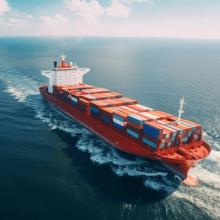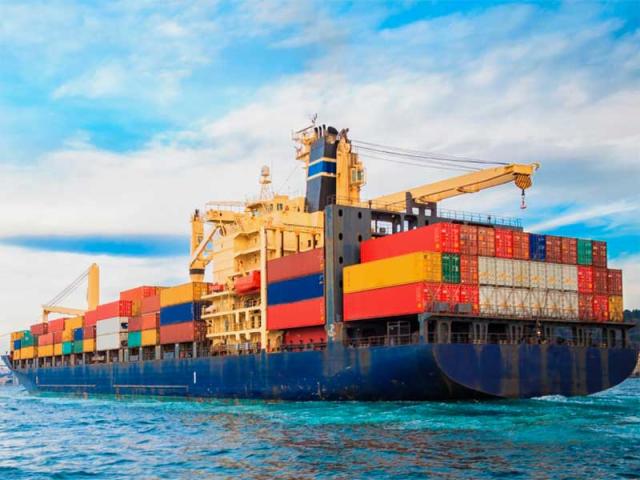
Container ships are divided into several generations based on container capacity (TEU) and hull size, ranging from small feeder ships for short-haul intra-regional routes to ultra-large container ships (ULCS) that can only call at a small number of deep-water hub ports. Different ship types correspond to different routes, port conditions, and booking choices. This article provides a parameter comparison of each generation of ship types and explains the characteristics of the main ship types. For other cargo ship types, see Classification of maritime cargo ships: bulk carriers, container ships, oil tankers, and other cargo ships; for the relationship between ship types and route port calls, see What is a transshipment port? Introduction to major global transshipment ports.
I. Classification Standards for Container Ships
Container ships are divided into the following generations based on container capacity (TEU) and hull dimensions:
| Vessel type classification | Container capacity (TEU) | Length | Beam | Draft | Main routes |
|---|---|---|---|---|---|
| Small Feeder | 300-1,000 | <150m | <25m | <10m | Intra-regional short-haul |
| Panamax | 3,000-5,000 | 290m | 32.3m | 12m | Trans-Pacific (old Panama Canal) |
| Post-Panamax | 5,000-8,000 | 300m | 40m | 13m | Asia-Europe routes |
| New Panamax | 8,000-12,000 | 366m | 48.2m | 15m | Asia-Europe + Trans-Pacific (new Panama Canal) |
| Very Large Container Ship (VLCS) | 12,000-15,000 | 366m | 48-51m | 15.5m | Asia-Europe trunk routes |
| Ultra Large Container Ship (ULCS) | 18,000-24,000 | 400m | 58-61m | 16m | Asia-Europe trunk routes |
II. Detailed Explanation of Major Ship Types
Panamax — The Limit of the Old Canal Era
Its design dimensions were limited by the old Panama Canal locks (305m × 33.5m), with a maximum container capacity of about 5,000 TEU. It has now gradually withdrawn from its position as the mainstay of mainline services.
New Panamax
After the 2016 expansion of the Panama Canal, the new locks measure 426m × 55m. New Panamax ships can carry up to 12,000 TEU and are currently the mainstay vessel type on Asia-Europe and trans-Pacific routes.
ULCS (Ultra Large Container Ship)
Currently the world's largest container ships, with a container capacity exceeding 20,000 TEU and a length approaching 400 meters. They require deep-water berths and large gantry cranes, and can currently call only at a few deep-water hub ports worldwide, such as Shanghai Yangshan, Ningbo Zhoushan, Shenzhen Yantian, Rotterdam, etc.
III. Representative Ship Types of the World's Largest Container Ships Today
| Vessel Name | Shipping Line | Container Capacity (TEU) | Maiden Voyage Year |
|---|---|---|---|
| MSC Irina | MSC | 24,346 | 2023 |
| OOCL Spain | OOCL (COSCO Shipping Group) | 23,992 | 2023 |
| HMM Algeciras | HMM | 23,964 | 2020 |
| Ever Alot | Evergreen | 23,992 | 2022 |
| CMA CGM Jacques Saade | CMA CGM | 23,112 | 2021 (LNG-powered) |
The larger the vessel type, the higher the requirements for port water depth, quay crane outreach, and yard capacity. Therefore, ultra-large vessels are mainly deployed on long-haul mainlines such as Asia-Europe, and connect to other regions through transshipment ports and feeder vessels.
Data Notes: Vessel data is sourced from Clarksons Research and publicly available information from major shipping companies, and is current as of July 2026; new vessel deliveries and vessel type parameters are subject to market changes, so please refer to the latest announcements from the shipping companies.
📖 Further Reading: Classification of Sea Cargo Ships: Bulk Carriers, Container Ships, Oil Tankers, and Other Cargo Ships—the structures and uses of various cargo ships; What Is a Transshipment Port? Introduction to Major Global Transshipment Ports—large vessels and transshipment connections.
Need to check vessel schedules or shipping space? Bofeng Logistics provides one-stop services including domestic container shipping, international shipping (FCL/LCL), Hong Kong-Macao dedicated logistics routes, as well as trucking, customs clearance, and warehousing. Submit an inquiry online, or call 13075678958 for consultation.
Contact Information: 13075678958 | info@zhbfwl.com
Container Ship Types FAQ
Q: What is the difference between Panamax and Neopanamax?
A: Panamax vessels are designed to fit the old Panama Canal locks (305 m × 33.5 m), with a maximum container capacity of about 5,000 TEU. After the canal was expanded in 2016, the new locks measure 426 m × 55 m, and Neopanamax vessels can carry up to 12,000 TEU. They are currently the main vessel type on Asia-Europe and trans-Pacific routes.
Q: Which ports can ULCS ultra-large container ships call at?
A: ULCSs have a container capacity of more than 20,000 TEU and are nearly 400 meters long. They require deep-water berths and large ship-to-shore cranes, so currently they can only call at a few deep-water hub ports worldwide, such as Shanghai Yangshan, Ningbo-Zhoushan, Shenzhen Yantian, Rotterdam, etc.
Disclaimer: This article was compiled and written by the Bofeng Logistics team, and its content was verified in 2026-09. Ship container capacities and parameters will be updated as new ships are delivered and the market changes; please refer to the information published by the shipping company.
Related Logistics Services
Bofeng Logistics offers the following related services, feel free to inquire: