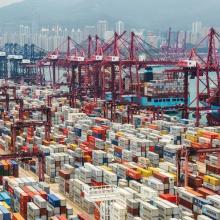
Hong Kong warehousing is a key node in re-export trade and cross-border e-commerce supply chains. After goods are transported to Hong Kong via cross-border trucks, they need to be temporarily stored, sorted, or processed for value-added services at a Hong Kong warehouse before being dispatched for secondary shipment. Hong Kong's free port policy ensures no customs duties are incurred during storage, which is a core advantage over mainland warehouses. For traders needing flexible inventory control, Hong Kong warehousing offers a zero-tariff buffer that allows dispatch schedules to be adjusted based on order demands. Hong Kong's main warehousing areas are Kwai Chung, Yuen Long, and Tuen Mun, offering convenient transportation near the Kwai Tsing Container Terminal and Hong Kong International Airport for easy goods dispatch.
1. Four modes of Hong Kong warehousing
Transit Storage: Goods are temporarily stored for 1-7 days upon arrival and dispatched in batches to different destinations. For example, a trader's batch of goods arriving in Hong Kong needs to be distributed to 10 local supermarket stores; the Hong Kong warehouse can pick and dispatch goods by store orders. Suitable for traders with multiple stores or clients, allowing goods from the same shipment to be dispatched in batches per store or client order. Transit storage is the most frequently used Hong Kong warehousing service, offering flexible operations, billing based on actual storage days with no minimum storage period, and even same-day inbound and outbound capability. Hong Kong's free port policy ensures no duties are incurred during storage. For instance, a cross-border e-commerce seller's goods can be sent to Amazon FBA warehouses in batches rather than all at once.
Long-term Stocking: Ideal for cross-border e-commerce sellers to stock best-selling products in Hong Kong in advance to shorten international logistics lead times. The replenishment model using cross-border logistics enables a "mainland factory → cross-border truck → Hong Kong warehouse → global delivery" chain, compressing the stocking cycle to about one week—shortened by 2-3 weeks compared to direct shipment from the mainland. Long-term stocking is especially important before peak seasons to ensure sufficient inventory without stockouts. In contrast, stocking from the mainland directly to overseas customers takes 2-3 weeks.
Labeling and Relabeling: Provides services such as applying FNSKU labels (for Amazon inbound), relabeling (for returns and reshelving), and applying address labels (for multi-address sorting). Cross-border e-commerce sellers have the greatest demand for labeling. After goods arrive at the Hong Kong warehouse, labels are applied per FBA requirements before being shipped to destination country warehouses. This service ensures end-to-end compliance from the mainland to FBA warehouses, reducing the need for sellers to set up teams in Hong Kong. Labeling is charged per item and is simple to execute. Warehouse finishes labeling on the same day goods arrive, with no extra time delays.
B2C Dropshipping: Hong Kong warehouses connect with international couriers (DHL/UPS/FedEx) for direct delivery to global consumers, suitable for cross-border e-commerce's small parcel direct mail scenarios. The advantage of dropshipping is that mainland companies don't need to establish their own warehousing team in Hong Kong; the warehouse handles the entire process from order receipt, picking, packing, labeling, to shipment.
2. Full cross-border logistics plus warehousing and delivery process
After cross-border trucks deliver goods from mainland factories to Hong Kong warehouses, the following end-to-end services are provided: inbound (unloading, counting, and shelving within about 2 hours after arrival); storage (stored per instructions, securely kept, from 1 day to several months as needed, with no minimum storage period); outbound (picking and packing per orders, completed within 24 hours of order placement—Hong Kong warehouses have discounted accounts with multiple international couriers, offering dropshipping freight rates 20%-40% lower than individual direct shipping); and delivery (same-day or next-day delivery across Hong Kong, 1-3 days to major European and US cities via international couriers).
Goods from Guangdong Province arrive at Hong Kong warehouses via cross-border trucks in 1-2 days; goods from other regions can be transferred via Zhuhai warehouses. Delivery covers all of Hong Kong, or goods can be dispatched globally via Hong Kong Airport or port. After arrival, no need to seek another warehouse—shelving and delivery are directly connected. Hong Kong warehouses have high operational efficiency; upon inbound, the system updates inventory information automatically, and clients can check stock status in real time. The integrated service of cross-border transport, warehousing, and delivery allows mainland businesses to manage Hong Kong inventory as if using a local warehouse. The integration of Hong Kong warehousing with cross-border logistics is a core link in re-export trade and cross-border e-commerce supply chains; leveraging Hong Kong warehousing's zero-tariff advantage and flexible dispatch methods significantly boosts logistics efficiency. Bofeng Logistics offers a one-stop service for cross-border transport plus Hong Kong warehousing and delivery, providing door-to-door pickup within Guangdong Province, goods clearing via Shenzhen Bay or Huanggang Port directly to Hong Kong warehouses. Goods from other regions can be transferred via Zhuhai warehouses for Hong Kong delivery. Services cover the full process of warehousing, labeling, sorting, and dropshipping. Contact Bofeng Logistics for more details on warehousing and delivery services.
3. Which businesses need Hong Kong warehousing
Cross-border e-commerce sellers: Stocking in Hong Kong significantly shortens delivery times to markets in Europe and the US—airfreight 1-3 days, sea freight 10-15 days. The replenishment plus Hong Kong storage model compresses the stocking cycle from the original 2-3 weeks to about one week, while Hong Kong's free port policy incurs no duties on stocking inventory. For Amazon FBA sellers, the combination of cross-border logistics and Hong Kong warehousing effectively reduces stockout risk and shortens replenishment cycles.
Re-export traders: Goods are produced in the mainland and shipped to Hong Kong warehouses in batches, awaiting confirmation of overseas orders before dispatch. Hong Kong's free port policy means no duties during storage, allowing re-export traders to flexibly control the shipping pace without being subject to bonded warehouse regulatory requirements as in mainland. Traders can use Hong Kong warehouses to achieve flexible arrangements for immediate dispatch or staged shipments.
Hong Kong local traders: Goods are transported via cross-border trucks to Hong Kong warehouses, then sorted and distributed per orders to local supermarkets, restaurants, convenience stores, etc. In Hong Kong's 1,100 square kilometer area, the warehouse can cover same-day delivery across the entire region.
4. Bofeng Logistics’ one-stop warehousing and delivery service
Cross-border trucking to Hong Kong warehouse → inbound shelving → outbound per instructions → delivery across Hong Kong — a seamless process. Hong Kong warehousing also offers value-added services such as quality inspection, kit assembly, and palletizing, helping mainland companies perform secondary processing and sorting in Hong Kong without building their own teams. Value-added services are billed by actual usage, so businesses pay only for what they need without fixed costs. In Guangdong Province, door-to-door service; outside, goods can be transferred via Zhuhai warehouses. For details on cross-border transport options, see Four Cross-border Logistics Models and Selection Guide.
Data as of: July 2026
Need warehousing and delivery for goods arriving in Hong Kong? Contact us.
Inquiries: 13075678958 | info@zhbfwl.com
Related Logistics Services
Bofeng Logistics offers the following related services, feel free to inquire: